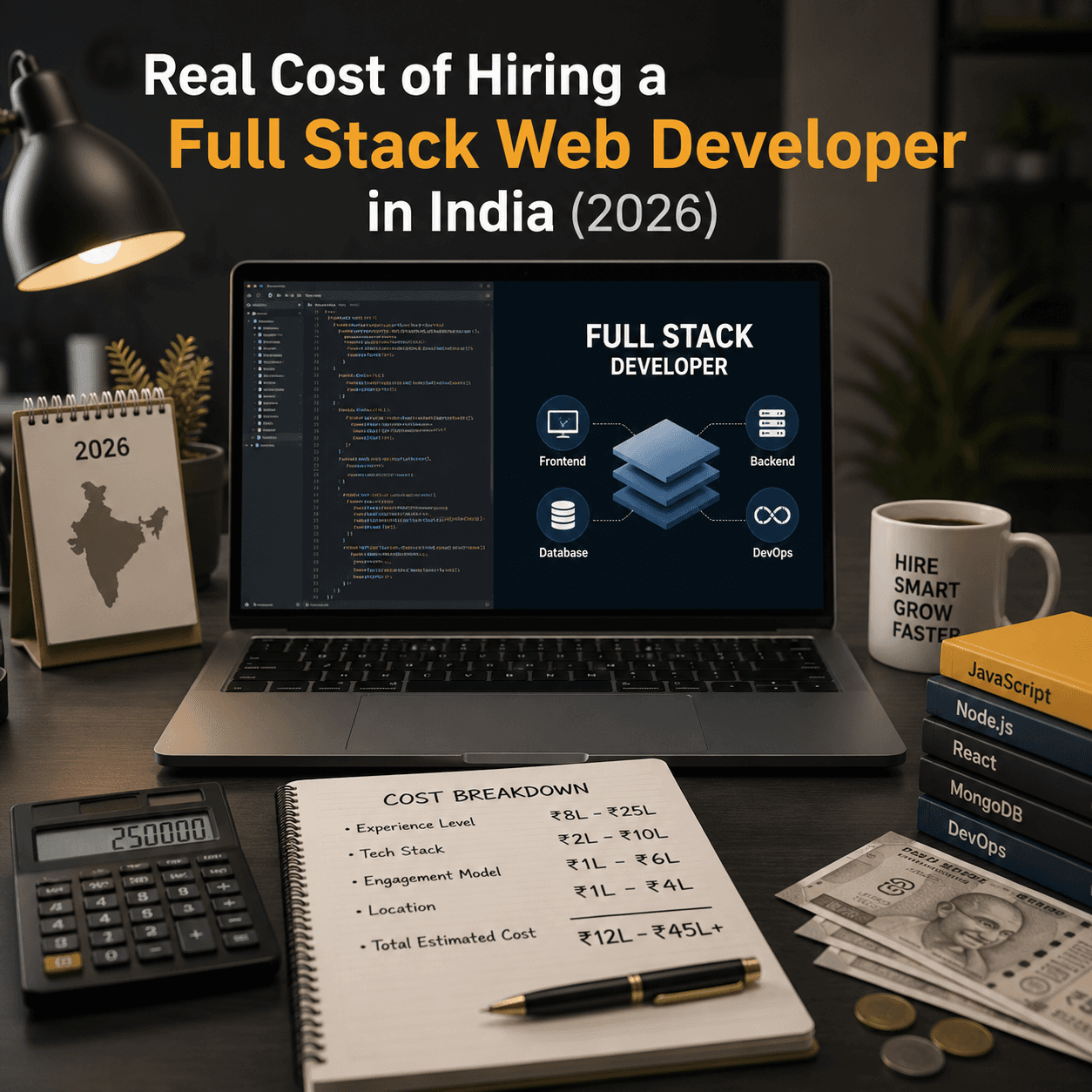
Real Cost of Hiring a Full Stack Web Developer in India (2026)
Why India Is Still the World's Top Destination for Hiring Full Stack Developers
If you're a startup founder in San Francisco, a SaaS company in New York, or a digital agency in London trying to figure out where to get quality software built without draining your runway — India should be at the top of your list. And in 2026, that statement is more true than ever.
India has consistently remained the world's leading offshore software development destination for over two decades. But what's changed recently is the quality of talent. Post-pandemic remote work normalization, the explosion of coding bootcamps, AI-assisted development workflows, and a booming startup ecosystem have elevated India's developer pool to a genuinely world-class standard.
The numbers back this up. India has over 5.8 million software developers, the second largest developer population in the world after the United States. Every year, India's technical universities produce over 1.5 million engineering graduates. And increasingly, these developers are not just building basic websites — they're building AI-powered SaaS products, headless commerce platforms, cloud-native applications, and complex distributed systems.
For US businesses especially, the math is compelling. A senior full stack developer in Silicon Valley costs upward of $150,000/year in salary alone — before benefits, equity, office space, and HR overhead. The equivalent senior developer in Bangalore or Pune can be hired as a dedicated remote resource for $40,000–$60,000/year, at comparable technical skill levels.
But "cost" is more nuanced than a simple hourly rate comparison. In this guide, we'll break down:
Actual 2026 pricing data — junior to architect level
India vs USA cost comparisons with real numbers
Technology-specific pricing (MERN, React, Django, Laravel, AI SaaS)
Freelancer vs agency vs dedicated team cost structures
City-by-city pricing differences within India
Hidden development costs most businesses miss
AI-ready development trends shaping hiring decisions in 2026
Whether you're an Indian startup hiring locally or a US company looking to offshore intelligently, this guide gives you the real numbers and practical insights to make confident hiring decisions.
What Does a Full Stack Web Developer Actually Do?
Before we dive into pricing, let's be precise about what you're actually hiring.
The term "full stack developer" gets thrown around loosely. But a genuinely skilled full stack developer in 2026 is someone who can own the complete technical lifecycle of a web application — from user interface to server logic to database design to cloud deployment.
Frontend Development
The frontend is everything a user sees and interacts with. Full stack developers working on the frontend are typically proficient in:
React.js — The dominant JavaScript library for building dynamic user interfaces, used by companies like Facebook, Airbnb, and thousands of SaaS startups.
Next.js — A React framework adding server-side rendering, static site generation, and API routes. Critical for SEO-optimized and performance-focused applications in 2026.
Vue.js — A progressive JavaScript framework popular for its simplicity, particularly in mid-size projects.
Angular — Google's enterprise-grade frontend framework, common in corporate and enterprise applications.
Strong frontend developers also understand responsive design, accessibility standards, performance optimization (Core Web Vitals), CSS architecture, and increasingly — AI-driven UI components.
Backend Development
The backend powers the logic, data processing, authentication, and integrations that users never see directly. Common backend technologies include:
Node.js with Express.js — Fast, event-driven JavaScript runtime ideal for real-time applications, APIs, and high-concurrency systems.
Python with Django or FastAPI — Strongly typed, readable, excellent for AI-adjacent applications and data-heavy platforms.
Laravel (PHP) — The most popular PHP framework, widely used for ecommerce, CMS, and business web applications.
Ruby on Rails — Still relevant in mature startups for rapid development and convention-over-configuration.
Database Management
Full stack developers design and manage the data layer. This typically includes:
MongoDB — Flexible NoSQL document database popular in MERN stack applications.
PostgreSQL — Advanced open-source relational database used in enterprise and SaaS products.
MySQL — Industry-standard relational database widely used in web applications.
Redis — In-memory data store for caching, sessions, and real-time features.
API Development, Cloud, and DevOps
Modern full stack developers are also expected to:
Design and consume REST and GraphQL APIs — connecting frontend, backend, third-party services, and AI tools.
Deploy on cloud platforms like AWS, Google Cloud, or Azure — including serverless functions, container orchestration, and CDN configuration.
Understand CI/CD pipelines — automated testing, deployment workflows, and version control.
Implement security best practices — authentication, data encryption, rate limiting, OWASP compliance.
Why Startups Prefer Full Stack Developers
For early-stage startups and lean teams, a full stack developer is extremely cost-effective. Instead of hiring separate frontend and backend engineers (plus a DevOps person), a skilled full stack developer can handle the complete product. This reduces communication overhead, speeds up development, and keeps burn rates manageable.
As products scale, teams typically specialize — but for MVP stage and early growth, full stack talent is the most efficient investment.
Real Cost of Hiring a Full Stack Developer in India (2026)
Let's get to the numbers. These are realistic 2026 market rates, based on hiring patterns across Indian tech hubs, agency pricing data, and offshore outsourcing market trends.
Junior Full Stack Developers (0–2 Years Experience)
Junior developers are comfortable with the fundamentals. They can build standard CRUD applications, implement UI components, write basic APIs, and work productively under senior guidance. They typically struggle with complex architecture decisions, high-traffic optimization, or advanced security implementations.
Metric | INR | USD |
|---|---|---|
Hourly Rate | ₹900 – ₹1,500 | $11 – $18 |
Monthly Salary (Employment) | ₹35,000 – ₹65,000 | $420 – $780 |
Monthly Dedicated Remote Rate | ₹1,00,000 – ₹1,50,000 | $1,200 – $1,800 |
Annual Salary (India) | ₹4.2L – ₹7.8L | $5,000 – $9,400 |
Best for: Simple websites, basic web apps, internal tools, MVP prototypes with senior oversight.
Mid-Level Full Stack Developers (2–5 Years Experience)
This is the sweet spot for most startups and growing businesses. Mid-level developers understand architecture patterns, can make independent technical decisions, implement complex features, optimize performance, and collaborate effectively with product teams. They're comfortable with modern toolchains, cloud platforms, and increasingly, AI integrations.
Metric | INR | USD |
|---|---|---|
Hourly Rate | ₹1,500 – ₹3,000 | $18 – $36 |
Monthly Salary (Employment) | ₹80,000 – ₹1,60,000 | $960 – $1,920 |
Monthly Dedicated Remote Rate | ₹1,50,000 – ₹2,80,000 | $1,800 – $3,400 |
Annual Salary (India) | ₹9.6L – ₹19.2L | $11,500 – $23,000 |
Best for: SaaS products, ecommerce platforms, marketplace applications, REST API-heavy projects, mobile-web applications.
Senior Full Stack Developers (5–10 Years Experience)
Senior developers are technically authoritative. They architect scalable systems, make technology selection decisions, mentor junior developers, lead code reviews, and own the long-term quality of a product's codebase. In 2026, senior developers with AI integration expertise (LLM APIs, vector databases, AI-powered features) command a significant premium.
Metric | INR | USD |
|---|---|---|
Hourly Rate | ₹2,500 – ₹5,000 | $30 – $60 |
Monthly Salary (Employment) | ₹1,60,000 – ₹3,20,000 | $1,920 – $3,840 |
Monthly Dedicated Remote Rate | ₹2,50,000 – ₹4,50,000 | $3,000 – $5,400 |
Annual Salary (India) | ₹19.2L – ₹38.4L | $23,000 – $46,000 |
Best for: Complex SaaS platforms, high-traffic applications, AI-powered products, enterprise systems, applications requiring strong security or compliance.
Technical Architects (10+ Years Experience)
Technical architects don't just write code — they design entire systems. They set technical standards, evaluate third-party vendors, plan infrastructure scaling, and ensure the product can grow from 1,000 to 1,000,000 users without architectural debt. These are rare, high-value professionals.
Metric | INR | USD |
|---|---|---|
Hourly Rate | ₹4,000 – ₹8,000 | $48 – $95 |
Monthly Rate (Contract/Remote) | ₹3,50,000 – ₹6,00,000 | $4,200 – $7,200 |
Annual (Employment or Contract) | ₹42L – ₹72L | $50,000 – $86,000 |
Best for: Series A+ startups, enterprise digital transformation, platforms expecting rapid scale, organizations building for compliance-heavy industries (FinTech, HealthTech).
City-by-City Pricing Differences Within India
Developer costs vary meaningfully by city. Metro Tier-1 cities (Bangalore, Mumbai, Delhi NCR) have higher living costs and salary expectations. Tier-2 cities (Ahmedabad, Pune, Hyderabad) offer excellent talent at slightly lower rates.
City | Junior Monthly | Mid-Level Monthly | Senior Monthly |
|---|---|---|---|
Bangalore | ₹55,000–₹75,000 | ₹1,20,000–₹1,80,000 | ₹2,00,000–₹3,50,000 |
Mumbai | ₹50,000–₹70,000 | ₹1,10,000–₹1,70,000 | ₹1,90,000–₹3,20,000 |
Delhi NCR | ₹45,000–₹65,000 | ₹1,00,000–₹1,60,000 | ₹1,80,000–₹3,00,000 |
Hyderabad | ₹40,000–₹60,000 | ₹90,000–₹1,50,000 | ₹1,60,000–₹2,80,000 |
Pune | ₹38,000–₹58,000 | ₹85,000–₹1,40,000 | ₹1,50,000–₹2,60,000 |
Ahmedabad | ₹32,000–₹50,000 | ₹75,000–₹1,20,000 | ₹1,30,000–₹2,20,000 |
Key insight: Ahmedabad and Pune are particularly attractive for cost-conscious businesses — they have strong technical university ecosystems, growing startup communities, and rates roughly 20–30% below Bangalore with comparable talent quality in many stacks.
Top Full Stack Web Development Agencies in India
Top Full Stack Web Development Agencies in India
Freecodeslab
Overview:
Freecodeslab is an emerging full stack web development company in India focused on building scalable, high-performance, and AI-ready digital solutions for startups, SaaS businesses, ecommerce brands, and growing enterprises. The company specializes in modern frontend and backend technologies, helping businesses launch fast, SEO-friendly, and conversion-focused web applications.
Core Services:
Full Stack Web Development
Custom Website Development
MERN Stack Development
SaaS Application Development
Ecommerce Development
CMS Development
API Integration & Backend Systems
AI-Integrated Web Applications
UI/UX Development
Website Optimization & SEO-Friendly Architecture
Technology Expertise:
React.js
Next.js
Node.js
Express.js
MongoDB
Laravel
PHP
MySQL
Tailwind CSS
Headless CMS Platforms
Why Businesses Choose Freecodeslab:
Freecodeslab focuses on delivering lightweight, scalable, and business-oriented web solutions that align with modern SEO and AI-search optimization trends. Their development approach emphasizes performance optimization, responsive design, scalable backend systems, and future-ready architecture for startups and global businesses.
Best For:
Startups
SaaS Companies
Small Businesses
Ecommerce Brands
Agencies
Businesses looking for affordable offshore development
VNA Infotech
Overview:
VNA Infotech is a modern web development and digital solutions company specializing in full stack development, headless CMS solutions, SEO-driven architecture, and AI-ready business websites. Headquartered in Gandhinagar, India, the company serves both Indian and international clients with scalable digital products and custom software solutions.
Core Services:
Full Stack Web Development
Custom Software Development
Headless CMS Development
Web Application Development
Business Automation Solutions
Ecommerce Website Development
SEO-Friendly Website Architecture
AI-Integrated Digital Solutions
UI/UX Design
Digital Transformation Services
Technology Expertise:
React.js
Next.js
Node.js
Webflow
Framer
Headless CMS
API Integrations
JavaScript Frameworks
Cloud-Based Solutions
Why Businesses Choose VNA Infotech:
VNA Infotech is known for combining development, SEO strategy, and performance-focused architecture into one integrated workflow. The company emphasizes fast-loading websites, scalable backend systems, modern UI/UX practices, and AI-search optimized web experiences. Their “Code is Marketing” approach focuses on how technical development directly impacts search visibility, user engagement, and business growth.
Best For:
Startups
SMBs
Enterprises
SaaS Platforms
SEO-focused businesses
Companies seeking AI-ready web infrastructure
India vs USA Full Stack Developer Cost Comparison
This is the section US businesses care most about. Let's compare apples to apples.
Hourly Rate Comparison
Experience Level | India (USD/hr) | USA (USD/hr) | India Savings |
|---|---|---|---|
Junior | $12 – $18 | $50 – $75 | ~75% cheaper |
Mid-Level | $18 – $36 | $75 – $120 | ~70% cheaper |
Senior | $30 – $60 | $120 – $180 | ~65% cheaper |
Architect | $48 – $95 | $150 – $250 | ~60% cheaper |
Annual Cost Comparison: Hiring a Mid-Level Full Stack Developer
Cost Component | India (USD) | USA (USD) |
|---|---|---|
Annual Salary / Contract | $18,000 – $28,000 | $90,000 – $130,000 |
Benefits / PF / Insurance | $2,000 – $4,000 | $20,000 – $35,000 |
Office / Infrastructure | Minimal (remote) | $5,000 – $15,000 |
HR & Hiring Costs | $1,000 – $2,000 | $8,000 – $20,000 |
Total Estimated Annual Cost | $21,000 – $34,000 | $123,000 – $200,000 |
The math is stark. For the price of one mid-level US-based developer, you can often hire three mid-level developers in India — enabling you to build a complete feature team (frontend specialist + backend specialist + QA) for the same budget.
Time Zone Benefits
India Standard Time (IST) is UTC+5:30, which means:
US East Coast overlap: 8.5–10 hours of time zone difference, enabling an effective "follow-the-sun" model where Indian developers work during US off-hours, delivering progress every morning.
US West Coast overlap: 12.5–13.5 hours difference, better suited to async collaboration with daily handoffs.
Many Indian agencies and dedicated remote developers explicitly offer overlap hours (typically 10am–2pm IST) and are comfortable with async-first workflows via Slack, Jira, Notion, and Loom.
What US Businesses Gain
60–80% cost savings on equivalent development work
Access to large talent pools — India produces more CS graduates per year than any other country
Established offshore ecosystems — legal structures, payment rails, and collaboration norms are mature
Strong English communication — India is the world's largest English-speaking country by volume
AI-ready developers — Indian engineers are early adopters of GitHub Copilot, Cursor, and AI-assisted development
What to Watch Out For
Lowest-bid trap: Extremely cheap developers ($5–$8/hour) often mean inexperienced talent, poor communication, and code that costs more to maintain than it saved to build.
Portfolio review matters: Always review GitHub profiles, deployed projects, and technical interview candidates regardless of agency reputation.
Communication standards: Establish clear async communication norms, documentation requirements, and sprint protocols upfront.
IP protection: Use proper contracts, NDAs, and IP assignment agreements. Most established Indian agencies are experienced with US-standard legal agreements.
Full Stack Developer Cost by Technology Stack
Pricing varies significantly based on which technologies are involved. Here's a comprehensive breakdown by stack.
MERN Stack Developer Cost (MongoDB, Express, React, Node.js)
MERN is the most popular full stack JavaScript combination in 2026. It enables a single language (JavaScript/TypeScript) across the entire stack, making developers more versatile and codebases easier to maintain.
Junior MERN Developer: $14–$20/hour | $1,400–$2,000/month
Mid-Level MERN Developer: $20–$38/hour | $2,000–$3,800/month
Senior MERN Developer: $35–$60/hour | $3,500–$6,000/month
Best for: SaaS platforms, real-time applications, social products, dashboards, and AI-integrated web apps. Very strong US market demand. Excellent for startups due to fast development velocity.
MEAN Stack Developer Cost (MongoDB, Express, Angular, Node.js)
MEAN uses Angular instead of React. Angular's opinionated structure makes it slightly more expensive due to the steeper learning curve, but it's preferred in enterprise environments.
Mid-Level MEAN Developer: $22–$40/hour | $2,200–$4,000/month
Senior MEAN Developer: $38–$65/hour | $3,800–$6,500/month
Best for: Enterprise dashboards, internal tools, financial applications, and large-team codebases needing strong conventions.
React.js Developer Pricing
Standalone React developers (working with various backend choices) are in extremely high demand. React expertise commands a small premium over generic frontend skills.
Mid-Level React Developer: $20–$40/hour
Senior React Developer: $38–$65/hour
2026 note: React Server Components and React 19 adoption is increasing. Developers with RSC expertise are in higher demand and command slightly higher rates.
Next.js Developer Cost
Next.js has become the default choice for production-grade React applications. Developers with solid Next.js expertise — especially App Router, server actions, ISR, and edge deployment — are particularly valuable.
Mid-Level Next.js Developer: $22–$42/hour | $2,200–$4,200/month
Senior Next.js Developer: $40–$68/hour | $4,000–$6,800/month
Best for: SEO-optimized web applications, content-heavy platforms, ecommerce frontends, AI SaaS products, and any application requiring strong performance and discoverability.
Node.js Developer Pricing
Node.js backend developers are the most abundant in India's developer market — making them slightly more competitively priced relative to their skill level.
Mid-Level Node.js Developer: $18–$35/hour | $1,800–$3,500/month
Senior Node.js Developer: $32–$58/hour | $3,200–$5,800/month
Best for: REST and GraphQL APIs, real-time applications (WebSockets), microservices, serverless functions.
Laravel Developer Cost (PHP)
Laravel remains extremely popular globally, particularly for ecommerce, CRM, and business web applications. India has a very deep pool of Laravel developers.
Mid-Level Laravel Developer: $16–$32/hour | $1,600–$3,200/month
Senior Laravel Developer: $28–$52/hour | $2,800–$5,200/month
Best for: Ecommerce platforms, SaaS MVPs, content management systems, multi-tenant business applications.
Django Developer Pricing (Python)
Django is Python's "batteries included" web framework. In 2026, Python full stack developers with Django or FastAPI expertise command a premium due to Python's dominance in AI/ML integration.
Mid-Level Django Developer: $22–$42/hour | $2,200–$4,200/month
Senior Django/Python Developer: $38–$68/hour | $3,800–$6,800/month
Best for: AI-integrated applications, data-heavy platforms, FinTech, HealthTech, and any product with machine learning components.
AI SaaS Developer Cost
This is a new and fast-growing category in 2026. Developers who can build AI-powered SaaS products — integrating OpenAI, Anthropic, Cohere, or open-source LLMs, building RAG pipelines, implementing vector search, and creating AI-native UX — command the highest rates in the market.
AI SaaS Developer (Mid-Level): $35–$60/hour | $3,500–$6,000/month
AI SaaS Developer (Senior): $55–$90/hour | $5,500–$9,000/month
Best for: AI chatbots, AI-powered document processing, generative search products, AI copilots, and any application where LLMs are core to the product value proposition.
Factors That Affect Full Stack Developer Pricing
Understanding why pricing varies helps you budget more accurately and avoid surprises.
Experience Level
The single biggest pricing driver. A 7-year experienced developer doesn't just code faster — they make architectural decisions that prevent months of technical debt. Junior developers are cheaper per hour but frequently slower, require more oversight, and sometimes produce code that requires costly rewrites.
Rule of thumb: For a product you'll scale, invest in at least one senior developer, even if the rest of the team is mid-level.
Technology Expertise
Developers who specialize in high-demand, hard-to-learn technologies (Rust, Kubernetes, advanced WebGL, AI/ML integration) charge more. The market correctly rewards rare skills.
AI Development Skills
In 2026, developers who understand how to integrate and optimize large language models, build retrieval-augmented generation (RAG) systems, fine-tune models, or architect AI-native applications command a 30–50% premium over developers without AI exposure.
Project Complexity
A brochure website is fundamentally different from a multi-tenant SaaS platform with real-time collaboration, custom billing, analytics, and AI-powered features. Complexity drives time, which drives cost — and complex projects require more experienced developers.
UI/UX Requirements
Does your project require polished, pixel-perfect UI with smooth animations? Design-heavy implementations take significantly longer than functional-but-basic interfaces. Developers with strong UI sensibility (or who work alongside dedicated designers) cost more but deliver better products.
API Integrations
Modern applications typically integrate dozens of third-party services — payment gateways (Stripe, Razorpay), communication (Twilio, SendGrid), maps (Google Maps, Mapbox), analytics (Mixpanel, Segment), AI APIs, and business tools. Each integration adds scope and requires expertise. Complex API ecosystems add 20–40% to development timelines and costs.
Security Requirements
Applications handling financial data, healthcare information, or personal data require serious security implementation — encryption at rest and in transit, penetration testing, OWASP compliance, secure authentication flows. Developers with security expertise are more expensive but non-negotiable for compliance-heavy applications.
DevOps Expertise
Deployment, CI/CD pipelines, container management, cloud infrastructure — developers who can own this layer (rather than requiring a separate DevOps hire) are more valuable and priced accordingly.
English Fluency and Communication
Don't underestimate this. Developers who communicate proactively, write clear documentation, understand product requirements without constant clarification, and participate effectively in planning discussions add enormous value to remote teams. Better communicators typically cost more — and are worth it.
Agile Methodology
Experienced developers who understand and practice agile — sprint planning, velocity tracking, backlog grooming, retrospectives — integrate into product teams far more smoothly than developers who simply write code. Agile experience adds value and typically aligns with slightly higher rates.
Industry Expertise
A developer who has previously built fintech applications understands compliance requirements, financial data modeling, and payment processing nuances. This domain expertise reduces risk and development time significantly. Domain-specific experience commands a premium.
Why Cheap Developers Cost More in the Long Run
This is perhaps the most important concept in this entire guide. Hiring a $7/hour developer to build your SaaS product might save $20,000 upfront. But if that developer produces poorly architected, untested code with security vulnerabilities and no documentation, the cost to fix, refactor, and maintain that codebase over two years will dwarf any savings.
Experienced tech teams universally report that the most expensive development decisions are the ones made to save money early.
Freelancer vs Agency vs Dedicated Development Team
Choosing the right engagement model is as important as choosing the right developer. Each model has distinct tradeoffs.
Freelance Developers
Cost: $12–$55/hour depending on experience and platform (Upwork, Toptal, direct hire)
Pros:
Lowest cost for specific tasks
Flexibility to hire task-by-task
Large pool of available talent globally
Cons:
Availability is unpredictable — top freelancers are often busy
No team backup if the freelancer disappears (it happens)
Limited accountability for long-term outcomes
Juggling multiple clients often reduces focus
No built-in project management or quality control
Best for: Small, well-defined tasks; bug fixes; short-term feature additions; design-to-code conversion. Not ideal for building complex, long-lived products.
Development Agencies
Cost: $25–$75/hour for Indian agencies (pricing varies widely by agency quality)
Pros:
Structured team — PM, developers, QA, designers
Accountability and contracts
Processes for delivery management
Ability to scale team up or down
Continued support after launch
Cons:
Higher cost than direct freelancers
Variable quality between agencies (due diligence essential)
Less day-to-day transparency into individual developer performance
Senior resources sometimes replaced by junior ones mid-project
Best for: Defined-scope projects, startups without internal technical leadership, businesses needing turnkey delivery.
Dedicated Development Teams (Staff Augmentation)
Cost: $1,800–$5,500/month per developer depending on seniority
Pros:
Full-time resource dedicated entirely to your product
Builds domain knowledge over time
Works within your processes and tools
Strong communication and team integration
Cost-effective for continuous development
Cons:
Requires your own technical leadership to manage
Slightly higher monthly cost than project-based freelancers
Finding and vetting takes more upfront effort
Best for: Startups and scaleups with ongoing product development, SaaS companies building continuously, businesses that want the economics of offshore with the integration of in-house.
Criteria | Freelancer | Agency | Dedicated Team |
|---|---|---|---|
Cost | Lowest | Medium | Medium-High |
Reliability | Variable | High | High |
Scalability | Low | High | High |
Communication | Variable | Structured | Deep |
Long-term value | Low | Medium | Highest |
Best for | Tasks | Projects | Products |
Cost to Build Different Types of Applications in India
Here are realistic development cost estimates for common application types — using Indian development teams.
Startup / Corporate Website
Complexity: Low to Medium
Team: 1–2 developers + 1 designer
Timeline: 4–8 weeks
India Cost: $3,000 – $10,000
USA Equivalent: $15,000 – $40,000
Stack: Next.js, Tailwind CSS, CMS (Contentful / Sanity)
SaaS Platform (Standard)
Complexity: High
Team: 2–4 developers + PM + QA
Timeline: 3–6 months
India Cost: $20,000 – $60,000
USA Equivalent: $100,000 – $250,000
Stack: React/Next.js + Node.js + PostgreSQL + AWS
AI SaaS Product
Complexity: Very High
Team: 3–5 developers (including AI specialist) + PM + QA
Timeline: 4–8 months
India Cost: $35,000 – $100,000
USA Equivalent: $180,000 – $400,000
Stack: Next.js + Python FastAPI + LLM APIs + Vector DB + AWS
Ecommerce Website (Custom)
Complexity: Medium to High
Team: 2–3 developers + designer
Timeline: 6–12 weeks
India Cost: $8,000 – $25,000
USA Equivalent: $40,000 – $100,000
Stack: Next.js Commerce / Shopify Custom / Laravel
Marketplace Platform (Airbnb/Upwork-style)
Complexity: Very High
Team: 4–6 developers + PM + QA + designer
Timeline: 5–10 months
India Cost: $40,000 – $120,000
USA Equivalent: $200,000 – $500,000
CRM Software
Complexity: High
Team: 3–4 developers + QA
Timeline: 3–5 months
India Cost: $20,000 – $55,000
USA Equivalent: $100,000 – $220,000
FinTech Application
Complexity: Very High (compliance + security + real-time)
Team: 4–6 developers + security specialist + QA
Timeline: 6–12 months
India Cost: $50,000 – $150,000
USA Equivalent: $250,000 – $600,000+
Healthcare Portal
Complexity: Very High (HIPAA / data compliance)
Team: 4–6 developers + compliance + QA
Timeline: 6–10 months
India Cost: $45,000 – $130,000
USA Equivalent: $220,000 – $500,000+
Educational Platform (LMS)
Complexity: Medium to High
Team: 3–4 developers + designer + QA
Timeline: 3–6 months
India Cost: $18,000 – $55,000
USA Equivalent: $90,000 – $220,000
Hidden Costs of Hiring Developers
Most project budgets only account for developer salaries. Here's what actually gets missed — and these costs add up fast.
Cloud Infrastructure: AWS, GCP, or Azure hosting for even a modest SaaS product can run $200–$2,000+/month depending on traffic. Factor this into your total cost of ownership from day one.
Third-Party APIs and SaaS Tools: Payment processing (Stripe takes 2.9% + $0.30 per transaction), email services, authentication (Auth0 can be expensive at scale), analytics, monitoring (Datadog, New Relic), error tracking (Sentry), and AI APIs (OpenAI, Anthropic) all add monthly costs that compound with growth.
DevOps and Infrastructure Management: If your developers aren't handling deployment, you'll need a separate DevOps resource or managed service. Estimate $500–$3,000/month.
QA and Testing: Automated testing infrastructure, manual QA sprints, cross-browser and device testing — often overlooked until bugs hit production. Budget 15–20% of development costs for proper QA.
UI/UX Design: Strong design is not free. A dedicated UI/UX designer for a 4-month project typically costs $5,000–$20,000 in India, or more if you need high-fidelity prototyping and user research.
Security Audits: For any product handling user data or payments, a security audit before launch is essential. Expect $2,000–$15,000 depending on scope.
Maintenance and Updates: Post-launch maintenance — bug fixes, dependency updates, security patches, performance optimization — typically runs 15–25% of the original development cost annually.
AI API Costs: Building with LLMs? OpenAI, Anthropic, or Cohere API costs can escalate quickly with user volume. Factor per-token costs into your financial model from day one.
Total real cost is often 30–50% higher than the raw developer cost estimate. Build a buffer.
Why US Companies Prefer Indian Full Stack Developers
The economic argument is compelling, but cost alone doesn't explain why US companies keep coming back to India, year after year. Here's the full picture.
Technical Caliber: Indian engineers train in intensely competitive academic environments. The IITs, NITs, and top private engineering colleges produce graduates who can compete globally. US companies consistently report that Indian engineers are not "cheaper substitutes" — they're genuinely skilled practitioners who happen to be more affordable due to India's cost of living.
English Proficiency: India has over 250 million English speakers. Business communication, technical documentation, and client-facing communication are natural. This dramatically reduces the friction that plagues non-English-speaking offshore destinations.
Startup Ecosystem Experience: India's startup ecosystem — centered in Bangalore, Mumbai, Hyderabad, and Delhi — has exploded in the last decade. Thousands of Indian developers have worked at well-funded startups, learned modern development practices, and understand product thinking, not just code writing.
AI Adoption: Indian developers have been among the fastest adopters of AI coding tools globally. GitHub Copilot, Cursor, and LLM-assisted development are standard at top Indian tech companies, meaning developers are already operating with AI-enhanced productivity.
Time Zone as an Asset: Rather than seeing the time zone gap as a problem, many US startups use it strategically. Daily async handoffs create a near-continuous development cycle. Indian developers commit progress overnight; US founders review in the morning. With proper process, you effectively get a longer working day out of your development investment.
Common Outsourcing Mistakes to Avoid
Hiring based on lowest price alone — it's the most reliable path to a bad outcome
Skipping the technical interview — always verify skills directly, never just on portfolio
Poor onboarding — remote teams need documentation, clear context, and active integration
No project management process — offshore teams need structured sprints, not open-ended task lists
Not protecting IP — use proper contracts with clear IP ownership and NDA clauses
AI-Ready Full Stack Development in 2026
The most significant shift in software development in the last two years is the integration of AI into virtually every layer of modern applications. In 2026, "AI-ready development" is not a niche skill — it's rapidly becoming a baseline expectation.
What AI-Ready Development Means
LLM API Integration: Building features that leverage OpenAI GPT-4o, Anthropic Claude, Google Gemini, or open-source models like Llama 3. This includes prompt engineering, context management, streaming responses, and cost optimization.
Retrieval-Augmented Generation (RAG): Allowing AI to answer questions using your proprietary data by combining vector search (Pinecone, Weaviate, pgvector) with language models. This is the core architecture behind AI chatbots, knowledge bases, and document Q&A systems.
Agentic Workflows: Building systems where AI models don't just respond but take multi-step actions — browsing, writing to databases, calling APIs, and completing complex workflows autonomously.
AI-Powered UX: Conversational interfaces, AI-assisted form filling, intelligent search, predictive recommendations, and natural language query interfaces are becoming standard product features rather than differentiators.
GEO-Optimized Architecture: Applications built for discoverability in 2026 need to account for how AI search engines (Google AI Overviews, Perplexity, ChatGPT Search) retrieve and cite content. This means structured data, semantic HTML, fast loading (Core Web Vitals), and content architecture that makes information extractable by AI crawlers.
AI Coding Assistants Are Changing Productivity
GitHub Copilot, Cursor, and Windsurf are now standard tools in professional development workflows. Experienced Indian developers using these tools are producing code at 30–50% higher velocity on routine tasks, while spending more time on architecture and product decisions. This doesn't reduce the value of good developers — it amplifies it.
What This Means for Hiring in 2026
When hiring full stack developers for any AI-adjacent product, look specifically for:
Experience with LLM API integration (any major provider)
Understanding of vector databases and embedding workflows
Knowledge of prompt engineering and context management
Awareness of AI cost optimization (token management, caching strategies)
Familiarity with AI-powered development tools (Copilot, Cursor)
Developers with this profile command a 30–50% rate premium over equivalent general full stack developers — and in most cases, that premium is well justified by faster, smarter delivery.
How to Reduce Development Costs Without Sacrificing Quality
You don't need to choose between affordability and quality. Here are the most effective strategies for cost-efficient development.
Build MVP First: Define the smallest version of your product that delivers core value and ships fast. Every feature beyond the MVP should be validated before being built. Skipping the MVP trap saves 40–60% on initial development.
Choose Scalable, Standard Technologies: Exotic tech stacks are harder to hire for and harder to maintain. Stick to well-supported, widely-used technologies (React, Node.js, PostgreSQL, AWS) unless you have a very specific technical reason to deviate.
Hire Dedicated Developers, Not Project Shops for Long-Term Work: If you're going to be building continuously, dedicated remote developers are almost always more cost-effective than project-based agency contracts after the first 3–4 months.
Plan Architecture Before You Write Code: Architectural mistakes are expensive. Investing in a technical discovery phase (2–4 weeks with a senior architect) before development starts consistently reduces total project cost.
Use Reusable Component Libraries: Don't build UI from scratch. Component libraries (shadcn/ui, MUI, Chakra UI, Radix) eliminate weeks of frontend development time while producing better, more accessible interfaces.
Prioritize Automation in QA: Manual testing is slow and expensive. Investing in automated testing early (unit tests, integration tests, E2E with Playwright) reduces QA costs over the product's lifetime.
Embrace Async-First Communication: Synchronous meetings are expensive development time. Well-run async teams (clear documentation, structured Loom updates, Notion wikis) ship faster at lower cost.
Future Trends in Full Stack Development Hiring (2026–2027)
The hiring landscape is evolving rapidly. Here's what's shaping the next 12–24 months.
AI Copilots Are Standard: Every serious developer will be using AI coding assistance by 2027. Developers who don't are already at a productivity disadvantage. Hiring managers are increasingly asking about AI tool fluency.
Remote-First Is Now the Default: The hybrid/office debate is largely over in software development. Top Indian developers expect and prefer remote-first arrangements. Companies offering async-friendly, remote-first environments attract better talent.
Specialization in AI Stacks: As AI becomes a core product feature (not just a nice-to-have), demand for developers who specialize in LLM-powered applications, autonomous agents, and AI-native architectures will grow faster than general full stack demand.
Serverless and Edge Computing: Vercel Edge, Cloudflare Workers, AWS Lambda@Edge — the server is becoming an abstraction. Developers who understand serverless architecture and edge deployment are building faster, more scalable products at lower infrastructure cost.
Headless Architecture at Scale: The decoupling of frontend and backend through headless CMS, headless commerce, and API-first architectures is becoming the default for any product expecting multi-channel distribution (web, mobile, voice, IoT).
Voice and Conversational Interfaces: With AI voice agents becoming commercially viable (ElevenLabs, OpenAI Voice, Hume), full stack developers will increasingly be expected to build voice-enabled features and conversational UI patterns.
Global Developer Marketplaces Mature: Platforms like Toptal, Arc.dev, Lemon.io, and India-specific platforms are making it easier to find vetted, pre-screened developers. The friction of offshore hiring continues to decrease.
Conclusion: Making the Right Hiring Decision in 2026
The cost of hiring a full stack web developer in India in 2026 ranges from $12/hour for a junior developer to $90+/hour for a specialized AI architect. Monthly dedicated developer costs range from $1,200 to $9,000 depending on seniority and technology expertise.
But the real insight in this guide is not the numbers themselves — it's understanding the value behind them.
India's developer ecosystem has matured dramatically. The country that once competed on price alone now competes on quality, technical depth, communication, and AI readiness. For US startups and global businesses, this means you can hire offshore without compromise — if you hire thoughtfully.
The businesses that win with Indian developers are the ones that:
Invest in quality — not the cheapest rate, but the best value
Hire for the product, not the task — dedicated teams outperform one-off project shops for anything long-term
Integrate developers properly — treat offshore teams as product team members, not vendors
Plan for the full cost — budget hosting, tools, QA, security, and maintenance from the start
Build with AI in mind — products built with AI-native architecture in 2026 are better positioned for the next five years
India offers an extraordinary opportunity for global businesses to build world-class products at a fraction of the cost of equivalent Western development. The companies that approach this opportunity strategically — with proper vetting, clear processes, and fair compensation — consistently report it as one of the highest-ROI investments they make.
Ready to hire a full stack developer from India? Focus on finding developers who combine technical excellence, clear communication, and AI fluency. That combination, at Indian market rates, is still one of the best deals in global business.
Frequently Asked Questions :
How much does a full stack developer cost in India in 2026?
A full stack developer in India costs between $12–$60/hour depending on experience. Junior developers charge $12–$18/hour, mid-level developers $18–$40/hour, and senior developers $40–$60+/hour. Monthly dedicated developer rates range from $1,200–$5,500.
What is the hourly rate of Indian developers?
Indian full stack developer hourly rates in 2026 range from $12 (junior) to $90+ (senior AI specialist). The most common rate for a productive mid-level developer is $20–$35/hour.
Why are Indian developers cheaper than US developers?
The cost difference reflects India's lower cost of living, not a difference in technical skill. A developer earning $25,000/year in Pune lives very comfortably — the equivalent of earning $120,000+ in San Francisco. The talent quality is genuinely comparable; the economics of location are simply different.
Is outsourcing web development to India safe?
Yes — when done properly. Use formal contracts with IP assignment and NDA clauses. Work with established agencies or vetted platforms. Always do technical interviews. Establish clear communication protocols. Thousands of US companies successfully outsource to India every year.
How much does it cost to build a SaaS platform in India?
A standard SaaS platform built by an Indian development team costs $20,000–$60,000. A complex AI-powered SaaS product can range from $35,000–$100,000+. US equivalent costs are 3–5x higher.
What technologies do full stack developers use?
Common stacks include MERN (MongoDB, Express, React, Node.js), MEAN (with Angular), Python/Django, Laravel/PHP, and Next.js. In 2026, AI integration skills (LLM APIs, vector databases) are increasingly expected.
Is MERN stack development expensive in India?
MERN developers in India are among the most affordable for their skill level globally. Mid-level MERN developers typically charge $20–$38/hour or $2,000–$3,800/month.
Should startups hire freelancers or agencies?
For defined, short-term projects: freelancers. For complete product development: agencies or dedicated teams. For ongoing product development: dedicated teams offer the best long-term value.
How long does full stack development take?
A simple website: 4–8 weeks. A standard SaaS platform: 3–6 months. A complex marketplace or AI product: 5–12 months. Timeline scales with complexity and team size.
What is the cost difference between India and USA developers?
India is typically 60–80% cheaper than the USA for equivalent full stack development. A senior US developer costs $120–$180/hour; the equivalent Indian developer costs $35–$60/hour.
How do I hire trusted Indian developers?
Use vetted platforms (Toptal, Arc.dev), established Indian agencies with client references, or LinkedIn/direct sourcing with a thorough interview process. Always request GitHub portfolios, conduct technical assessments, and check client references.
What is the cost of hiring a full stack developer for 6 months?
A dedicated mid-level full stack developer from India for 6 months costs approximately $10,800–$20,400 (at $1,800–$3,400/month). US equivalent would be $45,000–$72,000.
Do Indian developers work in US time zones?
Many do, or offer significant overlap hours. Established agencies and dedicated remote developers are accustomed to async collaboration with US clients and often provide morning/evening overlap windows.
What is the best city in India to hire developers from?
Bangalore, Hyderabad, and Pune are top choices for technical talent quality. Ahmedabad and Delhi NCR offer strong talent at slightly lower rates. Remote hiring allows you to access talent nationally regardless of city.
How do I protect my IP when outsourcing to India?
Use a formal development agreement with clear IP assignment clauses, NDA, non-compete (where enforceable), and ensure all work-for-hire is explicitly assigned to your company. Most reputable Indian agencies are experienced with US-standard legal agreements.
What are AI-ready developers, and why should I hire them?
AI-ready developers understand how to integrate large language models, build retrieval-augmented generation systems, and create AI-native user experiences. In 2026, products built with AI capabilities have a significant competitive advantage, and developers who understand AI integration deliver substantially more value.
Related Reads for You
Discover more articles that align with your interests and keep exploring.