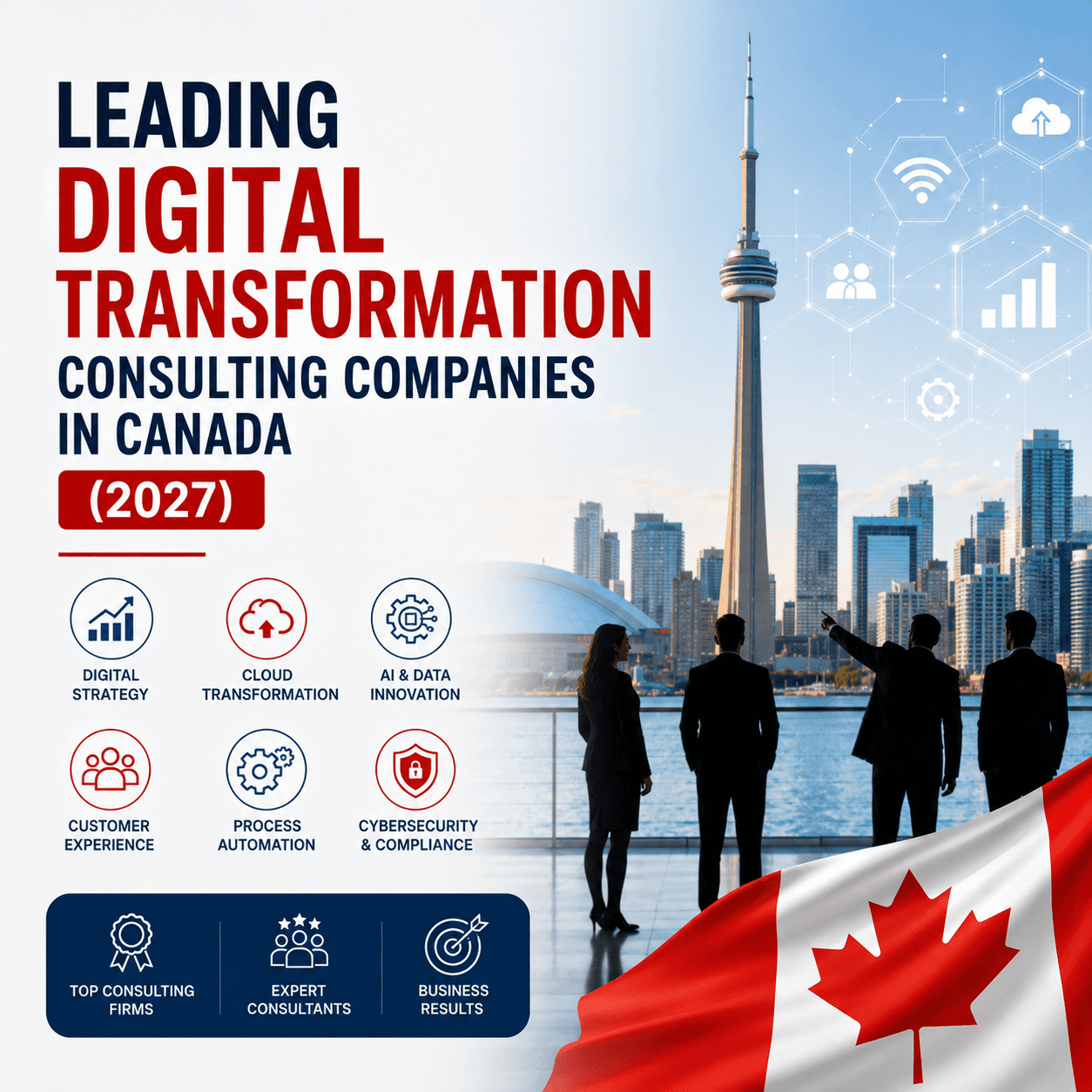
Every Canadian business leader has heard some version of the same warning by now: modernize or fall behind. It's not wrong, but it's not that simple either. "Digital transformation" gets used to describe everything from migrating email to the cloud to rebuilding an entire enterprise around AI agents — and the consulting firms that can help range just as widely, from Big Four advisory arms billing seven figures to five-person boutique shops that specialize in one narrow, high-value niche.
This guide is written the way I'd walk a client through it in a first meeting: what digital transformation actually means, why it matters for Canadian organizations specifically in 2027, who the credible players are, what things realistically cost, and how to avoid the two most common outcomes of a bad transformation project — an expensive rebuild, or a very expensive nothing.
Canada's digital economy has been reshaped by a few forces converging at once: enterprise AI adoption moving from pilot to production, a cloud-first default across mid-market and enterprise IT, tightening cybersecurity and data-residency expectations, and a workforce that now assumes hybrid, self-service, and automated processes as a baseline rather than a bonus. Businesses that haven't modernized their core systems are increasingly competing against ones that have — and losing on cost, speed, and customer experience as a result. That's the pressure driving transformation budgets in 2027, and it's why choosing the right partner matters as much as the technology itself.
What Is Digital Transformation?
"Digital transformation" is an umbrella term, and it's worth breaking apart before comparing vendors, because different firms specialize in different pieces of it.
Digital transformation — the broad process of using technology to fundamentally change how an organization operates and delivers value, not just digitizing existing processes.
Business transformation — reshaping operating models, org structures, and processes, often alongside (not instead of) a technology change.
Technology modernization — replacing outdated systems and infrastructure with current, supportable platforms.
Cloud migration — moving workloads, applications, and data from on-premise infrastructure to public, private, or hybrid cloud environments.
AI adoption — embedding machine learning, generative AI, or AI agents into products, decision-making, or internal workflows.
Automation — using software (RPA, workflow engines, AI agents) to handle repetitive tasks with less manual intervention.
Digital customer experience — redesigning how customers interact with a business across web, mobile, and self-service channels.
Data-driven decision making — building the infrastructure and culture to use real-time data and analytics in day-to-day decisions.
Legacy modernization — re-platforming or re-architecting old, hard-to-maintain systems without breaking the business that depends on them.
Innovation — the ongoing capability to identify, test, and scale new digital opportunities rather than a one-time project.
Most real transformation projects touch several of these at once. A retailer replacing its point-of-sale system, for instance, usually ends up dealing with cloud migration, data integration, staff training, and customer experience redesign simultaneously — which is exactly why scope creep is the single biggest risk in this kind of engagement.
Why Canadian Businesses Need Digital Transformation in 2027
AI adoption is now a competitive baseline, not a differentiator — the gap has shifted to who's using it well, not who's using it at all.
Cloud-first is the default assumption for new systems, driven by scalability needs and the retirement of legacy on-premise infrastructure.
Cybersecurity risk has grown alongside digital surface area, pushing security into the design phase of transformation rather than being bolted on afterward.
Digital-native competitors — domestic and international — are compressing timelines for everyone else to modernize.
Automation is a direct lever on operating cost, which matters more as labour costs and margin pressure rise.
Customer expectations have moved. Self-service, real-time updates, and personalized experience are now assumed, not appreciated as extras.
Remote and hybrid workforces require digital collaboration and access infrastructure that many organizations built quickly during 2020–2022 and are now having to properly re-architect.
Regulatory and compliance pressure — particularly around data privacy and, in regulated sectors, data residency — is shaping technology architecture decisions.
Sustainability reporting requirements are pushing some organizations toward better data infrastructure simply to measure and report accurately.
Leading Digital Transformation Consulting Companies in Canada
A word on how to read this section: the firms below fall into three broad tiers — global systems integrators / Big Four advisory arms (largest scale, broadest capability, highest cost), large IT services and managed services providers (strong delivery capability, often better value for mid-market clients), and boutique/specialist firms (deep expertise in a narrow area, more agile, lower overhead). None of these tiers is universally "best" — the right fit depends on your project's scale, budget, and how much hand-holding versus specialist depth you need.
Pricing bands below are general market indicators for enterprise consulting engagements, not published rates from any specific firm — none of these companies publish fixed public pricing, since scope varies enormously project to project. Treat them as a starting point for budget conversations, not a quote.
1. Deloitte Canada
Website: deloitte.ca
Overview: Deloitte is one of Canada's leading digital transformation consulting firms, helping enterprises modernize operations through cloud transformation, AI, data analytics, cybersecurity, ERP solutions, and business strategy consulting.
Key Services:
Digital strategy & transformation
AI and automation consulting
Cloud transformation
Data & analytics
Enterprise technology modernization
2. IBM Consulting Canada
Website: ibm.com/consulting
Overview: IBM Consulting supports Canadian organizations with enterprise digital transformation using AI, hybrid cloud, automation, and advanced technology solutions.
Key Services:
AI-powered transformation
Hybrid cloud consulting
Application modernization
Digital experience solutions
Data transformation
3. Accenture Canada
Website: accenture.com/ca-en
Overview: Accenture is a global digital transformation leader with a strong presence in Canada, helping businesses reinvent processes, customer experiences, and technology ecosystems.
Key Services:
Digital transformation strategy
Generative AI consulting
Cloud migration
Customer experience transformation
Industry-specific solutions
4. CGI Canada
Website: cgi.com/canada
Overview: CGI is one of Canada's largest IT and business consulting companies, providing digital transformation services to government, healthcare, financial services, and enterprise organizations.
Key Services:
IT modernization
Digital government solutions
Cloud services
Business process transformation
Cybersecurity consulting
5. Slalom Canada
Website: slalom.com/canada
Overview: Slalom helps Canadian businesses accelerate digital transformation through strategy, technology implementation, and customer-focused innovation.
Key Services:
Digital strategy
Cloud transformation
Data & AI solutions
Customer experience design
Agile transformation
Services Offered by Digital Transformation Consultants
Service Area | What It Typically Covers |
|---|---|
Digital strategy | Roadmapping, technology vision, prioritization frameworks |
AI consulting | Use case identification, model selection, responsible AI governance |
Cloud migration | Assessment, migration planning, execution, optimization |
ERP consulting | Selection, implementation, and optimization (SAP, Dynamics, NetSuite, Oracle) |
CRM consulting | Selection and implementation (Salesforce, Dynamics, HubSpot) |
Business automation | RPA, workflow automation, hyperautomation |
Process reengineering | Redesigning core business processes around new technology |
Customer experience | Digital channel design, self-service, omnichannel strategy |
Cybersecurity | Risk assessment, architecture, Zero Trust implementation |
Data analytics | Data architecture, BI, reporting infrastructure |
Machine learning | Custom model development, predictive analytics |
IoT | Connected device architecture and data pipelines |
Blockchain | Distributed ledger use cases (niche, mostly financial services/supply chain) |
RPA | Robotic process automation for repetitive, rules-based tasks |
Low-code solutions | Rapid application development on platforms like Power Platform |
Legacy modernization | Re-platforming or re-architecting outdated core systems |
Application modernization | Updating existing applications for cloud/modern architecture |
Managed services | Ongoing operational support post-implementation |
Industry Expertise
Different consulting firms cluster around different industries, and that specialization matters more than general reputation when you're evaluating fit.
Industry | What Transformation Typically Focuses On |
|---|---|
Healthcare | Patient data systems, interoperability, compliance, telehealth infrastructure |
Finance | Core banking modernization, fraud/risk analytics, regulatory compliance |
Insurance | Claims automation, underwriting analytics, customer self-service |
Retail | Ecommerce, inventory/supply chain visibility, personalization |
Manufacturing | IoT/Industry 4.0, supply chain digitization, predictive maintenance |
Government | Citizen services digitization, legacy system modernization, accessibility |
Education | Student information systems, digital learning platforms |
Energy | Grid modernization, sustainability reporting, asset management |
Construction | Project management platforms, BIM integration, field data capture |
Transportation | Fleet/logistics tracking, route optimization |
Real estate | Property management platforms, virtual tours, CRM |
Telecommunications | Network operations automation, customer billing systems |
Hospitality | Booking systems, guest experience personalization |
Logistics | Supply chain visibility, warehouse automation |
Professional services | Client portals, practice management, knowledge systems |
Digital Transformation Cost in Canada (2027)
These are general market bands for Canadian enterprise and mid-market engagements. Actual project cost depends heavily on scope, integration complexity, and which tier of firm you engage.
Engagement Type | Typical Cost Range (CAD) |
|---|---|
Digital strategy consulting (assessment + roadmap) | $30,000 – $250,000 |
Cloud migration (mid-size workload) | $50,000 – $500,000+ |
AI implementation (single use case, production-ready) | $75,000 – $600,000+ |
ERP implementation (mid-market) | $150,000 – $2,000,000+ |
CRM implementation | $40,000 – $400,000 |
Business process automation (department-level) | $50,000 – $350,000 |
Website/digital experience modernization | $30,000 – $300,000 |
Enterprise software development (custom) | $100,000 – $1,500,000+ |
Digital workplace modernization | $40,000 – $400,000 |
Data analytics platform build | $75,000 – $600,000 |
Cybersecurity transformation program | $60,000 – $750,000+ |
Ongoing managed services/support | $5,000 – $100,000+/month |
Enterprise-wide, multi-year transformation programs at large organizations routinely exceed these bands by a significant margin — the ranges above reflect single-project or single-department scope, not organization-wide transformation.
What Drives the Cost Up or Down
Company size and complexity — more systems, departments, and stakeholders means more coordination overhead
Industry — regulated industries (finance, healthcare, government) add compliance and governance requirements
Technology stack — modern, well-documented systems cost less to integrate with than aging, poorly documented ones
AI complexity — a simple chatbot is a fraction of the cost of a custom-trained model integrated into core operations
Cloud migration scope — lift-and-shift is far cheaper than re-architecting for cloud-native operation
Legacy systems — old, undocumented, or heavily customized legacy systems are consistently the single biggest cost driver in modernization projects
Compliance requirements — data residency, audit trails, and regulatory sign-off add time and cost
Number and complexity of integrations — each additional system you need to connect adds testing and maintenance burden
Security requirements — Zero Trust architecture and advanced security tooling add meaningfully to project cost
Training and change management — often underbudgeted, but critical to adoption
Maintenance and support — ongoing costs after go-live should be planned from the start, not treated as an afterthought
Timeline — compressed timelines typically require more resources running in parallel, raising cost
Enterprise vs Boutique Consulting Firms
Factor | Enterprise Firm (Big Four / Global SI) | Boutique Firm |
|---|---|---|
Pricing | Higher — reflects brand, scale, and overhead | Lower — leaner cost structure |
Support capacity | Very high — large bench of specialists | Limited — but often more senior attention per hour |
Innovation | Strong R&D and partnership investment (AI labs, hyperscaler alliances) | Often faster to adopt niche or emerging tools |
Expertise breadth | Very broad across industries and technologies | Narrow but deep in a specific niche |
Speed | Can be slower due to internal process and governance | Often faster decision-making and delivery |
Customization | Standardized methodologies, less flexible | Highly tailored to the specific client |
Communication | Structured, often through account/delivery layers | Direct access to senior consultants |
Scalability | Can flex resources up significantly for large programs | Limited capacity for very large, multi-year programs |
Neither is objectively "better" — a $2M enterprise-wide ERP rollout across five countries needs enterprise-firm scale; a targeted AI use case for a single department is often better served by a specialist boutique.
Emerging Technologies Shaping Transformation in 2027
Generative AI embedded directly into business applications and workflows, not just standalone chat tools
AI agents capable of executing multi-step tasks with limited human oversight
Machine learning for predictive analytics across operations, risk, and customer behaviour
Cloud computing as the default deployment model, with hybrid approaches for regulated data
Edge computing for latency-sensitive applications (manufacturing, logistics, IoT)
IoT connecting physical operations to digital data pipelines
Blockchain in narrow, proven use cases (supply chain provenance, certain financial applications)
Digital twins for simulation and predictive maintenance in manufacturing and infrastructure
Hyperautomation — combining RPA, AI, and process mining to automate end-to-end workflows
AR/VR in training, remote assistance, and select retail/real estate applications
Quantum computing — still largely experimental for most businesses, but increasingly discussed in financial services and cryptography planning
Predictive analytics moving from historical reporting to forward-looking operational decisions
LLMs integrated into internal knowledge management, customer service, and decision support
A Practical Digital Transformation Roadmap
Assessment — audit current systems, processes, and pain points
Strategy — define the business outcomes the transformation must achieve, not just the technology
Planning — sequence the work, define budget, timeline, and governance structure
Technology selection — choose platforms based on fit, not hype
Implementation — build/configure/integrate, ideally in phased releases rather than one "big bang"
Testing — technical testing plus real user acceptance testing before go-live
Optimization — tune performance and workflows based on real usage data
Continuous improvement — treat transformation as ongoing, not a single project with an end date
KPIs — define measurable success criteria before the project starts, not after
Governance — establish clear decision-making authority and change-management processes throughout
ROI of Digital Transformation
Operational efficiency — reduced manual work and faster process cycle times
Revenue growth — better customer experience and data-driven decisions supporting sales
Customer experience — measurable gains in satisfaction and retention
Employee productivity — less time on repetitive tasks, more on higher-value work
Cost reduction — lower infrastructure and operational overhead post-modernization
Automation savings — direct labour cost reduction on automated processes
Innovation capacity — faster ability to launch new products/services
Business agility — improved ability to respond to market changes
Competitive advantage — sustained differentiation versus slower-moving competitors
The organizations that see the strongest ROI are the ones that define success metrics before the project starts and hold the consulting partner accountable to them — not the ones that measure success purely by whether the project launched on time.
Common Mistakes in Digital Transformation Projects
Choosing the wrong partner — picking based on brand name alone rather than actual fit for your project's scale and industry
No clear roadmap — starting implementation before strategy is settled
Poor executive sponsorship — transformation stalls without visible leadership commitment
Ignoring organizational culture — the best technology fails if the organization isn't ready to change how it works
Lack of training — expensive systems go underused without proper onboarding
Weak cybersecurity planning — bolted on late instead of designed in from the start
No governance structure — unclear decision rights slow everything down and invite scope creep
Poor change management — underestimating the human side of transformation is the single most common reason projects underperform
How to Choose the Best Digital Transformation Consulting Company
Checklist:
Do they have verifiable experience in your specific industry?
Can they show measurable outcomes from past engagements, not just case study narratives?
Is their pricing model transparent (fixed-fee, time-and-materials, or outcome-based) and clearly explained?
Do they propose a phased approach, or push for one large "big bang" implementation?
Who will actually do the work — senior consultants, or a junior team once the contract is signed?
Do they have a clear change-management and training methodology, not just technical delivery?
What does post-launch support look like, and what does it cost?
Questions to ask:
"Can you walk me through a project similar to ours, including what went wrong and how you handled it?"
"Who exactly will be on our project team day-to-day?"
"How do you measure success on a project like this?"
"What happens if scope changes mid-project?"
Red flags:
Reluctance to provide references
Vague answers about who will staff the project
Pressure toward a single large contract rather than a phased pilot
No clear plan for change management or training
Future Trends (2027–2030)
Agentic AI taking on increasingly autonomous operational roles within defined guardrails
AI-powered enterprises where AI is embedded across functions rather than isolated in pilot projects
Hyperautomation maturing from department-level to end-to-end process automation
Cloud-native businesses built from the ground up on modern architecture rather than migrated in stages
Industry-specific AI — vertical models trained on domain data outperforming general-purpose tools
Composable architecture — modular systems that can be reconfigured rather than replaced as needs change
Digital ecosystems — deeper integration between organizations, partners, and platforms
Zero Trust security becoming the default architecture rather than an advanced option
Sustainability technology — data infrastructure built specifically to support ESG measurement and reporting
Autonomous operations in narrow, well-defined domains (network operations, certain manufacturing processes)
Frequently Asked Questions
1. What is digital transformation consulting?
It's advisory and implementation support to help organizations use technology to fundamentally change how they operate, rather than simply digitizing existing processes.
2. How much does digital transformation cost in Canada?
It varies enormously by scope — from roughly $30,000 for a focused strategy engagement to several million dollars for enterprise-wide, multi-year programs.
3. What's the difference between a Big Four firm and a boutique consultancy?
Big Four and global systems integrators offer broader capability and larger delivery capacity at higher cost; boutique firms offer narrower, deeper specialization, often at lower cost and with more senior attention.
4. How long does a digital transformation project take?
A focused project (e.g., a single system migration) might take 3–6 months; enterprise-wide transformation programs often span 2–5 years.
5. Do I need a consulting firm, or can I do this in-house?
It depends on your internal capability. Many organizations use consultants for strategy and specialized technical work while building internal capability for ongoing operation.
6. What industries need digital transformation most urgently in 2027?
Financial services, healthcare, government, manufacturing, and retail are seeing the most active transformation investment, largely driven by AI adoption and competitive pressure.
7. How do I measure ROI on a digital transformation project?
Define specific, measurable KPIs (efficiency gains, cost reduction, revenue impact, customer satisfaction) before the project starts, and track them consistently afterward.
8. What's the biggest risk in a digital transformation project?
Scope creep combined with weak change management — technically successful projects often still fail because the organization wasn't prepared to adopt the new way of working.
9. Should I hire a Canadian-headquartered firm specifically?
Not necessarily required, but it can simplify data residency, regulatory compliance, and relationship management for Canadian-specific projects.
10. What's the difference between cloud migration and cloud-native development?
Cloud migration moves existing systems to cloud infrastructure ("lift and shift" or re-platforming); cloud-native development builds new systems specifically designed to take advantage of cloud architecture from the start.
11. How do consulting firms typically price their services? Common models include fixed-fee for defined scope, time-and-materials for evolving scope, and increasingly, outcome-based pricing tied to specific results.
12. What is AI governance, and why does it matter in transformation projects?
It's the framework for how an organization manages AI risk, bias, transparency, and accountability — increasingly a required component of any serious AI implementation, not an optional add-on.
13. Can a small or mid-sized business afford digital transformation consulting?
Yes — many boutique firms specifically serve the mid-market with scoped, phased engagements well below enterprise pricing.
14. What's the role of change management in a transformation project?
It's the discipline of preparing people, not just systems, for change — training, communication, and addressing resistance are usually as important as the technology itself.
15. How do I know if a consulting firm has real AI expertise versus marketing claims?
Ask for specific, verifiable examples of production AI systems they've built (not pilots), and ask detailed technical questions about how they approach model selection, data quality, and governance.
16. What's the typical team structure on a transformation project?
Usually a mix of a project/program lead, technical architects, developers or platform specialists, and a change-management lead, with the specific mix depending on project type.
17. Is legacy system modernization always necessary?
Not always — sometimes a well-maintained legacy system with targeted integrations is more cost-effective than a full replacement. A good consultant will tell you this rather than push a rebuild.
18. What's the difference between RPA and AI-driven automation?
RPA automates rules-based, repetitive tasks by mimicking user actions; AI-driven automation can handle more variable, judgment-based tasks using machine learning.
19. How do I evaluate competing consulting proposals fairly?
Compare them against the same defined scope and success criteria, not just headline price — ask each firm to address the same specific questions about your business.
20. What happens if a transformation project goes over budget?
This should be addressed contractually upfront — clarify how scope changes are handled, and build a contingency budget (typically 10–20%) into your original plan.
21. Do I need a dedicated internal team for digital transformation?
For any significant program, yes — an internal sponsor and project team is critical for continuity and knowledge transfer, even when a consulting firm leads delivery.
22. What's the typical timeline for an ERP implementation in Canada?
Mid-market ERP implementations typically run 6–18 months depending on complexity and the number of modules and integrations involved.
23. How important is industry-specific experience when choosing a firm?
Very important for regulated industries (finance, healthcare, government) where compliance requirements shape the technical approach significantly.
24. What's the difference between digital transformation and IT modernization?
IT modernization typically refers narrowly to updating technical infrastructure; digital transformation is broader, encompassing business process, culture, and strategy alongside the technology.
25. Can digital transformation projects fail even with the right technology?
Yes — technology choice is rarely the primary failure point. Weak governance, poor change management, and unclear success criteria are the more common causes.
Conclusion
There's no single "best" digital transformation consulting firm in Canada — there's only the best fit for your organization's scale, industry, budget, and appetite for risk. Big Four and global systems integrators bring scale and breadth that smaller organizations rarely need and mid-market clients often can't fully afford. Mid-market Canadian IT providers like Softchoice and Long View Systems bring strong delivery capability at a more accessible price point, particularly for cloud and infrastructure-focused work. Boutique specialists bring depth, speed, and senior attention that can outperform larger firms on narrowly scoped, high-value projects.
Before engaging anyone, get clear on what outcome you're actually trying to achieve — not just what technology you think you need. The firms that ask hard questions about your business before proposing a solution are, more often than not, the ones worth hiring.
Related Reads for You
Discover more articles that align with your interests and keep exploring.