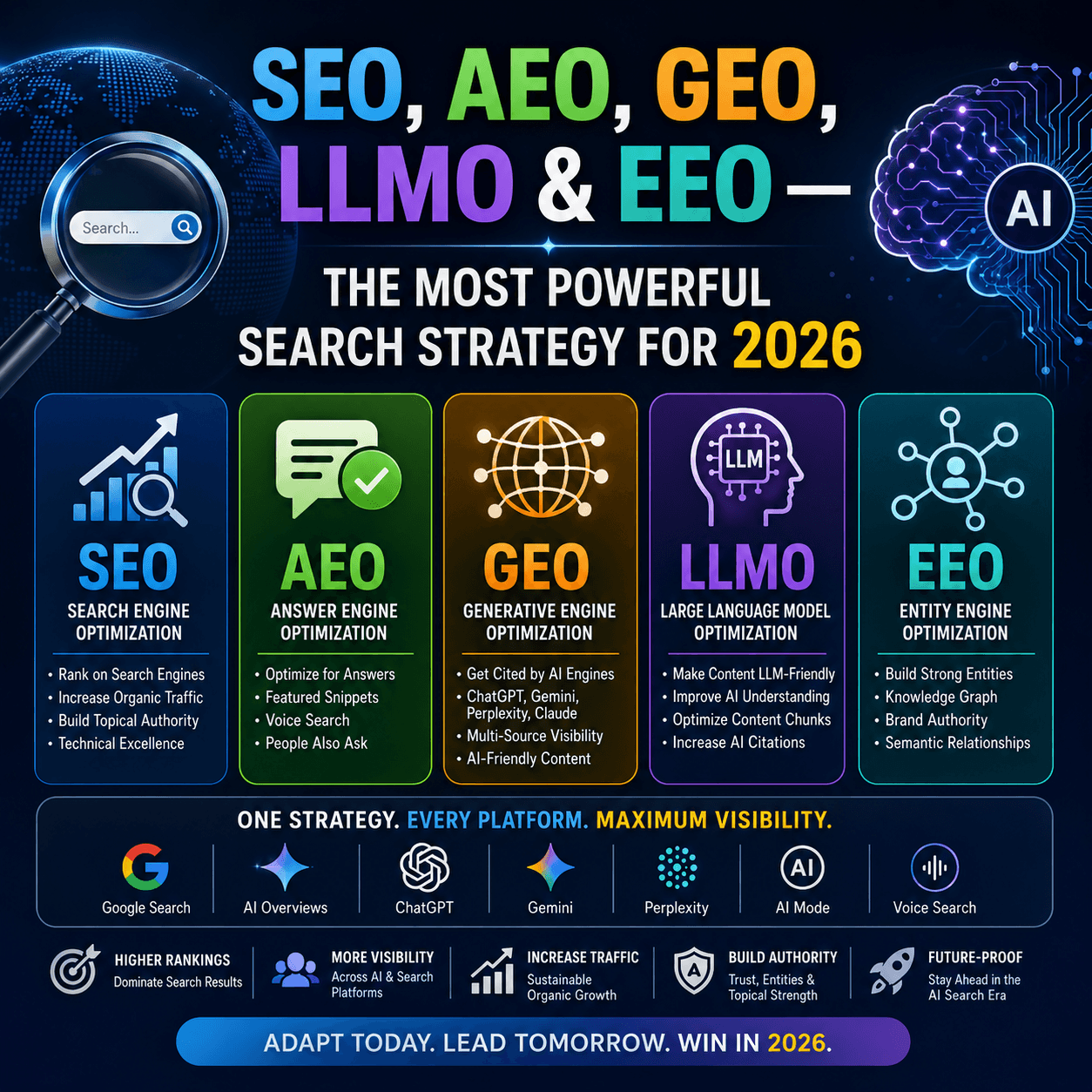
SEO, AEO, GEO, LLMO & EEO — The Most Powerful Search Strategy for 2026
The Search Landscape Has Fundamentally Changed
Not long ago, SEO meant one thing: rank on Google's first page and watch the traffic roll in. Ten blue links, a featured snippet here and there, and you were set. That era is over.
In 2026, the search experience is fragmented across dozens of AI-powered surfaces. Google AI Overviews now appear at the top of roughly 60% of informational queries, often answering the question before users even see organic results. ChatGPT processes over 100 million search-style queries per day. Perplexity has grown its user base by more than 400% year-over-year. Gemini is deeply embedded in Google Workspace and Android. Voice assistants handle hundreds of millions of conversational queries that never touch a traditional SERP at all.
The consequence? Zero-click searches now account for approximately 65% of all Google searches (SparkToro, 2025). Users get their answer, close the tab, and move on — never visiting your website. If you're only optimizing for blue-link rankings, you're optimizing for a shrinking share of a transformed market.
But here's the opportunity nobody is fully capitalizing on yet: the brands that show up inside AI-generated answers — as citations, as trusted entities, as authoritative voices — are capturing something far more valuable than a click. They're building top-of-mind authority at the exact moment a user is making a decision.
That's why the most forward-thinking SEO professionals, digital marketers, and brand strategists in 2026 are no longer talking about a single optimization discipline. They're talking about a unified five-layer framework: SEO + AEO + GEO + LLMO + EEO.
SEO (Search Engine Optimization) — Organic Google visibility
AEO (Answer Engine Optimization) — Featured snippets, AI Overviews, voice answers
GEO (Generative Engine Optimization) — Citations in ChatGPT, Gemini, Claude, Perplexity
LLMO (Large Language Model Optimization) — How AI systems understand and retrieve your content
EEO (Entity Engine Optimization) — Knowledge graph authority and semantic brand identity
This article walks you through each layer, how they interact, and how to build a complete 2026 AI search strategy that works across every platform where your audience might find an answer.
Section 1: What Is Traditional SEO in 2026?
SEO isn't dead. It's evolved — dramatically.
The keyword-stuffing era gave way to semantic SEO. PageRank gave way to helpful-content signals. And "rank for keywords" has been replaced by a richer goal: build topical authority and satisfy search intent at every stage of the funnel.
How SEO Has Evolved
Old SEO (Pre-2022) | SEO in 2026 |
|---|---|
Keyword density targeting | Semantic intent coverage |
Backlink quantity focus | E-E-A-T and authority signals |
Individual page optimization | Topic cluster architecture |
Desktop-first indexing | Mobile + AI-first indexing |
Meta keyword tags | Structured data & schema markup |
Thin, keyword-rich pages | Deep, expert-authored content |
Exact-match anchor text | Natural language linking signals |
Page speed as optional | Core Web Vitals as ranking factor |
Core Pillars of SEO in 2026
1. Semantic SEO and Topic Clusters Google no longer ranks pages in isolation. It evaluates your entire site's topical depth. A single blog post about "email marketing" won't rank well unless your site demonstrates comprehensive expertise across the email marketing domain — from subject line optimization to deliverability, segmentation, and automation.
Topic clusters — a pillar page supported by dozens of related subtopic posts — remain the strongest architecture for both ranking and AI citation.
2. E-E-A-T: Experience, Expertise, Authoritativeness, Trustworthiness Google's quality rater guidelines make E-E-A-T the foundation of ranking in competitive niches. In 2026, this means:
Named, credentialed authors with verifiable online presence
First-person experience signals ("We tested this," "Our client saw...")
Cited sources and transparent methodology
Clear author bios linked to professional profiles
3. Technical SEO Fundamentals Core Web Vitals, mobile responsiveness, crawlability, and HTTPS remain non-negotiable. Add to that: AI-accessible content structure (more on this in LLMO), proper canonicalization, and fast server response times.
4. The Helpful Content System Google's Helpful Content System penalizes content created primarily for search engines rather than people. In 2026, that signal has become more sophisticated. Google can now detect:
Content that summarizes other content without adding original value
Pages that answer a query but never go beyond surface-level coverage
Thin "me too" articles that mirror competitors without perspective
The bar for "helpful" has risen sharply.
2026 SEO Quick Checklist
✅ Pillar pages + topic cluster architecture
✅ Named expert authors with E-E-A-T signals
✅ Structured data / schema markup implemented
✅ Core Web Vitals passing on mobile
✅ Internal linking strategy mapped to topic clusters
✅ Original research, data, or first-person experience included
✅ Search intent (informational, commercial, navigational) matched per page
✅ Entity mentions consistent across all pages
Mini Summary: SEO in 2026 is about demonstrating deep topical authority, satisfying nuanced search intent, and meeting Google's quality standards at a structural level. It's the foundation everything else is built on.
Section 2: What Is AEO (Answer Engine Optimization)?
Answer Engine Optimization is the practice of structuring your content so that AI systems and search engines can extract, present, and deliver your answers directly to users — often without requiring a click.
AEO targets:
Google AI Overviews
Featured Snippets (Position Zero)
People Also Ask boxes
Voice search responses (Google Assistant, Siri, Alexa)
Conversational query results
Why AEO Matters More Than Ever
When Google introduced AI Overviews at scale in 2024, the rules changed. Instead of sending users to your page, Google now synthesizes an answer from multiple sources and presents it at the top of the SERP. The websites that get cited inside the AI Overview receive a new kind of visibility — one that builds brand trust even without a click.
The same dynamic applies to voice search. When someone asks Alexa "What's the best CRM for small businesses?", the assistant reads one answer aloud. Whoever's content gets pulled wins 100% of that moment.
Traditional SEO | AEO |
|---|---|
Optimize for ranking position | Optimize to become the answer |
10 blue links compete | One answer is selected |
Click-through rate dependent | Zero-click visibility |
Long-form content wins | Concise, extractable answers win |
Keyword targeting | Question + answer formatting |
Page authority signals | Clarity, structure, and directness |
How AI Systems Extract Answers
AI systems and Google's featured snippet algorithms look for:
A clear question stated in the heading (H2 or H3)
A direct, concise answer in the first 40–60 words following the heading
Supporting context that reinforces the answer with examples, steps, or data
Structured formats — numbered lists, bullet points, and tables are extracted more reliably than dense paragraphs
AEO Best Practices
FAQ Sections: Add a dedicated FAQ section to every key page. Format each question as an H3, followed by a 2–3 sentence answer that stands alone. Use FAQ schema markup.
Inverted Pyramid Writing: Lead with the answer, then provide context. Don't bury the key point in paragraph three.
Schema Markup: Implement FAQPage, HowTo, Article, Product, and Organization schema. These structured signals help both Google and AI systems understand your content's purpose.
Conversational Query Mapping: Identify question-based queries (who, what, why, how, when, where) and create dedicated sections or pages that answer each one directly.
Common AEO Mistakes
Writing answers that require surrounding context to make sense
Using jargon that voice assistants can't read naturally
Burying answers deep in long paragraphs
Missing schema markup entirely
Not targeting "People Also Ask" questions with dedicated content
Mini Summary: AEO is about being chosen as the answer. Structure your content so AI systems can extract it cleanly, deliver it directly, and attribute it to your brand.
Section 3: What Is GEO (Generative Engine Optimization)?
Generative Engine Optimization is the discipline of optimizing your content to be cited, referenced, and recommended by generative AI platforms — including ChatGPT, Google Gemini, Claude, and Perplexity.
When a user asks ChatGPT "What's the best project management tool for remote teams?" — the response isn't based on a search ranking. It's based on what the model has learned from web data, combined (in search-enabled modes) with real-time retrieval. Your goal is to be the source those systems choose to reference.
Why GEO Is a Distinct Discipline
Traditional SEO optimizes for Google's ranking algorithm. GEO optimizes for AI citation probability — a very different signal set.
SEO | GEO |
|---|---|
Rank in Google SERPs | Appear in AI-generated responses |
PageRank and authority signals | Citation-worthiness and clarity |
Keyword matching | Semantic relevance to query intent |
Backlink volume | Multi-platform brand mentions |
Page-level optimization | Entity-level authority |
Traffic from clicks | Influence without clicks |
Why AI Tools Choose Certain Websites
Generative AI platforms — especially when using retrieval-augmented generation (RAG) systems — select sources based on several factors:
Authority and trust signals: Is this domain recognized as an expert source in this topic?
Content clarity: Is the information clearly structured and unambiguous?
Factual density: Does the content contain specific, verifiable claims?
Entity consistency: Does the brand appear reliably across Wikipedia, social profiles, directories, and citations?
Freshness: For retrieval-enabled AI, recently updated content ranks higher for time-sensitive queries.
GEO Optimization Checklist
✅ Publish original research, surveys, and data your industry will cite
✅ Build topical authority across a clear content niche
✅ Ensure your brand entity is consistent across all platforms (more in EEO)
✅ Get cited by authoritative domains (journalists, academia, industry publications)
✅ Create content that AI systems can quote cleanly (specific stats, clear definitions)
✅ Build a Wikipedia presence or contribute to Wikidata
✅ Maintain up-to-date content — especially for fast-moving topics
✅ Use clear, unambiguous brand and author names across all platforms
AI Visibility Framework
[Visual Suggestion: A diagram showing a content piece at the center, with arrows pointing to five AI platforms — ChatGPT, Gemini, Perplexity, Claude, and Google AI Overviews — illustrating multi-platform citation flow]
The goal is to create content so authoritative, so clearly structured, and so consistently referenced that AI systems consider it a default source for your topic area. Think of it as becoming the Wikipedia of your niche — the trusted reference point AI tools naturally turn to.
Mini Summary: GEO is about earning AI citations. It requires deep topical authority, brand entity consistency, original data, and AI-friendly content architecture. It's SEO for the generative web.
Section 4: What Is LLMO (Large Language Model Optimization)?
Large Language Model Optimization is the practice of structuring your content so that LLMs — the AI systems powering ChatGPT, Gemini, Claude, and others — can effectively parse, understand, index, and retrieve it.
Where GEO focuses on getting cited, LLMO focuses on being understood. It's the content engineering layer that makes everything else work.
How LLMs Consume Web Content
LLMs don't read web pages the way humans do. They process text in chunks — segments of content that are embedded as vectors and stored in retrieval systems. When a query arrives, the system retrieves the most semantically relevant chunks and synthesizes a response.
This has profound implications for how you should write.
Chunk-Based Content Optimization
A "chunk" is typically 200–500 words of semantically coherent content. If your key insight is buried in a 2,000-word monolith without clear section breaks, the AI system may never extract it reliably.
Best practices for chunk-optimized content:
Use clear H2 and H3 headings that describe the section's topic
Keep each section self-contained — it should make sense even without the surrounding context
State the key point in the first 1–2 sentences of each section
Avoid ambiguous pronouns across long passages ("it," "they," "this")
Define acronyms and technical terms inline, every time they appear in a new section
Bad LLMO Practice | Good LLMO Practice |
|---|---|
3,000-word wall of text | Clearly headed sections of 300–500 words |
Answer buried in paragraph 8 | Key answer in first 2 sentences |
Ambiguous pronoun references | Explicit noun repetition for clarity |
Jargon without definition | Inline definitions for every technical term |
Dense academic prose | Natural language, active voice |
Generic section titles ("Overview") | Descriptive titles ("How LLMs Index Content") |
No structure signals | Bold key terms, numbered steps, tables |
Semantic Context and NLP-Friendly Writing
LLMs understand meaning through semantic relationships. Your content should:
Use natural language variations of key concepts (synonyms, related terms)
Explicitly connect concepts ("This is important because...", "The relationship between X and Y is...")
Include examples that reinforce abstract points
Write the way a knowledgeable human would explain something to a smart non-expert
AI-Readable Content Architecture
[Visual Suggestion: A content architecture diagram showing pillar page → cluster posts → FAQ pages → schema markup layer, illustrating how AI systems navigate and retrieve content]
Think of your content architecture as a knowledge graph your audience can walk through. Every page should link to related concepts. Every term should be defined somewhere on your site. The AI system that crawls your domain should emerge with a coherent, interconnected map of your expertise.
AI Citation Formatting
When other AI systems quote your content, they pull the cleanest, most quotable phrases. Write for quotability:
Create "quotable sentences" that contain a complete insight in 15–25 words
Use present tense for timeless statements ("The most effective approach is...")
Avoid hedging language that weakens citation value ("It might potentially be possible that...")
Mini Summary: LLMO is the engineering layer of AI search optimization. It ensures that when AI systems encounter your content, they understand it, can extract it cleanly, and can represent it accurately in generated responses.
Section 5: What Is EEO (Entity Engine Optimization)?
Entity Engine Optimization is the practice of ensuring that your brand, your authors, your products, and your content are recognized as coherent, trustworthy entities within Google's Knowledge Graph and the semantic web.
An entity is anything the web can uniquely identify: a person, a company, a product, a concept, a place. Google's understanding of search has shifted from "matching keywords" to "connecting entities." In 2026, if Google doesn't know what entity you are, you're invisible to its most powerful ranking systems.
How Google Understands Entities
Google's Knowledge Graph contains hundreds of billions of entity relationships. When you search "Apple," Google knows you likely mean the tech company, not the fruit — because it understands the entity Apple Inc., its products, its CEO, its history, and its relationships to thousands of other entities.
For your brand to benefit from this system, Google must be able to:
Identify your brand as a unique entity (not confuse it with similarly named companies)
Understand your topical domain (what subject areas does your brand have authority in?)
Verify your entity across multiple sources (your website, social profiles, directories, Wikipedia, press mentions)
Associate you with trusted entities (other known experts, publications, and organizations in your niche)
Keyword SEO | Entity SEO |
|---|---|
Optimize for search terms | Optimize for recognized entities |
Rank for "best CRM software" | Be the entity associated with CRM expertise |
Meta keywords and tags | Knowledge Graph, schema, Wikipedia |
Link building for PageRank | Co-citation and entity association |
Author as content producer | Author as verified, credentialed entity |
Brand name in content | Brand entity consistently structured across web |
Building Your Brand Entity
Consistency is everything. Your brand name, logo, address, and description should be identical across:
Your website's About page and schema markup
Google Business Profile
LinkedIn, Twitter/X, Facebook, Instagram
Industry directories and review platforms
Wikipedia (if applicable) or Wikidata
Press mentions and bylines
Author authority is entity authority. Google attributes E-E-A-T signals to specific named authors, not just domains. Every author on your site should have:
A complete bio page with credentials and experience
A consistent name used across all publications
A link to their LinkedIn or professional portfolio
Ideally, a Google author profile (via Google Search Console)
Entity Optimization Checklist
✅ Organization schema implemented on homepage
✅ Person schema on all author bios
✅ NAP (Name, Address, Phone) consistent across all directories
✅ Brand entity described consistently across all social profiles
✅ SameAs schema markup linking to authoritative external profiles
✅ Topical authority clearly communicated in About page
✅ Author credentials verifiable via third-party sources
✅ Wikipedia presence or Wikidata entity entry (for established brands)
[Visual Suggestion: An entity relationship diagram showing a brand entity at the center, with nodes connecting to authors, products, topics, and external authority sources]
Mini Summary: EEO is about becoming a known, trusted entity in Google's semantic model of the web. Brands that nail entity optimization become default reference points for their topic area — in Google, in AI systems, and across the entire search ecosystem.
Section 6: Why SEO + AEO + GEO + LLMO + EEO Is the Ultimate Strategy
Each of these five disciplines addresses a different layer of modern search visibility. None is sufficient alone.
A site with perfect SEO but no AEO will miss zero-click visibility. A brand with great GEO optimization but poor LLMO will be misrepresented by AI systems. A company investing in content but ignoring EEO will struggle to be recognized as an authoritative entity.
The most powerful brands in 2026 integrate all five layers into a single unified strategy.
The Five-Layer Search Dominance Framework
Layer | Focus | Platform Impact |
|---|---|---|
SEO | Organic rankings | Google, Bing, DuckDuckGo |
AEO | Answer extraction | Google AI Overviews, voice search, featured snippets |
GEO | AI citations | ChatGPT, Gemini, Claude, Perplexity |
LLMO | LLM comprehension | All AI platforms using retrieval systems |
EEO | Entity authority | Knowledge Graph, semantic search, all AI systems |
[Visual Suggestion: A layered pyramid infographic with SEO at the base and EEO at the top, showing how each layer builds on the previous one]
Multi-Platform Visibility in Practice
Consider a B2B SaaS company targeting the query "best project management tools for remote teams." With a full five-layer strategy:
SEO puts their comparison page on page one of Google
AEO gets their succinct recommendation pulled into a featured snippet
GEO ensures ChatGPT and Perplexity cite their content when answering the same question
LLMO means their content is parsed accurately and not misrepresented in AI summaries
EEO means Google's Knowledge Graph associates their brand with "project management" as a topical domain
The result? Brand presence across every touchpoint where their audience asks this question — search, voice, AI chat, and beyond.
Why Single-Channel SEO Is Risky
In 2024 and 2025, many sites saw 30–50% organic traffic drops from Google algorithm updates and the expansion of AI Overviews. Brands that had diversified into AI citation visibility experienced far less impact — because their traffic and visibility extended beyond the traditional SERP.
The risk of single-channel dependency in 2026 is not hypothetical. It's documented. Diversification across the five layers is the hedge.
Section 7: The Complete 2026 Optimization Framework (Step-by-Step)
Here is the full workflow for implementing a five-layer search strategy from scratch.
Step 1 — Keyword + Intent Research
Start with intent, not keywords. For every topic you target, identify:
Informational queries (How does X work?)
Commercial queries (Best X for Y)
Navigational queries (Brand name searches)
Conversational queries (What would you recommend for X situation?)
Map each intent type to a content format: blog posts, landing pages, comparison pages, FAQ sections.
Tools: Semrush, Ahrefs, Google Search Console, AlsoAsked.com, AnswerThePublic
Step 2 — Entity Mapping
Before writing a word, map your brand's entity relationships:
What topics does your brand own?
Who are your key authors and what are their credentials?
What related entities (tools, companies, concepts) should your content associate with?
Build an entity map that guides your internal linking, schema markup, and content architecture.
Step 3 — AI-Friendly Content Structure
Write every piece of content with LLMO in mind:
Clear H2/H3 headings that describe each section
Self-contained chunks of 300–500 words
Key answer in the first 1–2 sentences of each section
Tables, numbered lists, and FAQs wherever they add clarity
Step 4 — Schema & Structured Data
Implement schema markup across your site:
Organizationon homepagePersonon author pagesArticleorBlogPostingon content pagesFAQPageon FAQ sectionsHowToon tutorial contentProductandReviewon product pagesBreadcrumbListon all pages
Tools: Google's Structured Data Markup Helper, Schema.org, Rank Math / Yoast SEO
Step 5 — Topic Clusters
Build your content architecture around 3–7 core pillar topics. Each pillar should have:
One comprehensive pillar page (3,000–5,000 words)
10–20 supporting cluster posts covering subtopics
Internal links flowing from clusters to pillar and back
Step 6 — AI Citation Optimization
Create content designed to be cited by AI systems:
Original research and surveys with specific statistics
Definitive "ultimate guides" that go deeper than any competitor
Clear, quotable definitions of industry terms
Expert opinion pieces that take a distinct position
The goal is to become the reference source AI systems naturally draw from.
Step 7 — Brand Authority Building
Build off-site authority through:
PR campaigns targeting high-authority publications
Podcast appearances that mention your brand in published transcripts
Industry association memberships and directory listings
Speaking engagements with published writeups
Each mention is an entity signal that reinforces your brand's topical authority.
Step 8 — Conversational Search Optimization
Voice and conversational queries are phrased differently than typed queries. Optimize specifically for:
Long-tail question phrases ("What's the best way to...")
Local intent queries ("Near me," city-specific)
Comparative queries ("X vs Y")
"How to" and instructional queries
Create dedicated content or sections targeting these formats.
Step 9 — Internal Linking Strategy
Internal linking is both an SEO signal and an LLMO signal. A well-linked site helps AI systems understand the relationships between your content pieces.
Rules:
Link from high-authority pages to newer, lower-authority pages
Use descriptive anchor text that reflects the target page's topic
Map your links to your entity and topic cluster architecture
Audit quarterly to remove broken links and add new contextual links
Step 10 — Continuous Content Expansion
The 2026 search landscape rewards content depth and freshness. Build a system for:
Quarterly refreshes of top-performing pages
Monthly new content targeting emerging queries
Rapid-response content for industry news and data releases
Annual comprehensive updates to pillar pages
Publishing Frequency Suggestion:
2–4 new cluster posts per month
1 major pillar page refresh per quarter
1 original research piece per quarter
Weekly social amplification of top content
Section 8: Freelancer vs Agency vs AI-Augmented Team
Which operating model is right for your 2026 search strategy?
Feature | Freelancer | Agency | AI-Augmented Team |
|---|---|---|---|
Cost | Low | High | Medium |
Speed | Variable | Moderate | High |
Scalability | Limited | High | Very High |
AI Adoption | Variable | Moderate | Native |
GEO Readiness | Low–Medium | Moderate | High |
AEO Implementation | Basic | Standard | Advanced |
Technical SEO | Variable | Strong | Strong |
Content Volume | Low | High | Very High |
Reporting Quality | Basic | Advanced | AI-Enhanced |
Entity Optimization | Rare | Emerging | Standard |
Recommendations
Best for Startups: An AI-augmented in-house team of 1–2 people using AI writing tools (Claude, ChatGPT), SEO platforms (Semrush, Ahrefs), and automation for schema markup and internal linking. Low cost, high adaptability.
Best for Enterprises: A hybrid model — in-house content strategy team + specialist agency for technical SEO + freelance subject-matter experts for E-E-A-T content signals.
Best Hybrid Model: Retain a boutique agency for strategy, technical audit, and GEO/EEO implementation. Use AI-assisted tools for content at scale. Hire credentialed freelance writers for E-E-A-T-heavy niches (health, finance, legal).
Section 9: Common Mistakes in AI SEO (2026)
The market is flooded with content teams that think they're doing AI SEO but are making fundamental errors. Here are the most damaging — and how to fix them.
1. Publishing Generic AI-Generated Content at Scale Using LLMs to produce hundreds of surface-level posts might generate temporary traffic but fails Google's Helpful Content System and gets ignored by AI citation systems. Fix: use AI for research and drafting, but add original insights, data, and expert perspective before publishing.
2. Ignoring Entity Consistency Your brand name, author names, and descriptions vary across platforms. Google can't consolidate the signals. Fix: audit every profile, directory, and mention. Standardize everything.
3. Weak Author Profiles Anonymous content or thin author bios destroy E-E-A-T signals. Fix: invest in author bio pages with credentials, photos, professional links, and publishing history.
4. Poor Topical Depth Publishing one shallow post on a topic and moving on. AI systems recognize topical authority — and the lack of it. Fix: build full topic clusters before targeting competitive terms.
5. Over-Optimization Stuffing keywords or over-engineering content for snippets at the expense of natural readability. Fix: write for humans first, then optimize structure. Google's language understanding is sophisticated enough to detect manipulation.
6. No Schema Markup Leaving structured data completely unimplemented. Fix: start with Organization and Article schema — these are foundational and take under an hour to set up.
7. Thin Content on Key Pages Product pages, service pages, and landing pages with 200–300 words. These can't compete for AI citation or featured snippet extraction. Fix: expand key pages to 800–1,500 words with FAQs, use cases, and supporting detail.
8. No AI Visibility Strategy Assuming Google SEO is enough. Fix: build a GEO and LLMO strategy alongside traditional SEO. Track your brand mentions in AI tools using prompts like "What's the best [your category] tool?"
9. Lack of Trust Signals No About page, no real team information, no privacy policy, no transparent business information. In 2026, trust signals matter both for Google and for AI systems that evaluate source credibility. Fix: invest in your brand's web presence as seriously as your content.
Case Study: How a B2B SaaS Brand Achieved 3x AI Visibility in 12 Months
Background: A mid-sized project management SaaS company (~$20M ARR) saw organic traffic decline 28% after Google's March 2025 core update. AI Overviews had absorbed a significant portion of their informational traffic.
Strategy Applied:
Rebuilt their blog around five core topic clusters with proper pillar pages
Added named expert authors with full bios to every article
Implemented complete schema markup across the site
Created an annual "State of Remote Work" survey with original data
Built Wikidata and Freebase entity entries for the brand
Optimized all FAQ sections with FAQPage schema
Ran a PR campaign that generated citations in TechCrunch, Forbes, and ProductHunt
Results (12-month comparison):
Metric | Before | After |
|---|---|---|
Organic traffic | 85,000/month | 72,000/month |
AI Overview citations | 0 | 47 tracked keywords |
ChatGPT mentions (sampled) | Rarely cited | Cited in ~30% of category queries |
Perplexity citations | 2 | 38 |
Total search visibility | Declining | Up 41% |
The lesson: they lost some click-based traffic that AI Overviews absorbed — but their total presence in search experiences grew substantially. Brand recognition, inbound leads, and trial signups all increased because users encountered their brand as an authoritative source at multiple AI touchpoints.
Section 10: The Future of Search Beyond 2026
We're in an inflection point, not an endpoint. Here's where search is heading — and what it means for your strategy today.
AI Agents and Agentic Search The next evolution is AI agents that don't just answer questions but take actions — booking appointments, comparing products, filling forms — all within the AI interface. Brands visible in AI systems today will be the default choices for agentic execution tomorrow.
Personalized Search Ecosystems AI platforms are building memory and personalization layers. Search results will increasingly be customized based on individual history, preferences, and context. Brands that build deep topical associations now will benefit as personalization amplifies existing authority signals.
Conversational Commerce Voice and chat interfaces are collapsing the distance between discovery and purchase. The answer engine that recommends your product becomes a sales channel. AEO and GEO are becoming e-commerce strategies, not just content strategies.
Search Without Clicks The "zero-click" phenomenon will deepen. Users will increasingly satisfy intent entirely within AI interfaces. Brand visibility in AI responses becomes the new top-of-funnel metric — replacing impressions and clicks.
AI Assistants Replacing Browsers As AI assistants become the default gateway to information (replacing the browser search bar for many users), the platforms that matter will multiply. Every AI assistant is a new search engine, and each one has different source-selection criteria.
Predictive Search Systems like Google's "Search Generative Experience" features are experimenting with proactive search — surfacing relevant information before users ask. Brands deeply embedded in knowledge graphs will benefit disproportionately from predictive exposure.
[Visual Suggestion: A search evolution timeline from 1998 to 2028, showing progression from keyword search → semantic search → AI Overviews → agentic AI search]
FAQs
1. What is GEO in SEO? GEO (Generative Engine Optimization) is the practice of optimizing content to be cited and referenced by generative AI platforms like ChatGPT, Google Gemini, Claude, and Perplexity. It focuses on building the authority, clarity, and entity consistency signals that AI systems use to select sources.
2. What is the difference between SEO and AEO? SEO optimizes for ranking in traditional search results — getting users to click your link. AEO (Answer Engine Optimization) optimizes to become the direct answer extracted by AI systems and voice assistants, often without requiring any click.
3. How does ChatGPT choose which websites to cite? ChatGPT with browsing uses retrieval-augmented generation (RAG) to select sources based on topical authority, content clarity, freshness, and domain trust signals. Sites with structured, expert-level, consistently updated content are cited more frequently.
4. What is LLMO? LLMO (Large Language Model Optimization) is the practice of structuring content so that large language models can accurately parse, retrieve, and represent it. It focuses on chunk-based content structure, semantic clarity, and AI-readable formatting.
5. Is traditional SEO dead in 2026? No. SEO remains the foundation of organic Google visibility. However, relying on SEO alone is increasingly risky as AI systems absorb traffic from informational queries. A combined SEO + AEO + GEO + LLMO + EEO strategy is necessary for comprehensive search visibility.
6. How do I rank in Google AI Overviews? Optimize for AEO: use clear question-based headings, provide direct concise answers in the first 1–2 sentences of each section, implement FAQ schema, build E-E-A-T signals, and establish topical authority through comprehensive topic clusters.
7. What is Entity SEO (EEO)? EEO (Entity Engine Optimization) involves making your brand, authors, and products recognizable as trusted entities in Google's Knowledge Graph and the broader semantic web. It requires consistent brand signals across all platforms, schema markup, and topical authority.
8. What is AI-first SEO? AI-first SEO is an approach to content creation and optimization that prioritizes visibility across AI-powered search experiences — including AI Overviews, generative AI platforms, and voice search — in addition to traditional Google rankings.
9. How can websites appear in ChatGPT answers? Build topical authority in a specific niche, earn citations from high-authority domains, publish original research, maintain consistent entity signals across the web, and structure content so AI retrieval systems can parse it cleanly.
10. What is semantic SEO? Semantic SEO focuses on optimizing for meaning and intent rather than individual keywords. It involves topic cluster architecture, natural language writing, entity relationships, and content that comprehensively covers a subject domain.
11. What is topical authority? Topical authority is the degree to which Google and AI systems recognize your website as a comprehensive, trustworthy resource for a specific subject area. It's built through deep topic cluster coverage, consistent publishing, E-E-A-T signals, and inbound citations.
12. Does schema markup help with AI visibility? Yes. Schema markup provides structured data signals that both Google and AI retrieval systems use to understand your content's type, purpose, and context. FAQPage, Article, Organization, and Person schema are particularly impactful.
13. How important is E-E-A-T in 2026? Extremely important. E-E-A-T (Experience, Expertise, Authoritativeness, Trustworthiness) is baked into Google's quality evaluation systems and influences both ranking and AI citation selection. Named expert authors with verifiable credentials are now a competitive advantage.
14. What tools are best for AI SEO in 2026? Semrush and Ahrefs for SEO and keyword research; AlsoAsked and AnswerThePublic for conversational query mapping; Google Search Console for performance data; Schema.org and Rank Math for structured data; Brandwatch or Mention for brand entity monitoring; custom ChatGPT/Perplexity prompts for AI citation auditing.
15. How do I measure success in a five-layer SEO strategy? Track organic traffic and rankings (SEO), featured snippet wins (AEO), AI citation frequency across platforms (GEO), content clarity scores (LLMO), and entity consistency scores (EEO). Combine these into a single dashboard that reflects total search ecosystem presence — not just Google click volume.
Conclusion: Adapt Now or Get Left Behind
The search landscape of 2026 is not something that's coming — it's already here. AI Overviews dominate Google's first screen. ChatGPT and Perplexity handle hundreds of millions of queries. Voice assistants are answering questions your customers used to Google. If your strategy is still "publish posts and rank on page one," you're already behind.
The brands winning in 2026 are those that have understood the shift from ranking pages to becoming the answer — across every platform where their audience is asking questions.
The five-layer framework — SEO + AEO + GEO + LLMO + EEO — isn't five separate strategies. It's one integrated strategy with five dimensions. Each layer amplifies the others. Strong entity optimization (EEO) makes your GEO more effective. Clean LLMO architecture makes your AEO answers more extractable. Deep SEO authority creates the foundation that every other layer stands on.
Your next steps:
Audit your current state — Where do you appear today across Google, AI Overviews, ChatGPT, and Perplexity?
Build your entity foundation — Standardize your brand and author entities across every platform.
Restructure your content — Implement topic clusters, schema markup, and LLMO-friendly formatting.
Create citation-worthy content — Original research, definitive guides, and expert perspectives.
Monitor AI visibility — Track your brand's presence in AI-generated responses, not just Google rankings.
The organizations that move first will compound their advantage. Every original data piece published today becomes a future AI citation. Every entity signal established now becomes a future ranking signal. Every AEO-optimized FAQ captures a voice search query someone will ask tomorrow.
The integrated five-layer strategy isn't just the most powerful search strategy for 2026. It's the architecture of search dominance for the decade ahead. Build it now, while the advantage is still available.
Last updated: 2026 | Reading time: approximately 20 minutes | Expertise level: Intermediate to Advanced
Related Reads for You
Discover more articles that align with your interests and keep exploring.