SEO Has Fundamentally Changed — Has Your Infrastructure?
Not long ago, ranking on Google meant mastering title tags, backlinks, and keyword density. That playbook still matters, but it's no longer the whole game.
In 2026, the search landscape is split across multiple AI-powered surfaces: Google AI Overviews, Google AI Mode, ChatGPT search, Gemini, Perplexity, Claude, and a growing constellation of agentic browsers that retrieve, summarize, and recommend content autonomously. These systems don't just crawl your pages — they understand them, extract structured meaning, and decide whether your content is worth citing.
The uncomfortable truth for many businesses: their CMS infrastructure was built for a world that no longer exists.
Traditional content management systems — monolithic, tightly coupled, JavaScript-heavy — were engineered to serve web browsers. But AI search engines aren't browsers. They're semantic retrieval systems. They favor content that is clean, structured, fast, and machine-readable at the architectural level.
This is exactly where headless CMS earns its place as the defining infrastructure choice of the AI era.
This guide breaks down every meaningful benefit of adopting a headless CMS for AI-optimized websites in 2026 — from Core Web Vitals to Generative Engine Optimization (GEO), from schema markup to vector search readiness. Whether you're a SaaS founder, enterprise CTO, agency director, or SEO professional, this is the architecture briefing you need.
What Is a Headless CMS?
A headless CMS is a content management system that stores and manages content independently of how that content is displayed. Unlike traditional CMS platforms (WordPress, Drupal, Joomla), which bundle content storage, backend logic, and frontend rendering into a single system, a headless CMS decouples the backend from the frontend entirely.
Content is delivered via APIs — typically REST or GraphQL — to any frontend: a React app, a Next.js site, a mobile app, a voice assistant, an IoT display, or an AI agent. The CMS has no "head" (no built-in frontend rendering layer). Hence: headless.
How It Works
Content authors create and manage content inside the headless CMS dashboard.
Developers consume that content through APIs and render it using the frontend framework of their choice.
Content is delivered to any channel — web, mobile, email, voice, AR — from a single structured source of truth.
Traditional CMS vs. Headless CMS
Feature | Traditional CMS | Headless CMS |
|---|---|---|
Frontend / Backend | Tightly coupled | Fully decoupled |
Content Delivery | Page rendering | API-first |
Frontend Choice | Limited (themes) | Any framework |
Performance | Server-rendered, often slow | Edge-ready, highly optimized |
Scalability | Vertical scaling | Horizontal / cloud-native |
AI Readiness | Low | High |
Schema Implementation | Complex / plugin-dependent | Native, flexible |
Omnichannel | Difficult | Built-in |
Developer Control | Constrained | Full |
Leading Headless CMS Platforms in 2026
Contentful, Sanity, Storyblok, Hygraph, Payload CMS, Strapi, Directus, and Prismic are the most widely adopted options — each covered in depth later in this article.
Why AI-Optimized Websites Need Better Architecture
AI search systems process content differently from traditional crawlers. Understanding how they work is essential to understanding why headless CMS architecture is such a natural fit.
How LLMs and AI Search Engines Process Your Website
Large language models and AI retrieval systems — the technology powering Google AI Overviews, ChatGPT search, and Perplexity — don't just read your text. They:
Chunk your content into semantic segments for retrieval
Extract entities (people, places, brands, concepts) and their relationships
Evaluate structural clarity — clean HTML beats messy, script-heavy markup
Assess page speed and reliability as signals of content quality
Cross-reference structured data (schema markup) to validate claims
Use Retrieval-Augmented Generation (RAG) to pull the most relevant, cleanly structured content into AI answers
Retrieval-Augmented Generation is particularly important. When an AI answers a question, it retrieves relevant content from the web and uses it to generate a response. Content that is well-structured, semantically clear, and delivered in clean HTML is dramatically more likely to be retrieved and cited.
The Problem with Traditional CMS Architecture in the AI Era
Platforms like WordPress and Drupal were designed to serve rendered HTML to browsers. That works, but comes with significant overhead:
Bloated page source filled with plugin scripts, tracking tags, and theme code
Inconsistent content structure that's hard for AI systems to parse
Slow page load times that signal lower quality to AI ranking systems
Poor semantic HTML hierarchy due to theme-driven template constraints
Schema markup gaps because structured data requires plugins that conflict with themes
Rendering dependencies on client-side JavaScript that AI crawlers handle inconsistently
These aren't just SEO problems. They're AI visibility problems. And in 2026, visibility in AI search is as commercially significant as Google page-one rankings.
Benefits of Headless CMS for AI-Optimized Websites
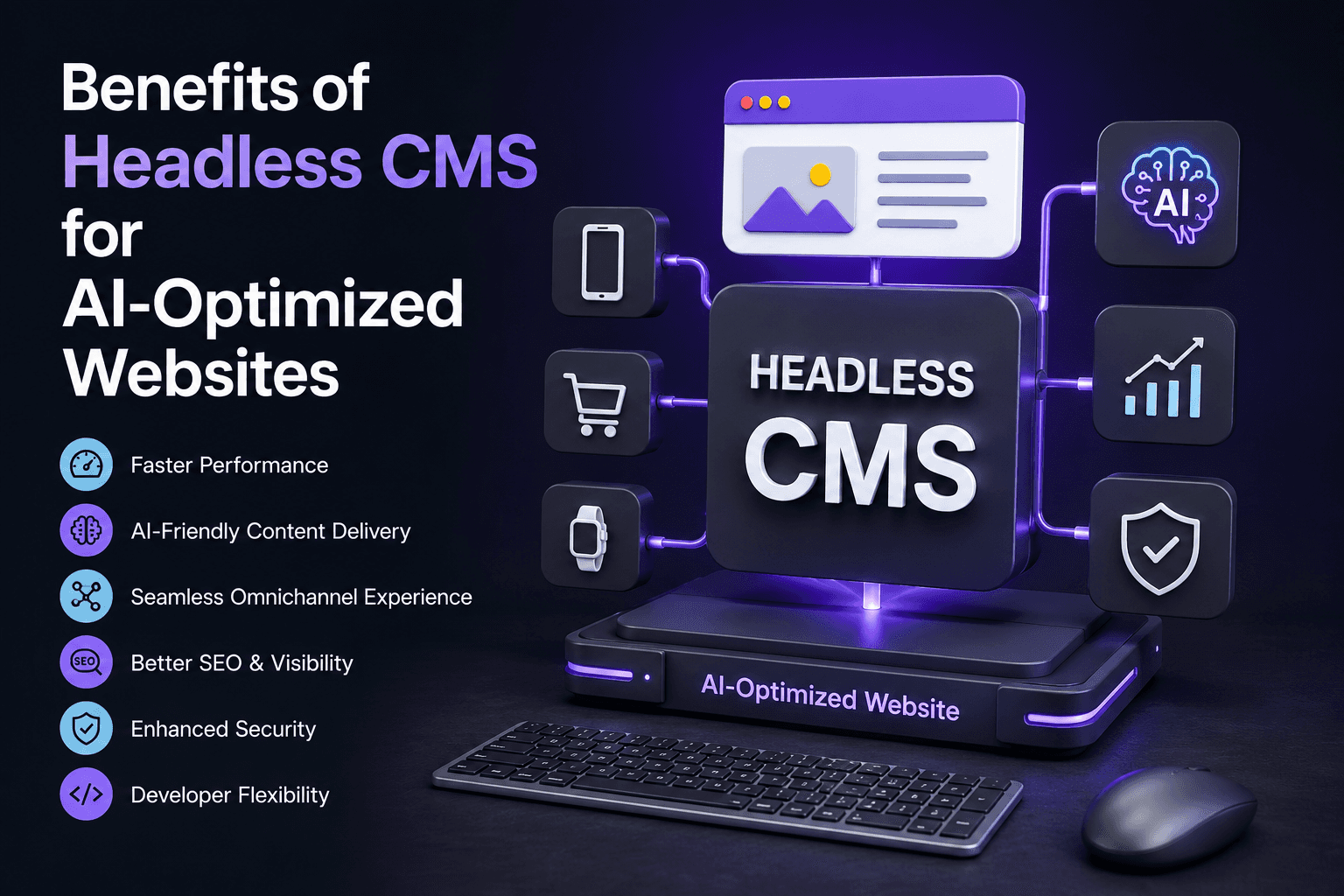
1. Faster Website Performance
Speed is the foundation of both SEO and AI visibility. Headless CMS sites, paired with modern frontend frameworks, consistently outperform traditional CMS deployments because:
Content is pre-rendered at build time (Static Site Generation) or at the edge
There's no theme engine or plugin stack slowing down server responses
Assets are served from CDNs with minimal latency
No unnecessary database queries on each page load
Brands like Netlify, Vercel, and Cloudflare Pages have made edge-deployed headless sites mainstream. A sub-second Time to First Byte (TTFB) is now achievable for most sites using this stack.
2. Better Core Web Vitals
Google's Core Web Vitals — Largest Contentful Paint (LCP), Interaction to Next Paint (INP), and Cumulative Layout Shift (CLS) — are direct ranking signals. Headless architectures improve all three:
LCP: Faster because pages are pre-rendered, images are optimized at build time, and no heavy PHP rendering pipeline exists.
INP: Improved because modern JS frameworks handle interactivity more efficiently than jQuery-era plugins.
CLS: Better because layout is controlled precisely by developers, without theme-imposed positioning conflicts.
3. Improved AI Crawlability
AI systems favor content that is clean, predictable, and structurally consistent. Headless CMS sites produce:
Semantic HTML output — developers control every tag
Consistent heading hierarchy (H1 → H2 → H3) across every page
Clean URL structures without query string pollution
Minimal JavaScript dependencies when using SSG or SSR
Fast loading that AI bots appreciate as a quality signal
4. Structured Content Delivery
Headless CMS platforms are built around content modeling — defining explicit fields, types, and relationships for every piece of content. A product page isn't just a blob of text; it's a structured document with defined fields for name, description, price, specifications, FAQs, and reviews.
This structured content is:
Easier for AI systems to parse and extract relevant answers from
More consistently rendered as semantic HTML
Naturally aligned with schema markup implementation
Portable across channels without restructuring
Content modeling is, in essence, creating machine-readable content at the source — before it ever reaches a crawler.
5. Better Semantic Architecture
Semantic SEO is about helping search engines understand meaning, not just keywords. Headless CMS enables:
Entity-rich content structures that explicitly connect related concepts
Internal linking systems that reinforce topical authority
Content taxonomy management that creates semantic clusters
Consistent relationship modeling between content types (e.g., author → article → topic)
AI systems trained on semantic web data are particularly responsive to well-organized entity relationships. A headless CMS is purpose-built to express these relationships.
6. Easier Schema Markup Implementation
Schema.org structured data is one of the most powerful tools for appearing in Google AI Overviews, rich results, and AI citations. With traditional CMS platforms, schema often relies on plugins that produce generic, incomplete markup.
With headless CMS:
Developers implement schema at the component level with precise control
Content fields map directly to schema properties (e.g.,
datePublished,author,faqPage)JSON-LD can be generated dynamically from content API responses
Schema completeness is enforceable at the content model level
This is a meaningful competitive advantage. Sites with complete, accurate structured data are cited more frequently in AI Overviews and featured snippets.
7. Omnichannel Publishing
A headless CMS publishes content to any channel from a single backend. In 2026, this means:
Web (desktop and mobile)
Native mobile apps
Voice assistants (Alexa, Google Assistant, Siri)
AI agents and chatbots
Digital signage and IoT displays
Smartwatch apps
Email newsletters
AR/VR experiences
Each channel gets the same structured, accurate content — eliminating the inconsistency and duplication that harms AI discoverability. When your website, app, and assistant all say the same thing with the same structure, AI systems assign higher entity confidence to your brand.
8. Scalable Content Management
Traditional CMS platforms hit performance walls as content volume grows. Headless CMS platforms scale horizontally — more content, more API requests, more traffic — without architectural overhaul. For enterprise brands managing thousands of pages, this is not optional infrastructure; it's business continuity.
9. Developer Flexibility and Frontend Freedom
Teams using headless CMS can build with Next.js, Nuxt, Astro, Remix, or any framework that optimizes for performance and SEO. This flexibility means developers can:
Implement custom rendering strategies (SSG, SSR, ISR) per content type
Use React Server Components for optimal performance
Build tailored URL structures and metadata systems
Integrate custom analytics, A/B testing, and personalization tools
10. Enhanced Security
Traditional CMS platforms are high-value attack targets. WordPress alone powers roughly 40% of the web and is the most exploited CMS in existence. Headless architectures dramatically reduce the attack surface:
The CMS backend is not publicly accessible
No PHP execution on the public web server
API tokens with scoped permissions replace broad database access
Frontend is static or edge-rendered, with no direct CMS connection at request time
11. Future-Proof Infrastructure
Headless CMS platforms are built for a world where content consumption patterns keep evolving. Today's AI agents, tomorrow's ambient interfaces — all can consume content from the same structured API. Businesses that adopt headless architecture now are not betting on one channel; they're building infrastructure that adapts to any channel.
12. Better AI Discoverability
AI discoverability — the likelihood your content gets retrieved and cited by AI systems — depends on:
Speed: Fast content is indexed and retrieved more reliably
Clarity: Clean HTML with consistent structure is easier for AI to parse
Structure: Defined content types produce predictable, machine-readable output
Accuracy: Consistent content across channels increases entity confidence
Schema: Structured data gives AI explicit signals about content type and meaning
Headless CMS architecture addresses every one of these factors systematically.
13. Better Multilingual SEO
International SEO is notoriously complex. Headless CMS platforms handle multilingual content at the content model level — managing translations as structured data, not page variants. This enables:
Consistent
hreflangimplementationLocale-specific metadata management
Translation API integrations (DeepL, Google Translate) at the content pipeline level
Clean URL localization without plugin conflicts
14. Programmatic SEO at Scale
Headless CMS is the ideal backbone for programmatic SEO — generating thousands of structured pages from data. Whether building location pages, product variants, comparison pages, or FAQ clusters, the headless approach offers:
Dynamic page generation from structured content types
Template-level schema markup applied consistently
API-driven metadata injection (title, description, canonical)
Easy integration with external data sources
15. Better Content Reuse and Efficiency
In headless CMS, content is created once and referenced everywhere. A product description written in the CMS appears on the website, the mobile app, the chatbot, and the API — without rewriting or copying. This eliminates content duplication (a known SEO risk) and ensures factual consistency across all surfaces AI systems index.
Headless CMS and Technical SEO in 2026
Dynamic Metadata Management
Every page on a headless site can have precisely controlled metadata — title tags, meta descriptions, Open Graph tags, Twitter Cards, and canonical URLs — generated directly from content API responses. No plugin dependency, no theme override, no inherited metadata from parent pages.
XML Sitemaps
Headless sites typically generate XML sitemaps programmatically at build time, ensuring 100% accuracy with zero manual maintenance. Every new piece of content is immediately included.
Canonical URL Strategy
Canonical tags can be enforced programmatically across all content types, eliminating duplicate content issues that plague plugin-heavy traditional CMS sites.
Internal Linking Architecture
Headless CMS platforms enable systematic internal linking through content relationships — related articles, topic clusters, and pillar page links defined at the content model level, not manually inserted by editors.
Server-Side Rendering and Static Generation
Headless sites can choose rendering strategy by content type:
Static Site Generation (SSG): Pre-rendered at build time. Fastest possible delivery. Best for content that doesn't change frequently.
Server-Side Rendering (SSR): Rendered on-demand. Better for personalized or real-time content.
Incremental Static Regeneration (ISR): Rebuilds pages on a schedule or trigger. Best of both worlds for high-volume sites.
Edge Rendering: Rendered at CDN nodes globally. Sub-100ms response times worldwide.
Each strategy produces clean, crawlable HTML — eliminating JavaScript rendering uncertainty.
How Headless CMS Helps With Google AI Overviews
Google AI Overviews extracts content from pages that are:
Fast and reliable — slow pages are less likely to be included in AI summaries
Structurally clear — content chunked into well-defined H2/H3 sections
Answer-first — content that opens with a direct answer before elaborating
Schema-enhanced — structured data that confirms the content's intent and type
Authoritative — consistent brand signals across multiple indexed pages
Headless CMS architecture directly supports all five criteria. Clean HTML output, programmable metadata, schema-at-component-level, and fast edge delivery give headless sites a structural advantage in AI Overview candidacy.
For FAQ content specifically: Headless CMS makes it trivial to implement FAQPage schema at the content model level — every FAQ entry becomes a structured data pair automatically fed into the schema output.
Best Headless CMS Platforms in 2026
Contentful
Best for: Enterprise brands with complex content models and global teams.
Best-in-class content modeling flexibility
GraphQL and REST API support
Strong localization features
Robust CDN and delivery infrastructure
Excellent developer experience
AI readiness: High — structured content API is ideal for RAG pipelines
Sanity
Best for: Developer teams that want maximum schema control and real-time collaboration.
Highly customizable content studio
GROQ query language for precise data retrieval
Real-time collaboration on content
Strong Next.js integration
AI readiness: Very high — GROQ enables efficient structured content extraction
Storyblok
Best for: Marketing teams that want a visual editor alongside headless delivery.
Component-based content architecture
Visual editor with live preview
Strong multilingual support
AI readiness: High — clean component structure maps well to semantic HTML
Hygraph (formerly GraphCMS)
Best for: Teams building federated content architectures and content mesh systems.
Native GraphQL
Content federation across multiple data sources
Strong schema enforcement
AI readiness: Very high — federated content modeling is inherently machine-readable
Strapi
Best for: Teams wanting open-source flexibility and self-hosted control.
Open-source, self-hosted or cloud
REST and GraphQL APIs
Highly extensible plugin system
AI readiness: High when properly configured
Payload CMS
Best for: Development teams building highly custom applications.
TypeScript-native
Code-first content modeling
Self-hosted by default
No vendor lock-in
AI readiness: Very high — full code control over output format and structure
Directus
Best for: Teams working with existing databases or needing a data platform approach.
Wraps any SQL database as a headless CMS
Strong permissions system
REST and GraphQL APIs
AI readiness: High for structured data workflows
Prismic
Best for: Content-heavy marketing sites with modular page building.
Slice-based content architecture
Strong Next.js and Nuxt integrations
Good multilingual support
AI readiness: High with proper slice modeling
Best Frontend Technologies for AI-Friendly Websites
Next.js
The dominant choice for headless CMS frontends in 2026. Next.js offers SSG, SSR, ISR, and React Server Components — each delivering clean, crawlable HTML. Its built-in <Image> optimization and font loading improve Core Web Vitals automatically.
Astro
Purpose-built for content-heavy sites. Astro's "islands architecture" ships zero JavaScript by default — producing some of the cleanest HTML output of any framework. Excellent for AI crawlability and featured snippet candidacy.
Nuxt.js
The Vue.js equivalent of Next.js. Strong SSR/SSG capabilities, excellent for teams preferring Vue, and well-supported across major headless CMS platforms.
Remix
Focuses on web standards and progressive enhancement. Fast server-side rendering with excellent data loading patterns. Growing adoption among teams prioritizing performance.
Gatsby
Strong for static site generation. Large plugin ecosystem for headless CMS integrations. Performance-optimized builds with aggressive prefetching.
Jamstack Architecture
The underlying philosophy connecting all of these: pre-render what can be pre-rendered, serve from the edge, load dynamic content asynchronously. Jamstack sites consistently outperform server-rendered monoliths on both performance benchmarks and AI crawlability metrics.
Headless CMS vs. Traditional CMS: A Detailed Comparison
WordPress
WordPress powers enormous scale and has an extensive SEO plugin ecosystem (Yoast, Rank Math). But in 2026:
Plugin bloat routinely degrades Core Web Vitals
Theme-driven HTML output limits semantic structure control
PHP rendering on every request creates server load and latency
REST API exists but full headless adoption requires significant refactoring
Security vulnerabilities remain a persistent operational burden
Verdict: WordPress is capable of strong SEO in experienced hands, but it increasingly requires fighting the platform to achieve AI-optimized output rather than working with it.
Drupal
Drupal is the strongest traditional CMS for enterprise SEO and structured content. Its content modeling capabilities and JSON:API support make it closer to headless than WordPress. However:
Significant development overhead and specialized skill requirements
Theme layer still introduces structural constraints
Performance optimization is complex
Less developer adoption momentum than modern headless alternatives
Verdict: Drupal is viable for enterprise teams already invested, but net-new projects benefit from purpose-built headless platforms.
Joomla
Joomla has lost significant market share and developer mindshare. AI optimization capabilities are limited. Not recommended for AI-first web projects in 2026.
Traditional Monolithic Systems
Any CMS that tightly couples content storage with frontend rendering faces the same fundamental constraints: slower performance, less developer flexibility, and weaker semantic HTML control. The monolithic model served well when web browsers were the only consumption channel. That world is gone.
Technical SEO Best Practices for Headless Websites
Schema Markup Implementation
Implement JSON-LD schema at the component level
Use
Article,FAQPage,Product,BreadcrumbList,Organization, andWebPagetypes as applicableGenerate schema dynamically from content API fields
Validate all schema with Google's Rich Results Test
Implement
SpeakableSpecificationfor voice search optimization
Semantic HTML Requirements
Enforce a single
<h1>per page at the layout component levelUse
<article>,<section>,<nav>,<aside>, and<main>elements appropriatelyImplement
<figure>and<figcaption>for all imagesUse
<time>elements withdatetimeattributes for dates
Dynamic Metadata
Generate unique
<title>and<meta name="description">from content fields for every pageImplement
<link rel="canonical">programmaticallyAdd
og:title,og:description,og:imagefor all shareable contentInclude
datePublishedanddateModifiedin both metadata and schema
Internal Linking Architecture
Define related content relationships in the content model
Implement breadcrumb navigation with BreadcrumbList schema
Build topic cluster structures at the content architecture level
Avoid orphan pages through systematic linking logic in templates
AI Crawl Optimization
Ensure all content is available in server-rendered HTML (no critical content JavaScript-only)
Implement
robots.txtcarefully — don't inadvertently block AI crawlersSubmit XML sitemaps to all major search properties
Use
<link rel="alternate">for multilingual pages withhreflangImplement Speakable schema for AI assistant surfaces
Common Mistakes to Avoid with Headless Websites
1. Relying on client-side rendering for critical content. If your primary content is only visible after JavaScript executes, AI crawlers may miss it entirely. Use SSG or SSR.
2. Missing or inconsistent metadata. Automated metadata generation is a headless strength — but only if implemented correctly from day one. Audit every content type for metadata completeness.
3. Poor internal linking. The decoupled nature of headless CMS can lead to isolated content islands. Internal linking must be explicitly designed, not assumed.
4. Weak content models. Under-specified content models produce unstructured output. Invest time in content modeling upfront — it pays dividends in semantic quality across the site.
5. Over-engineering the frontend. Not every project needs the most complex rendering strategy. Choose the simplest approach that meets performance requirements. Complexity creates maintenance overhead and potential rendering bugs.
6. Slow or unreliable APIs. If your content API is slow, your site is slow, your builds are slow, and your performance suffers. Choose a CMS with a proven, fast global CDN for content delivery.
7. Ignoring accessibility. Semantic HTML and ARIA attributes aren't just accessibility requirements — they're signals that AI systems use to understand content structure and purpose.
8. Neglecting image optimization. Use modern image formats (WebP, AVIF), implement lazy loading, and add meaningful alt text — all at the component level for consistency.
9. Missing structured data for new content types. As you add content types (events, FAQs, products), ensure schema markup is implemented immediately, not retroactively.
10. Treating headless as purely a developer decision. Content strategists, SEO professionals, and UX designers all need to be involved in content model design. The content model is the SEO architecture.
Future of AI-Friendly Web Development
The trajectory of AI search in 2026 points clearly toward:
Agentic search: AI agents that autonomously browse, retrieve, and synthesize information across multiple sources. These agents favor clean, structured, consistently formatted content.
Multi-modal AI: Search systems that process text, images, video, and audio together. Proper media annotation (alt text, captions, transcripts, schema) becomes critical.
Voice and conversational interfaces: Content structured for semantic clarity performs better in voice search responses. Speakable Specification schema and conversational heading structures matter more every year.
Personalized AI experiences: AI systems that customize information retrieval to individual users. Content modeled with explicit attributes (expertise level, topic, use case) enables more precise personalization.
Autonomous browsing systems: AI that navigates websites on behalf of users. Clean navigation structures, semantic HTML, and predictable URL patterns become functional requirements.
Vector search integration: AI systems increasingly use vector embeddings to retrieve semantically similar content. Content with high semantic density and clear conceptual structure performs better in vector search than keyword-stuffed pages.
The headless CMS architecture you build today is not just SEO infrastructure. It's the foundation of your brand's visibility across every AI interface that emerges over the next five years.
Actionable Checklist: Building AI-Optimized Headless Websites
Architecture Foundations
[ ] Select a purpose-built headless CMS (Contentful, Sanity, Payload, etc.)
[ ] Design content models with explicit field definitions for all content types
[ ] Choose a performance-optimized frontend framework (Next.js, Astro recommended)
[ ] Deploy to edge CDN infrastructure (Vercel, Netlify, Cloudflare Pages)
[ ] Implement SSG for static content, SSR or ISR for dynamic content
Technical SEO Implementation
[ ] Enforce single
<h1>at layout level[ ] Generate unique
<title>and<meta description>from content fields[ ] Implement canonical URLs programmatically across all content types
[ ] Generate XML sitemaps at build time with automatic updates
[ ] Add
hreflangfor all multilingual content[ ] Implement breadcrumb navigation with BreadcrumbList schema
Structured Data (Schema Markup)
[ ] Add
ArticleorBlogPostingschema to all editorial content[ ] Implement
FAQPageschema for FAQ sections[ ] Add
Productschema for all product pages[ ] Implement
Organizationschema on homepage and about pages[ ] Add
BreadcrumbListschema site-wide[ ] Implement
SpeakableSpecificationfor key factual content[ ] Validate all schema with Google Rich Results Test
AI and GEO Optimization
[ ] Ensure all critical content renders in server-side HTML (not JS-only)
[ ] Structure each article with a direct answer in the first paragraph
[ ] Use explicit H2/H3 question-format headings for FAQ-style sections
[ ] Include entity-rich language that names specific technologies, brands, and concepts
[ ] Add concise, self-contained definition paragraphs for key terms
[ ] Implement author entities with
Personschema
Performance Optimization
[ ] Achieve LCP under 2.5 seconds across all key pages
[ ] Implement next-gen image formats (WebP/AVIF) with lazy loading
[ ] Minimize third-party script loading in
<head>[ ] Use font display swap and preload critical fonts
[ ] Implement resource hints (preconnect, prefetch) for CMS API endpoints
Content Architecture
[ ] Build topic cluster structures in content model relationships
[ ] Define internal linking rules at template level
[ ] Implement content tagging and taxonomy systems
[ ] Create consistent URL slug patterns across content types
[ ] Add
datePublishedanddateModifiedfields to all content types
Conclusion: The Infrastructure Layer That AI Search Rewards
The shift from traditional CMS to headless architecture isn't a trend. It's the appropriate technical response to a fundamentally different content consumption environment.
In 2026, your website needs to be readable not just by users and crawlers, but by AI systems that summarize, cite, recommend, and retrieve content in real time. Those systems reward speed, structure, semantic clarity, and consistent entity signals. They penalize bloated JavaScript, inconsistent metadata, and thin content models.
Headless CMS architecture — paired with modern frontend frameworks, edge delivery infrastructure, and systematic schema markup — addresses every one of these requirements at the architectural level. You're not patching an old system with plugins. You're building with the grain of how AI search works.
For SaaS founders, enterprise brands, and technical decision-makers evaluating their web infrastructure in 2026: the question isn't whether to adopt a more AI-friendly architecture. It's how quickly you can close the gap between where your infrastructure is and where AI search visibility requires it to be.
The businesses that treat infrastructure as a competitive SEO and AI visibility advantage — not just a technical decision — will compound their organic and AI-driven traffic while competitors are still debugging plugin conflicts.
Frequently Asked Questions
1. What is the main difference between a headless CMS and a traditional CMS?
A headless CMS separates content storage and management from the frontend presentation layer. Content is delivered via APIs to any frontend framework, giving developers full control over rendering. A traditional CMS like WordPress couples content management with a built-in frontend rendering system (themes), which limits flexibility and often produces slower, less structured output.
2. Is headless CMS better for SEO than WordPress?
Headless CMS architecture gives developers more precise control over every SEO element — metadata, schema markup, HTML structure, URL patterns, and rendering strategy. When properly implemented, headless CMS sites consistently outperform traditional WordPress installations on Core Web Vitals and AI crawlability. However, poor implementation of a headless site can underperform a well-optimized WordPress site. The advantage is in what the architecture makes possible, not what it guarantees.
3. What is Generative Engine Optimization (GEO)?
Generative Engine Optimization (GEO) is the practice of optimizing content and website architecture to improve visibility and citation frequency within AI-generated responses — from Google AI Overviews, ChatGPT, Gemini, Perplexity, Claude, and other AI search surfaces. GEO extends traditional SEO to account for how AI systems retrieve, summarize, and recommend content.
4. Which frontend framework works best with headless CMS for SEO?
Next.js is the most widely adopted and best-supported frontend framework for headless CMS SEO in 2026. It offers multiple rendering strategies (SSG, SSR, ISR, edge), built-in image and font optimization, and excellent integration with all major headless CMS platforms. Astro is the top choice for purely content-heavy sites that need maximum performance with minimal JavaScript.
5. How does headless CMS improve AI crawlability?
Headless CMS sites produce clean, consistent, developer-controlled HTML output. Without theme frameworks or plugin overhead, content is structured exactly as developers define it, with proper heading hierarchies, semantic HTML elements, and complete structured data. AI crawlers and retrieval systems process this output more reliably than bloated, JavaScript-dependent pages.
6. What is content modeling and why does it matter for SEO?
Content modeling is the process of defining the structured fields, types, and relationships for content in a headless CMS. A well-designed content model ensures that every page type has consistent, complete fields for SEO-critical elements — titles, descriptions, publication dates, author references, categories, and schema-mappable attributes. This structural consistency is a foundational requirement for AI discoverability.
7. Can I use headless CMS for programmatic SEO?
Yes — headless CMS is ideal for programmatic SEO. Structured content types can be used to generate thousands of pages (location pages, product variants, comparison pages, FAQ clusters) with consistent metadata, schema markup, and internal linking. The API-first architecture makes it straightforward to inject external data into page templates at build time.
8. How does headless CMS help with Google AI Overviews?
Google AI Overviews favors content that is fast, structurally clear, answer-forward, and schema-enhanced. Headless CMS sites excel on all four dimensions. In particular, FAQ-structured content with FAQPage schema and answer-first paragraph writing are the most direct drivers of AI Overview candidacy — both of which are easier to implement systematically in headless architecture than in traditional CMS environments.
9. What are the best headless CMS platforms for enterprise brands in 2026?
For enterprise brands, Contentful and Hygraph are the most mature options — both offer robust content governance, localization, and CDN infrastructure. Sanity is an excellent enterprise choice for teams that need real-time collaboration and maximum schema flexibility. Payload CMS is the best option for teams that want enterprise capability without vendor lock-in.
10. Is headless CMS more expensive than WordPress?
The total cost comparison depends on scale and requirements. For small sites, WordPress hosting can be cheaper than headless CMS SaaS fees. For medium-to-large sites, the operational cost of WordPress (security management, plugin maintenance, performance optimization, developer time fighting the platform) often exceeds the licensing cost of a dedicated headless CMS. Headless architecture also eliminates several categories of technical debt that become expensive at scale.
Published 2026 | AI SEO Strategy & Modern Web Architecture
Related Reads for You
Discover more articles that align with your interests and keep exploring.