01 — The SEO Shift No One Warned You Enough About
If you built your entire digital strategy around ranking #1 on Google, 2026 just handed you a problem. Not because Google stopped mattering — it still does — but because a significant portion of how people find information no longer results in a click to your site.
Somewhere between late 2024 and mid-2025, the search paradigm fractured. Google's AI Overviews began absorbing hundreds of millions of queries that would have previously delivered organic traffic. AI Mode started replacing the traditional blue-link SERP for broad informational queries. Meanwhile, ChatGPT crossed 200 million daily users, Perplexity became the research tool of choice for knowledge workers, and Gemini integrated deeply across the Google ecosystem.
The result? People are getting answers without visiting websites. If your site isn't structured, authoritative, and machine-readable enough to be cited in those answers, you're invisible to an entire search layer that's growing faster than any other.
This is the world of Generative Engine Optimization (GEO) and Answer Engine Optimization (AEO). The websites thriving in 2026 are those built not just for crawlers, but for LLMs that read, understand, and synthesize web content into answers.
58% of Google searches trigger an AI Overview on mobile | 3.4× growth in AI-attributed zero-click searches since 2024 | 200M+ daily active ChatGPT users | ~40% of Perplexity users reduced traditional search usage |
02 — What Is an LLM-Friendly Website?
QUICK ANSWER An LLM-friendly website is one that large language models can accurately read, understand, and cite. It combines clean machine-readable structure, authoritative content, entity clarity, semantic HTML, and trust signals that AI systems use to determine whether a source deserves to appear in a generated answer. |
The term gets thrown around loosely, but it's worth being precise. An LLM-friendly website isn't just one that loads fast or has schema markup. It's a site AI systems actively want to reference — because the content is accurate, well-structured, clearly attributed, and matches the informational intent of the queries those AI systems are trying to answer.
How AI Models Actually Read Your Website
When an LLM like GPT-4o, Gemini 1.5, or Claude 3 processes web content — through retrieval-augmented generation (RAG) or live browsing — it pays attention to a very different set of signals than a traditional Googlebot crawl:
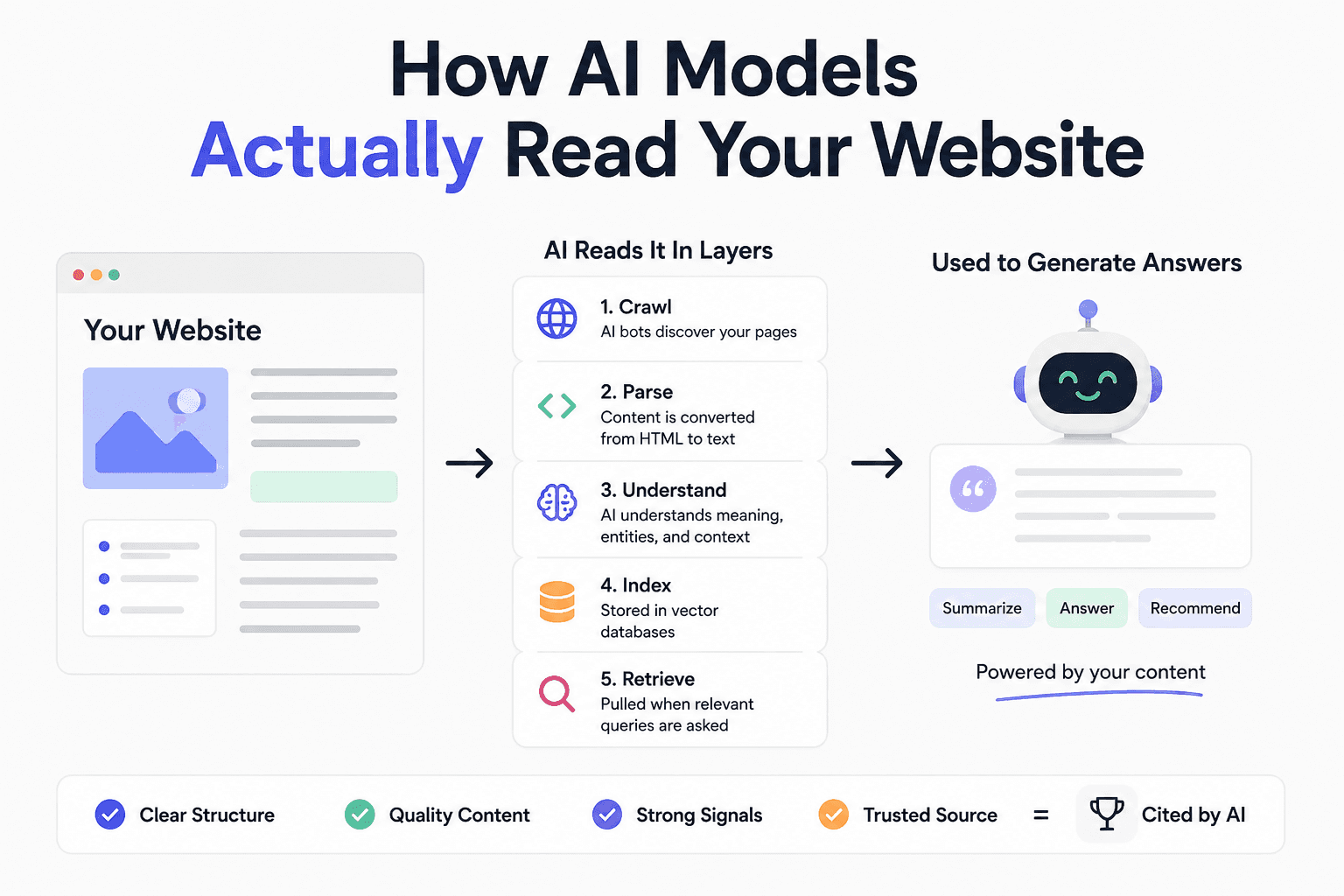
• Semantic coherence: Does the page consistently discuss a single topic, or does it wander?
• Factual density: Does the content contain specific, citable claims — stats, definitions, comparisons, steps?
• Source authority: Are there named authors, credentials, citations, and institutional affiliations?
• Structural clarity: Are headings logical? Is information chunked into digestible units?
• Entity relationships: Does the content clearly establish what the page is about in relation to known entities?
Traditional SEO vs. AI SEO: The Critical Differences
Dimension | Traditional SEO | AI SEO / GEO |
Goal | Rank on SERP Page 1 | Be cited in AI-generated answers |
Success metric | Position, CTR, impressions | Citation frequency, AI referral traffic |
Crawler | Googlebot, Bingbot | GPTBot, ClaudeBot, PerplexityBot |
Key signal | Backlinks, PageRank | Entity authority, topical depth, factual accuracy |
Content format | Keyword-optimized long-form | Answer-first, structured, citation-ready chunks |
Trust factor | Domain authority, E-A-T | E-E-A-T, author credentials, institutional trust |
03 — How AI Search Engines Work in 2026
To optimize for AI search, you need to understand the mechanics underneath it. Here's how the major systems actually work.
Google AI Overviews & AI Mode
Google's AI Overviews use a retrieval-augmented generation (RAG) approach: the system retrieves relevant pages from Google's index, then uses a language model to synthesize those pages into a coherent answer at the top of the SERP. AI Mode goes further — it replaces the traditional SERP with a full conversational interface that draws on multiple sources for complex queries.
Being in position 1 does not guarantee an AI Overview citation — content quality, structural clarity, and factual specificity matter more than raw rank.
Retrieval-Augmented Generation (RAG)
RAG is the backbone of almost every production AI search system in 2026. When a user asks a question, the system first retrieves relevant documents from a vector database, then passes those documents as context to the LLM, which generates an answer based on the retrieved content.
For your site to be included in RAG retrieval, your content needs to be:
• Crawlable and indexable by the AI system's crawler
• Semantically chunked — individual sections dense enough to be useful in isolation
• Factually specific enough to help the model answer a real question
• Structured such that the key answer appears near the top of a section
Semantic Search & Vector Indexing
Modern AI search doesn't match keywords — it matches meanings. Every piece of content on your site gets embedded into a high-dimensional vector that encodes its semantic meaning. When a user query comes in, its vector is compared against your content's vector. The closer the match, the more likely your content is to be retrieved.
KEY INSIGHT Keyword stuffing is not just unhelpful in 2026 — it's actively harmful. Unnatural language creates noisy vector embeddings that reduce semantic precision. Write clearly about a specific thing, and your embedding becomes a precise target for relevant queries. |
04 — Core Principles of an AI-Optimized Website:
1. E-E-A-T: The Trust Framework That Powers AI Citations
Google's E-E-A-T framework — Experience, Expertise, Authoritativeness, Trustworthiness — was designed for human quality raters. In 2026, it also functions as the primary signal for AI citation worthiness.
• Experience: First-person accounts, case studies, original data, direct testing
• Expertise: Author credentials, institutional affiliations, depth of coverage
• Authoritativeness: Backlinks from recognized sources, brand mentions, citation history
• Trustworthiness: HTTPS, accurate information, cited sources, transparent corrections
2. Semantic SEO: Writing for Meaning, Not Metrics
Semantic SEO means building content around concepts, not just keywords. Cover a topic comprehensively enough that your content naturally satisfies the full semantic space of related queries. Think less about exact-match keyword density and more about whether a domain expert reading your page would find it thorough and accurate.
3. Topical Authority: The New Domain Authority
In the AI search era, topical authority — deep, comprehensive coverage of a specific subject area — is the most durable ranking and citation signal. A site that publishes 50 excellent articles on SaaS pricing will consistently outperform a generic business blog that publishes one — even if the generic blog has a higher traditional DA.
EXPERT INSIGHT Topical authority isn't about volume — it's about coverage completeness. Map every subtopic, question, and related concept in your niche. If you haven't covered it, you have a gap an AI model will fill from a competitor. |
4. Human-First, Machine-Readable Content
The best strategy is to write genuinely excellent, human-first content — then ensure it's structured so machines can extract its meaning accurately. Clear headings, concise answer blocks, logical progression, and factual specificity serve both audiences simultaneously.
05 — Technical SEO for LLM-Friendly Websites :
AI Crawler Access & Robots.txt
Multiple AI crawlers are now indexing the web. If your robots.txt blocks them, you're invisible to those systems. Review against known AI crawler user-agents:
# Allow major AI crawlers (adjust per your strategy) User-agent: GPTBot Allow: /
User-agent: ClaudeBot Allow: /
User-agent: Google-Extended Allow: /
User-agent: PerplexityBot Allow: / |
Important: Blocking Google-Extended prevents your content from being used in Google's AI products (Gemini, AI Overviews) but does not affect traditional organic rankings. This is a strategic decision — not a default.
Core Web Vitals & Page Speed
• Largest Contentful Paint (LCP): under 2.5 seconds
• Interaction to Next Paint (INP): under 200ms
• Cumulative Layout Shift (CLS): under 0.1
Semantic HTML Structure
Semantic HTML is the most underrated technical SEO signal for AI readability. When you use <article>, <section>, <header>, <main>, and properly nested heading levels, AI parsers can understand your content's hierarchy without guessing. A page with flat <div> soup requires significantly more inference.
Internal Linking Architecture
Internal links signal topic relationships to both crawlers and AI models. A well-linked site creates a knowledge graph in miniature — demonstrating how your concepts relate, which pages are most authoritative, and what the depth of your coverage is.
TECHNICAL MINIMUM HTTPS + H1/H2/H3 hierarchy + semantic HTML + correct robots.txt + schema markup + fast server response + clean canonical structure + updated XML sitemap. |
06 — Content Optimization for AI Search
Answer-First Writing
AI systems overwhelmingly prefer content that delivers the answer immediately — before context, caveats, and elaboration. Every H2 or H3 section should be able to stand alone as a complete answer to the question implied by that heading. If a Perplexity answer bot extracts only your first two sentences under a heading, will it have a complete, accurate answer? If not, rewrite it.
Chunked Information Architecture
Think of your page as a collection of retrievable chunks, not a monolithic essay. Each chunk should:
• Address one specific question or concept
• Open with a direct answer or definition
• Be self-contained enough to be cited without surrounding context
• Be 150–400 words in length — the sweet spot for RAG retrieval
Data-Backed, Citation-Worthy Writing
AI systems are more likely to cite content that contains specific, verifiable claims: statistics, named studies, expert quotes, defined methodologies. Generic advice is hard to cite. Specific claims with sources are easy to cite because the AI can accurately attribute both the claim and its source.
Author Authority & Bylines
Named, credentialed authors dramatically improve E-E-A-T signals. Each article should have a byline with a link to an author page that includes credentials, professional history, other publications, and social proof. This gives AI systems a clear entity to associate with the content — one they can evaluate for trustworthiness.
Content Freshness
AI retrieval systems weight recency heavily. For evergreen content, add 'last updated' dates and ensure you're actually updating the content — not just refreshing the date. Shallow date refreshes are detected and penalized.
07 — GEO: Generative Engine Optimization Strategies
GEO is the discipline of optimizing your web presence to be cited, summarized, and recommended by generative AI systems. Here's how to approach each major platform.
How to Get Cited in ChatGPT
• Ensure Bingbot access in robots.txt
• Build Bing Webmaster Tools presence
• Publish content with high factual density and clear structure
• Earn mentions and links from Microsoft-indexed, authoritative sources
How to Get Cited in Gemini
Gemini draws primarily from Google's index. Ensure Google-Extended is allowed in your robots.txt — blocking it excludes your content from Gemini entirely. The factors mirror those for Google AI Overviews: strong E-E-A-T, structured content, relevant entity associations.
How to Rank in Google AI Overviews
Google's AI Overviews appear to favor:
• Pages already ranking in positions 1–5 for the query
• Content that directly answers the query within the first 100 words of a section
• Pages with structured data (FAQ, HowTo, Article schema)
• Sources with established topical authority in the query's domain
• Content with active brand mentions across the web
How Perplexity Chooses Sources
• Factually dense and specific (not opinion-heavy)
• Well-structured with clear headings and data
• Recently published or updated
• Referenced by other credible sources in the same topic area
• Accessible without paywalls or JavaScript rendering
Digital PR for AI Visibility
One of the most effective GEO strategies in 2026 is traditional digital PR: getting your brand, data, and experts mentioned in publications AI systems trust. A single mention in a Reuters article, TechCrunch feature, or government report does more for AI citation frequency than dozens of average backlinks.
08 — Best Website Structure for AI Visibility
Topic Clusters & Pillar Pages
The topic cluster model — one comprehensive pillar page supported by multiple in-depth cluster articles — is perfectly aligned with how AI systems understand topical authority. The pillar page establishes your ownership of a broad topic; the cluster articles demonstrate depth across every subtopic.
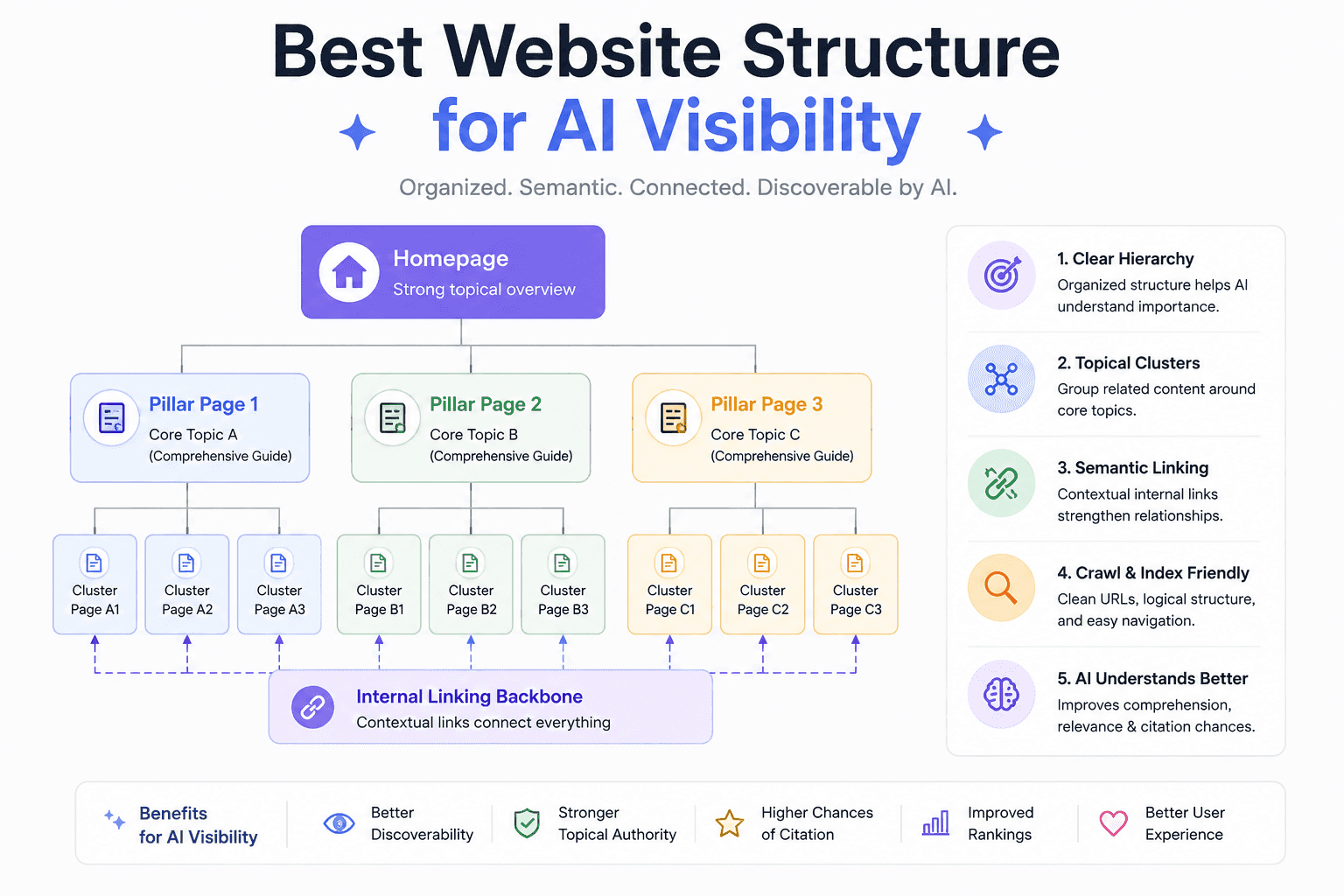
Example structure for a SaaS analytics product:
• Pillar: 'The Complete Guide to SaaS Analytics in 2026'
• Clusters: User Retention Analytics · Churn Prediction · Revenue Attribution · Cohort Analysis
• Each cluster links back to the pillar; the pillar links to each cluster
Semantic URL Architecture
URLs should reflect content hierarchy clearly: /blog/seo/ai-search-optimization/ is vastly more semantically informative than /blog/p=4291. AI crawlers use URL structure as a signal for understanding content hierarchy and topic groupings.
Taxonomy & Category Optimization
Well-defined category pages with substantial content serve as authority nodes in your site's knowledge graph. Write a strong 300-word introduction that defines the topic area and links to the most important content within it.
09 — LLM-Friendly Design & UX
Readability as a Quality Signal
AI systems evaluating content quality use readability as a proxy for expertise. Short paragraphs (2–4 sentences), clear heading hierarchy, generous whitespace, and legible body fonts all signal a well-crafted, authoritative piece.
Accessibility = Machine Readability
Accessibility and AI readability are nearly identical requirements. Alt text on images provides text descriptions AI can process. ARIA labels clarify UI elements. Proper heading hierarchy creates navigable structure. Building to WCAG 2.1 AA standards is a good proxy for building an LLM-friendly page.
Reduced Clutter, Increased Signal
Every non-content element on your page dilutes the content-to-noise ratio AI systems use to evaluate page quality. Sidebars stuffed with unrelated widgets, excessive ads, redundant navigation, and duplicate calls-to-action all reduce the quality signal of otherwise good content.
10 — Schema Markup Strategy in 2026
Schema markup is JSON-LD structured data that tells search engines and AI systems precisely what your content is about. In 2026, it has evolved from a nice-to-have into a near-mandatory requirement for AI Overview inclusion.
Schema Type | Use Case | AI Benefit |
Article | Blog posts, guides, news | Identifies author, date, headline for citation |
FAQPage | FAQ sections | Direct extraction of Q&A pairs for AI answers |
HowTo | Step-by-step guides | Structured step extraction for AI Overview carousels |
Organization | About/home pages | Entity disambiguation, Knowledge Panel eligibility |
Person | Author pages | Author entity verification, E-E-A-T signaling |
BreadcrumbList | All pages | Confirms site hierarchy to crawlers |
Product / Review | Product pages | Rich data extraction for product query answers |
Implementing FAQ Schema
FAQ schema is the single highest-leverage schema implementation for AI Overview and Perplexity citation probability. Every article should end with a marked-up FAQ section targeting the conversational questions users ask around your topic.
{ "@context": "https://schema.org", "@type": "FAQPage", "mainEntity": [{ "@type": "Question", "name": "What is an LLM-friendly website?", "acceptedAnswer": { "@type": "Answer", "text": "An LLM-friendly website is structured so that large language models can accurately read, understand, and cite it in AI-generated answers." } }] } |
11 — Common Mistakes That Kill AI Visibility
Thin AI-Generated Content at Scale
The rise of AI writing tools has flooded the web with exactly the kind of content AI search systems distrust most: generic, low-specificity, citation-free text that says a lot without asserting anything specific. Bulk AI content with no human review, expert input, or original data will actively undermine your AI citation chances.
Blocking AI Crawlers
Many sites blanket-block all AI crawlers in robots.txt. This is strategically damaging for visibility in AI search. The decision to block specific crawlers should be deliberate and narrow, not a default.
No Entity Optimization
If your website doesn't clearly establish who it is, what it's about, and who's behind it — as a named organizational entity — AI systems will treat it as an anonymous source and deprioritize it in favor of entities they can verify.
Over-Reliance on JavaScript Rendering
Many AI crawlers have limited JavaScript rendering capabilities. If your primary content only appears after client-side JS executes, a significant portion of AI crawlers will retrieve a blank or incomplete page. Critical content should always be in the initial HTML response.
Poor Internal Linking
Orphaned pages — articles with no internal links pointing to them — are invisible to AI systems trying to understand your site's knowledge structure. Every piece of content should be linked from at least two other relevant pages.
12 — The Future of SEO Beyond Google
AI Agents & Agentic Search
AI agents — autonomous systems that browse, research, and act on behalf of users — are moving from experimental to mainstream. When an AI agent researches a topic, it visits your site, reads it programmatically, and makes a recommendation — without a human ever seeing your page. Optimizing for agent readability is the next frontier.
Multi-Modal Search
Voice search through AI assistants, image-based search queries, and video understanding are expanding what it means to be 'findable.' Your website's accessibility to multi-modal AI systems — those that can see images, understand diagrams, and process audio — will be a competitive advantage.
Autonomous Search Systems
The trajectory is clear: search is becoming a service performed on behalf of users by AI systems, not a tool users directly operate. The websites that survive this transition are those that AI systems consistently find reliable, citable, and complete enough to stake their recommendation on.
THE CORE ARGUMENT Ranking on Google will remain important. But being the source an AI trusts — that's the durable competitive advantage of the next decade. |
13 — The Complete AI-Ready Website Checklist
Technical Foundation
☐ HTTPS enabled site-wide with no mixed content
☐ Core Web Vitals passing (LCP <2.5s, INP <200ms, CLS <0.1)
☐ Semantic HTML throughout (article, section, main, header, nav, aside)
☐ Proper H1/H2/H3 hierarchy — one H1 per page
☐ Mobile-first responsive design
☐ No JavaScript-only rendering for primary page content
☐ robots.txt reviewed for AI crawlers (GPTBot, ClaudeBot, PerplexityBot, Google-Extended)
☐ XML sitemap submitted and current with lastmod dates
☐ Canonical tags on all pages
☐ Internal linking from all pages (no orphaned content)
☐ Fast server response time (TTFB <200ms)
Content Architecture
☐ Topic cluster structure with clear pillar pages
☐ Each pillar page links to all cluster articles
☐ Semantic URL structure reflecting content hierarchy
☐ Answer-first writing: key answer in first 1–2 sentences of each section
☐ Content chunked into self-contained 150–400 word sections per concept
☐ FAQ sections on all major articles (minimum 5 questions)
☐ FAQ schema implemented on all FAQ sections
☐ All articles have named authors with credential-bearing author pages
☐ 'Last Updated' dates displayed and accurate
☐ Outbound citations to primary sources for all statistics
Entity & Authority Signals
☐ Organization schema on homepage with complete entity data
☐ Person schema on all author pages
☐ Brand name consistent across all web properties
☐ Google Knowledge Panel claimed and verified
☐ Active digital PR strategy targeting authoritative publications
☐ Social profiles consistent and linked from website
Schema Markup
☐ Article schema on all blog posts and guides
☐ FAQPage schema on FAQ sections
☐ BreadcrumbList schema on all pages
☐ Organization and WebSite schema on homepage
☐ HowTo schema on step-by-step guides
☐ All schema validated via Schema.org validator and Google Rich Results Test
AI-Specific Optimizations
☐ Primary content visible in raw HTML (not JS-only)
☐ No interstitials or overlays blocking content on initial load
☐ Images have descriptive alt text for multi-modal AI processing
☐ High factual density: specific numbers, dates, names, methodologies
☐ Conversational query variations addressed in content and FAQ sections
14 — Conclusion: Build for the Source Layer, Not Just the Rankings
The central insight of this guide is simple but consequential: in 2026, the most valuable piece of digital real estate isn't position #1 on a Google SERP. It's being the source an AI system trusts enough to cite when a human asks it something important.
The organizations winning in this environment are those that understood early that AI search isn't a threat to navigate — it's an opportunity to become genuinely authoritative in a way that search systems, both human-operated and AI-operated, will consistently recognize and reward.
The good news: the fundamentals haven't changed as much as the tactics. Write excellently about things you actually know. Structure your knowledge so it's findable and extractable. Build trust through consistency, transparency, and factual rigor.
The bad news: the execution bar has risen sharply. Average content, thin entity presence, and poor technical foundations were survivable in 2020. In the AI search ecosystem of 2026, they're disqualifying.
Start with the checklist above. Pick the three items furthest from complete and fix them this month. The window to establish topical authority and AI citation presence is still open — but the brands building it now will be very hard to displace by those who start in 2027.
Expert FAQs
Q: What is an LLM-friendly website and why does it matter in 2026?
An LLM-friendly website is structured and written such that large language models can accurately read, parse, and cite it in AI-generated answers. It matters in 2026 because a growing share of user queries are answered directly by AI systems like Google AI Overviews, ChatGPT, Gemini, and Perplexity — often without a click to the source. If your website isn't cited in those answers, you're invisible to a large and growing segment of search traffic.
Q: What is GEO (Generative Engine Optimization) and how is it different from SEO?
GEO — Generative Engine Optimization — is the discipline of optimizing your web presence to be cited in AI-generated search answers. It differs from traditional SEO in its goal (citation rather than ranking), its success metrics (mention share, AI referral traffic), its trust signals (E-E-A-T and entity authority rather than backlink quantity), and its content requirements (answer-first, factually dense, structurally chunked).
Q: How do I get my website cited in Google AI Overviews?
To appear in Google AI Overviews, first ensure your pages rank in the top 5 organic positions for target queries. Then implement structured data (Article, FAQ, HowTo schema), use answer-first content with the key answer within the first 100 words of each section, allow Google-Extended in your robots.txt, and build topical authority through comprehensive topic cluster coverage.
Q: Should I block AI crawlers like GPTBot and ClaudeBot?
For most websites, blocking AI crawlers is strategically counterproductive. While there are legitimate reasons to block training data collection (content licensing, paywalled content), blanket-blocking AI crawlers prevents your content from being cited by those systems' live search features. The better approach is a selective policy — allow crawlers used for real-time retrieval while making deliberate choices about training data crawlers.
Q: What schema markup is most important for AI visibility?
The three highest-priority schema types for AI visibility are: FAQPage schema (enables direct Q&A extraction), Article schema with author entity data (establishes content and author credibility), and Organization schema (establishes brand entity clarity). HowTo schema is particularly valuable for step-by-step guides targeted at Google AI Overview carousels.
Q: How does vector search affect content optimization strategy?
Vector search encodes your content's meaning into high-dimensional embeddings and matches it to queries by semantic similarity rather than keyword overlap. Clear, coherent writing about a specific topic produces precise embeddings that match relevant queries accurately. Keyword stuffing creates noisy embeddings that reduce relevance matching accuracy. Write with semantic clarity — one concept at a time, in plain, precise language.
Q: What is topical authority and how do I build it for AI search?
Topical authority is the degree to which your website is recognized as a comprehensive, reliable source on a specific subject area. Build it by creating a topic cluster architecture: one authoritative pillar page per major topic, supported by in-depth cluster articles covering every related subtopic, question, and concept. The goal is complete coverage, not content volume — map every query in your niche and ensure you have a definitive answer for each.
Q: How does E-E-A-T apply to AI search optimization?
E-E-A-T (Experience, Expertise, Authoritativeness, Trustworthiness) functions as a primary trust signal for AI citation decisions. AI systems prefer to cite content from sources with demonstrable real-world experience (original data, case studies), named credentialed authors, institutional recognition and backlinks from authority sources, and factual accuracy with transparent sourcing. Implementing E-E-A-T isn't just about Google quality raters — it's about building the kind of source AI models are trained to prefer.
Q: What content length and format works best for AI retrieval?
For RAG-based AI retrieval, content is optimally organized into self-contained chunks of 150–400 words per concept, each beginning with a direct answer to the implied question. Longer articles are still valuable for topical authority and organic ranking, but should be structured as collections of retrievable chunks. FAQ sections, definition blocks, step-by-step lists, and comparison tables are particularly high-yield formats for AI extraction.
Q: How will SEO change as AI agents become mainstream?
As AI agents become mainstream, the importance of machine-parseable, authoritative content will increase dramatically. Agents don't browse for discovery — they retrieve for task completion. Your content needs to be structured as functional knowledge that an AI agent can extract and act on, not just engaging text that persuades a human reader. Technical accessibility, entity clarity, and factual precision become non-negotiable requirements.
Related Reads for You
Discover more articles that align with your interests and keep exploring.