Introduction
Global businesses are rethinking how they build for the web — and the winner is headless architecture. In 2026, companies across the USA, Europe, and beyond are abandoning monolithic platforms in favor of decoupled, API-first systems that load faster, rank better on Google, and deliver content across every channel simultaneously.
At the center of this shift?
Indian headless website development companies have quietly become the go-to partners for US and European enterprises, SaaS companies, and ecommerce brands looking for world-class engineering at a fraction of the cost. With deep expertise in React, Next.js, GraphQL, Contentful, Strapi, and composable commerce platforms, India's top agencies are delivering experiences that compete with Silicon Valley's finest.
This guide covers everything you need: what headless development is, why it matters, what to look for in an agency, and which companies in India stand out in 2026.
What is Headless Website Development?
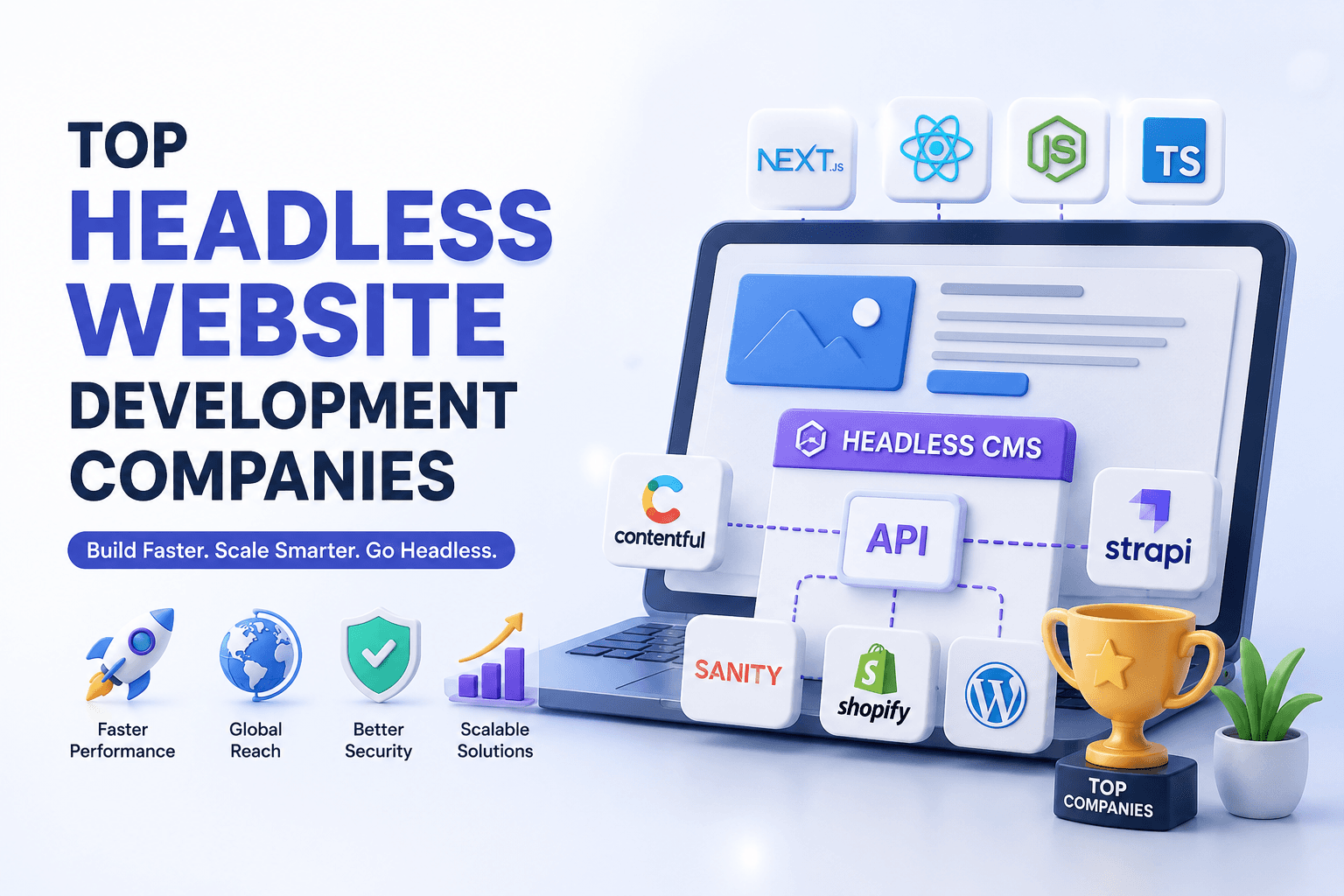
Headless website development is an architectural approach that decouples the frontend (what users see) from the backend (where content is stored and managed). Unlike traditional CMS platforms like WordPress or Drupal — where the presentation layer is tightly coupled to the database and admin panel — a headless setup communicates entirely through APIs.
In plain terms: your content sits in a headless CMS like Contentful, Strapi, or Sanity. Your frontend — built in React, Next.js, or Vue.js — pulls that content via REST or GraphQL APIs and renders it however it needs to, on any device or platform.
Traditional CMS vs Headless CMS — at a glance
Feature | Traditional CMS | Headless CMS |
|---|---|---|
Architecture | Monolithic (coupled) | Decoupled (API-first) |
Frontend flexibility | Limited to built-in themes | Any framework (React, Vue, etc.) |
Performance | Server-rendered, often slow | Static/edge-rendered, extremely fast |
SEO | Moderate | Excellent (Core Web Vitals optimized) |
Omnichannel | Web only | Web, mobile, kiosk, voice, AR/VR |
Security | Larger attack surface | Reduced surface (no exposed CMS) |
Scalability | Vertical, costly | Horizontal, cloud-native |
Developer experience | Template-constrained | Fully custom, modern toolchain |
Key concepts in headless development
API-first architecture: Every content operation happens through a standardized API, enabling any frontend to consume it.
Decoupled frontend/backend: Teams can work in parallel — content editors in the CMS, engineers in React — without blocking each other.
Omnichannel content delivery: One content repository powers your website, mobile app, smart TV, voice assistant, and digital signage simultaneously.
JAMstack: JavaScript, APIs, and Markup — the delivery paradigm underpinning most headless implementations.
Popular headless CMS platforms include Contentful, Strapi, Sanity, Hygraph, and Prismic. On the commerce side, Shopify Hydrogen, Magento headless, and BigCommerce lead the field.
Why Businesses in USA & Europe Prefer Indian Headless Development Companies
The outsourcing narrative has evolved. Companies aren't choosing Indian agencies to cut costs alone — they're choosing them because the technical depth is genuinely world-class.
1. Cost efficiency without quality compromise
Senior React and Next.js developers in the US or UK command $120–200/hour. Equivalent talent in India runs $25–60/hour. For a six-month enterprise headless project, this difference routinely amounts to hundreds of thousands of dollars — savings that can be reinvested in product, marketing, or infrastructure.
2. Deep specialization in modern stacks
India produces over 1.5 million engineering graduates annually, many of whom specialize in modern JavaScript ecosystems. Indian agencies fielding dedicated headless practices — with engineers certified in Next.js, GraphQL, and platforms like Contentful or Shopify Hydrogen — are no longer rare. They are the norm.
3. Proven experience with enterprise complexity
The Indian IT services sector has spent three decades serving global enterprises. That institutional knowledge — understanding compliance requirements, security practices, integration with legacy ERP and CRM systems — now applies directly to headless architecture engagements.
4. Time-zone collaboration at scale
Top Indian agencies have refined async-first and overlap-hour working models. US East Coast teams get evening stand-ups with Indian engineers; European teams enjoy a near-real-time overlap window. With the right process, the "timezone problem" becomes a continuous development advantage.
5. Scalable, dedicated teams
Need to scale from 3 engineers to 15 in six weeks? Indian agencies are built for exactly this. Their bench depth allows rapid team scaling without the 3–6 month recruiting lag that plagues in-house US/EU hiring.
Benefits of Headless Website Development
Before evaluating agencies, it helps to be clear on what you're buying. Here are the most impactful benefits of headless architecture in 2026:
⚡ Faster loading speed
Static site generation (SSG) and incremental static regeneration (ISR) in Next.js mean pages are pre-built and served from CDN edge nodes. Time-to-first-byte drops from seconds to milliseconds.
🔍 Better SEO performance
Headless sites score dramatically better on Core Web Vitals (LCP, FID, CLS) — Google's primary ranking signals. Server-side rendering (SSR) and SSG ensure crawlers see fully-rendered HTML, not empty JavaScript shells.
📱 True omnichannel publishing
A single content entry in your headless CMS can populate your website, iOS app, Android app, email template, and digital signage simultaneously. No copy-pasting. No version drift.
🔒 Improved security posture
No exposed admin login at /wp-admin. No database directly accessible from the public internet. The attack surface for a headless frontend is radically smaller than a traditional CMS.
📈 Unlimited scalability
Stateless frontends scale horizontally at near-zero cost using CDNs. Your backend API scales independently. You're no longer limited by what a single server can handle.
🛠 Future-ready architecture
When new channels emerge — AR glasses, voice interfaces, connected devices — a headless system extends to serve them without a rebuild. You wire up a new frontend; the content layer stays.
🎨 Superior developer experience
Engineers work in their preferred modern stacks. No legacy PHP templates. No plugin conflicts. This means faster iteration, fewer bugs, and easier talent recruitment.
Top Headless Website Development Companies in India (2026)
These companies stand out for their technical capability, client track record, and depth of headless-specific expertise.
1. VNA Infotech
Overview:
VNA Infotech is a modern digital transformation and web development company specializing in scalable, SEO-focused, and performance-driven websites for startups, enterprises, and growing brands. The company combines creative UI/UX design with advanced frontend technologies to deliver high-converting digital experiences tailored for global businesses.
Core Expertise:
Custom Website Development
Headless CMS Solutions
Next.js & React Development
SEO-Friendly Web Architecture
UI/UX Design Systems
Ecommerce Development
Framer & Modern Frontend Solutions
API Integration & Scalable Platforms
Why They Stand Out in 2026:
VNA Infotech focuses on building lightning-fast, conversion-oriented websites optimized for both users and search engines. Their development approach aligns with modern SEO, GEO, and AEO standards, making them a strong choice for businesses targeting Google rankings and AI search visibility. The company is particularly recognized for creating responsive digital experiences with clean architecture, strong Core Web Vitals, and future-ready frontend frameworks.
Best For:
SaaS companies
Startups & tech brands
Enterprise websites
Ecommerce businesses
Agencies needing white-label development
Companies seeking scalable headless architecture
Global Client Appeal:
VNA Infotech works with businesses across the USA, Europe, and emerging global markets, helping brands modernize their web presence with scalable, SEO-optimized development strategies.
2. FreeCodesLab
Overview:
FreeCodesLab is a fast-growing web development and digital solutions company known for delivering modern, high-performance websites built for scalability, SEO, and user engagement. The company specializes in combining visually engaging design with advanced frontend development technologies to help brands establish a powerful digital presence.
Core Expertise:
Custom Web Development
Headless Website Development
Framer Website Design
React & Next.js Development
Ecommerce Solutions
SEO-Optimized Website Architecture
Landing Page Development
Performance Optimization
Why They Are Growing Rapidly in 2026:
FreeCodesLab has gained recognition for creating visually modern websites that balance creativity with technical SEO performance. Their approach emphasizes speed, responsive design, mobile-first experiences, and conversion-focused layouts. By leveraging modern frameworks and headless technologies, the company helps businesses achieve better performance, stronger user engagement, and improved visibility across Google and AI-powered search platforms.
Best For:
Modern startups
Creative agencies
Personal brands
Ecommerce businesses
Service-based companies
Businesses wanting premium modern UI
Global Market Positioning:
FreeCodesLab positions itself as a modern web innovation partner for businesses targeting competitive markets in the USA, UK, Canada, Europe, and global digital industries. Their expertise in modern frontend ecosystems makes them suitable for brands seeking scalable and visually impactful digital experiences.
3. Bacancy Technology
Overview: Ahmedabad-based Bacancy is a 1,000+ person agency with a strong headless development practice embedded in its wider web and mobile services.
Specialization: Headless CMS implementation (Contentful, Strapi, Sanity), Next.js development, API-first architecture.
Technologies: Next.js, Nuxt.js, React, Vue.js, Strapi, Contentful, Node.js, REST/GraphQL.
Industries served: Ecommerce, real estate, healthcare, education, logistics.
Why choose them: Bacancy offers competitive pricing, a rigorous hiring process, and a well-structured delivery model that works well for US clients. Their headless team has delivered projects for brands in North America and Europe.
Best for: Startups and growth-stage companies needing full headless builds on a defined budget.
4. Unified Infotech
Overview: Kolkata and New York-based (with delivery in India), Unified Infotech positions itself specifically for US clients. Their headless development team specializes in building performance-first digital experiences.
Specialization: Headless WordPress, Next.js frontends, headless Shopify, enterprise CMS migrations.
Technologies: WordPress (headless), Next.js, React, WPGraphQL, Contentful, Shopify Hydrogen.
Industries served: Healthcare, legal, financial services, media.
Why choose them: Unified has a strong design-to-development pipeline, meaning the visual output is consistently polished. Their US presence makes communication frictionless for American clients.
Best for: US businesses wanting an agency with boots on the ground stateside and deep technical delivery in India.
5. Capital Numbers
Overview: Capital Numbers is a Kolkata-based agency recognized multiple years running by Clutch and Deloitte. Their team covers the full modern web stack with a notable headless CMS practice.
Specialization: JAMstack development, Next.js, headless ecommerce, Contentful and Strapi implementation.
Technologies: Next.js, Gatsby, React, Contentful, Strapi, Shopify Hydrogen, AWS, Vercel.
Industries served: Ecommerce, travel, SaaS, media.
Why choose them: Capital Numbers has consistently strong client reviews and ISO-certified processes. Their project management is transparent, with regular reporting that suits enterprise procurement requirements.
Best for: Ecommerce and media companies wanting a process-mature agency with a strong track record.
6. OpenXcell
Overview: OpenXcell, headquartered in Ahmedabad, has built a reputation for mobile and web development spanning 15+ years. Their headless web development services are backed by a dedicated frontend guild.
Specialization: Progressive web apps, Next.js SPAs, headless CMS integration, API development.
Technologies: React, Next.js, Node.js, GraphQL, Contentful, Firebase, AWS.
Industries served: Logistics, retail, healthcare, media.
Why choose them: OpenXcell brings mobile-first thinking to headless web development, which is critical as mobile traffic continues to dominate. Their PWA implementations consistently score 90+ on Lighthouse.
Best for: Businesses where mobile performance and PWA capability are primary objectives.
7. Radixweb
Overview: Gujarat-based Radixweb serves over 2,500 clients globally and has a mature practice in modern web architecture including headless and composable systems.
Specialization: Composable commerce, MACH architecture, headless CMS, enterprise integrations.
Technologies: Next.js, React, Vue.js, Nuxt.js, Strapi, Hygraph, Magento headless, REST/GraphQL.
Industries served: Manufacturing, retail, B2B enterprise, education.
Why choose them: Radixweb excels in integrating headless frontends with complex enterprise backends — ERP systems, legacy APIs, PIM platforms. If your headless project involves deep integration work, their experience is valuable.
Best for: B2B enterprises and manufacturers needing composable architecture with complex backend integrations.
8. Aalpha Information Systems
Overview: Aalpha is a Mysore-based agency with a focused team that punches above its size on technical quality. They serve startups and mid-market clients across Scandinavia, the UK, and the US.
Specialization: React frontends, headless CMS (Strapi, Sanity), Next.js applications, startup MVPs.
Technologies: React, Next.js, Strapi, Sanity, Node.js, MongoDB, PostgreSQL.
Industries served: SaaS startups, healthcare, non-profit, education.
Why choose them: Aalpha is well-suited for startups who need enterprise-quality headless architecture but don't have enterprise budgets. Their responsiveness and senior involvement on projects distinguish them from larger factory-model agencies.
Best for: Funded startups building their first scalable headless platform.
9. VNA Infotech
Overview: VNA Infotech offers headless web development services with a focus on frontend performance and clean API architecture. They serve clients across the US and Middle East.
Specialization: Headless Shopify, Contentful development, React/Next.js builds, API-first architecture.
Technologies: React, Next.js, Shopify Hydrogen, Contentful, Node.js, GraphQL.
Industries served: Ecommerce, retail, SaaS.
Best for: Ecommerce brands transitioning from traditional Shopify themes to Hydrogen-based headless storefronts.
10. FreeCodesLab
Overview: FreeCodesLab is a boutique headless development agency with a strong focus on performance-first web development and composable architecture for digital-native brands.
Specialization: Custom headless CMS solutions, Next.js development, API integrations, headless ecommerce.
Technologies: Next.js, React, Strapi, Sanity, GraphQL, Vercel, Netlify.
Industries served: Ecommerce, digital media, SaaS.
Best for: Digital-native brands that want bespoke headless builds without the overhead of a large agency.
11. Tata Consultancy Services (TCS) Digital
Overview: For enterprise-scale headless transformations, TCS Digital's practice around composable commerce and MACH architecture serves Fortune 500 clients. Their India engineering base provides cost leverage even at massive scale.
Best for: Global enterprises with $500K+ digital transformation budgets requiring SI-level coordination.
12. Infosys Digital Experience
Overview: Infosys brings certified partnerships with Contentful, Adobe Experience Manager, and Sitecore alongside deep Next.js and React capabilities. Suited for regulated industries requiring compliance overlays.
Best for: Financial services, pharma, and healthcare enterprises with complex compliance requirements.
Best Technologies Used in Headless Development
Understanding the stack helps you evaluate agencies more accurately.
Frontend Frameworks
React — The dominant UI library. Composable, fast, massive ecosystem.
Next.js — React framework adding SSR, SSG, ISR, and API routes. The default choice for headless in 2026.
Vue.js / Nuxt.js — Strong alternative for teams with Vue expertise; Nuxt.js mirrors Next.js functionality.
Gatsby — Static site generator, excellent for content-heavy sites with infrequent updates.
Headless CMS Platforms
Contentful — Enterprise leader. Structured content, global CDN, strong API. Best for large teams.
Strapi — Open-source, self-hostable. Ideal for startups and teams wanting full control.
Sanity — Developer-first, real-time collaboration, highly flexible schema. Popular with agencies.
Hygraph (formerly GraphCMS) — GraphQL-native CMS. Excellent for API-heavy architectures.
Prismic — Simple, fast, strong Next.js integration.
Headless Commerce
Shopify Hydrogen — React-based framework for headless Shopify storefronts.
Magento headless (Adobe Commerce) — Enterprise ecommerce with PWA Studio or custom React frontends.
BigCommerce headless — Flexible headless commerce with strong API surface.
API Layer
GraphQL — Query exactly what you need. Reduces over-fetching. Preferred for complex data models.
REST APIs — Simpler, universal. Works well for most standard integrations.
Infrastructure
Vercel — Optimized for Next.js deployments. Edge functions, ISR, preview environments.
Netlify — JAMstack pioneer. Strong CI/CD, edge functions.
AWS CloudFront / Amplify — Enterprise infrastructure with global CDN.
Headless CMS vs Traditional CMS — Detailed Comparison
Criteria | Traditional CMS (e.g., WordPress) | Headless CMS (e.g., Contentful/Strapi) |
|---|---|---|
Page speed | Slow to moderate (server-rendered PHP) | Very fast (SSG/SSR at edge) |
SEO capability | Good with plugins | Excellent natively (Core Web Vitals) |
Omnichannel | Web only | Web, mobile, IoT, voice, all channels |
Security | Frequent vulnerabilities, plugin risks | Minimal attack surface |
Frontend freedom | Limited (theme-constrained) | Unlimited (any framework) |
Scalability | Limited (vertical scaling) | Infinite (CDN + API scaling) |
Content modeling | Rigid (post/page paradigm) | Fully flexible schema |
Integration | Plugin-dependent, often fragile | API-first, robust integrations |
Cost at scale | High server costs | Lower through CDN offloading |
Developer experience | Legacy PHP/template syntax | Modern JS toolchain |
Non-technical editing | Excellent | Good (improving rapidly) |
Verdict: For performance, scalability, and omnichannel publishing, headless wins decisively. Traditional CMS still serves simple blogs or small sites where developer experience and speed are secondary.
Industries Using Headless Web Development in 2026
Ecommerce
Headless commerce separates the shopping engine from the storefront, enabling lightning-fast product pages, custom checkout flows, and seamless omnichannel selling. Brands using Shopify Hydrogen or headless Magento routinely see 20–40% improvements in conversion rates attributable to page speed alone.
SaaS
SaaS companies use headless architecture for marketing sites, documentation portals, and product dashboards. The ability to update marketing content without engineering deployments is a major operational win.
Healthcare
HIPAA-compliant headless platforms separate patient-facing interfaces from clinical data systems, enabling fast, accessible patient portals with strong security boundaries.
Financial Services
Banks and fintech companies deploy headless frontends over secure API gateways, keeping sensitive data off the presentation layer entirely.
Media & Publishing
News organizations and publishers use headless CMS to push content to web, mobile apps, AMP pages, Apple News, and smart TV apps simultaneously from a single editorial workflow.
Real Estate
Property portals leverage headless architecture for real-time MLS data integration, interactive map components, and fast property listing pages optimized for local SEO.
Education
EdTech platforms use headless systems to deliver course content across web, mobile, and offline-capable PWAs — critical for markets with inconsistent connectivity.
Travel
Travel brands combine headless frontends with real-time pricing APIs, enabling personalized, fast-loading booking experiences that outperform legacy systems.
How to Choose the Right Headless Development Company in India
Use this framework when evaluating agencies:
1. Technical stack alignment
Does their core team work daily in Next.js, GraphQL, and your preferred CMS platform? Request evidence: GitHub repos, case studies, certifications. A team that "also does headless" is different from one that only does headless.
2. Architecture consultation capability
Can they advise you on CMS selection, content modeling, ISR vs SSG vs SSR decisions, and API design? Or do they only execute briefs? The best agencies bring opinionated architectural thinking, not just coding bandwidth.
3. Portfolio with comparable complexity
Ask for case studies matching your industry and scale. A headless build for a five-page SaaS site is architecturally different from a 50,000 SKU headless ecommerce platform.
4. SEO and performance knowledge
Headless done wrong can hurt SEO badly. Ask specifically how they handle metadata, structured data, sitemaps, and Core Web Vitals optimization. If they can't answer clearly, move on.
5. CMS vendor partnerships
Official Contentful, Strapi, or Shopify Partner status indicates certified expertise and access to vendor support channels — useful when you hit edge cases.
6. Communication and project management tooling
Do they use transparent project management (Jira, Linear, Notion) with regular async updates? Insist on a documented communication cadence before signing.
7. Post-launch support model
Headless systems require ongoing maintenance: CMS updates, dependency management, security patches, performance monitoring. Understand their retainer model before committing.
8. Pricing model
Fixed-price projects suit well-defined scopes. Time-and-materials suits exploratory or evolving projects. Be wary of agencies who only offer one model regardless of project type.
Future Trends in Headless Development (2026 and Beyond)
The headless ecosystem is evolving rapidly. Here's what's shaping the next wave:
AI-integrated web experiences
AI personalization engines now connect directly to headless frontends via API, serving dynamically assembled page layouts, product recommendations, and content variations without full page rebuilds.
Composable architecture (MACH)
MACH — Microservices, API-first, Cloud-native, Headless — is the enterprise gold standard. Every component (commerce, CMS, search, payments) is independently replaceable. Composable architecture eliminates vendor lock-in at the platform level.
Edge rendering and React Server Components
Next.js 14 and 15 have made React Server Components mainstream. Combined with edge functions (Vercel Edge, Cloudflare Workers), this moves computation closer to users globally — reducing latency without sacrificing dynamic functionality.
AI-generated frontend experiences
Emerging tools generate UI components, landing page variants, and content layouts dynamically based on user context. Headless architecture is the prerequisite — you need a clean API layer for AI to operate against.
Voice commerce
Smart speaker and voice assistant adoption continues to grow. Headless content APIs are the natural data source for voice interfaces, delivering structured content without the visual layer.
Omnichannel commerce expansion
The next frontier is selling across messaging apps (WhatsApp, Instagram DMs), connected devices, and in-store digital touchpoints — all powered by the same headless commerce backend.
FAQ:
What is a headless website?
A headless website separates the content management backend from the frontend presentation layer. Content is stored in a CMS and delivered via API to any frontend framework. This enables faster performance, omnichannel publishing, and greater developer flexibility compared to traditional coupled CMS platforms.
Is headless CMS better for SEO?
Yes, significantly. Headless architectures implemented with Next.js (SSR/SSG) produce fully-rendered HTML that search engines index accurately. They also score better on Core Web Vitals — Google's primary performance ranking signals — due to static generation and CDN delivery.
Which is the best headless CMS in 2026?
Contentful leads for large enterprises needing robust workflow and governance. Strapi is best for teams wanting open-source flexibility. Sanity excels for agencies requiring real-time collaboration and schema flexibility. The right choice depends on your team size, content complexity, and budget.
Why choose Indian headless development companies?
Indian agencies offer senior-level React and Next.js engineers at 40–70% lower cost than US or European equivalents. Established agencies bring enterprise delivery processes, timezone overlap models, and proven track records with global clients.
Is Next.js good for headless websites?
Next.js is the leading framework for headless websites in 2026. It supports static generation, server-side rendering, incremental static regeneration, and React Server Components — covering every headless rendering pattern. It integrates natively with Contentful, Strapi, Sanity, and Shopify Hydrogen.
What is composable commerce?
Composable commerce is an approach where each ecommerce capability (cart, checkout, search, recommendations, CMS) is a separate, independently deployable service connected via APIs. It gives brands complete control over their stack without dependency on a single monolithic platform.
Is headless architecture expensive?
Headless has higher initial development costs than template-based CMS builds. However, it reduces long-term costs through better performance (higher conversion), easier scaling, lower infrastructure costs at scale, and faster feature development after initial setup.
Which industries benefit most from headless websites?
Ecommerce, SaaS, media and publishing, healthcare, and financial services see the highest ROI from headless architecture — particularly businesses with high traffic, multiple digital channels, or strict performance and security requirements.
What is the difference between headless and JAMstack?
JAMstack (JavaScript, APIs, Markup) is a delivery architecture — pre-built static files served from a CDN. Headless refers to the CMS architecture (decoupled content management). Most headless websites use JAMstack delivery, but headless can also use SSR without static files.
How long does a headless website project take?
A typical headless website — new design, CMS integration, API development, SEO setup — takes 10–20 weeks depending on complexity. Enterprise headless ecommerce projects with complex integrations run 4–9 months.
Can I use WordPress headlessly?
Yes. WordPress used headlessly (via WPGraphQL or the REST API) separates the WordPress admin from the frontend. Your content editors continue using the familiar WordPress interface while your frontend delivers the performance of a modern Next.js application.
What is MACH architecture?
MACH stands for Microservices, API-first, Cloud-native, and Headless. It is the enterprise framework for building composable digital platforms where every service is independently deployable, scalable, and replaceable.
Conclusion
Headless website development is no longer an advanced option for the technically adventurous. In 2026, it is the architectural foundation for any digital business that competes on performance, scale, and omnichannel reach.
India has become an undeniable center of gravity for this work. The combination of deep technical talent, mature delivery processes, and genuine cost advantage makes Indian headless development companies the pragmatic choice for global businesses — not just the budget-conscious choice.
Whether you're migrating an ecommerce brand to Shopify Hydrogen, building a composable enterprise CMS on Contentful, or launching a Next.js-powered SaaS marketing site, the agencies in this guide have the depth to execute it.
The right headless development partner doesn't just write code. They shape your architecture, model your content correctly from day one, optimize every page for Core Web Vitals, and build a system your team can actually maintain and extend. Use this guide as your starting checklist — then go deeper with each shortlisted agency through reference calls, technical assessments, and architecture discussions.
Ready to evaluate headless development partners? Request detailed proposals from at least three agencies using a standardized brief — it's the fastest way to surface true capability differences.
Related Reads for You
Discover more articles that align with your interests and keep exploring.