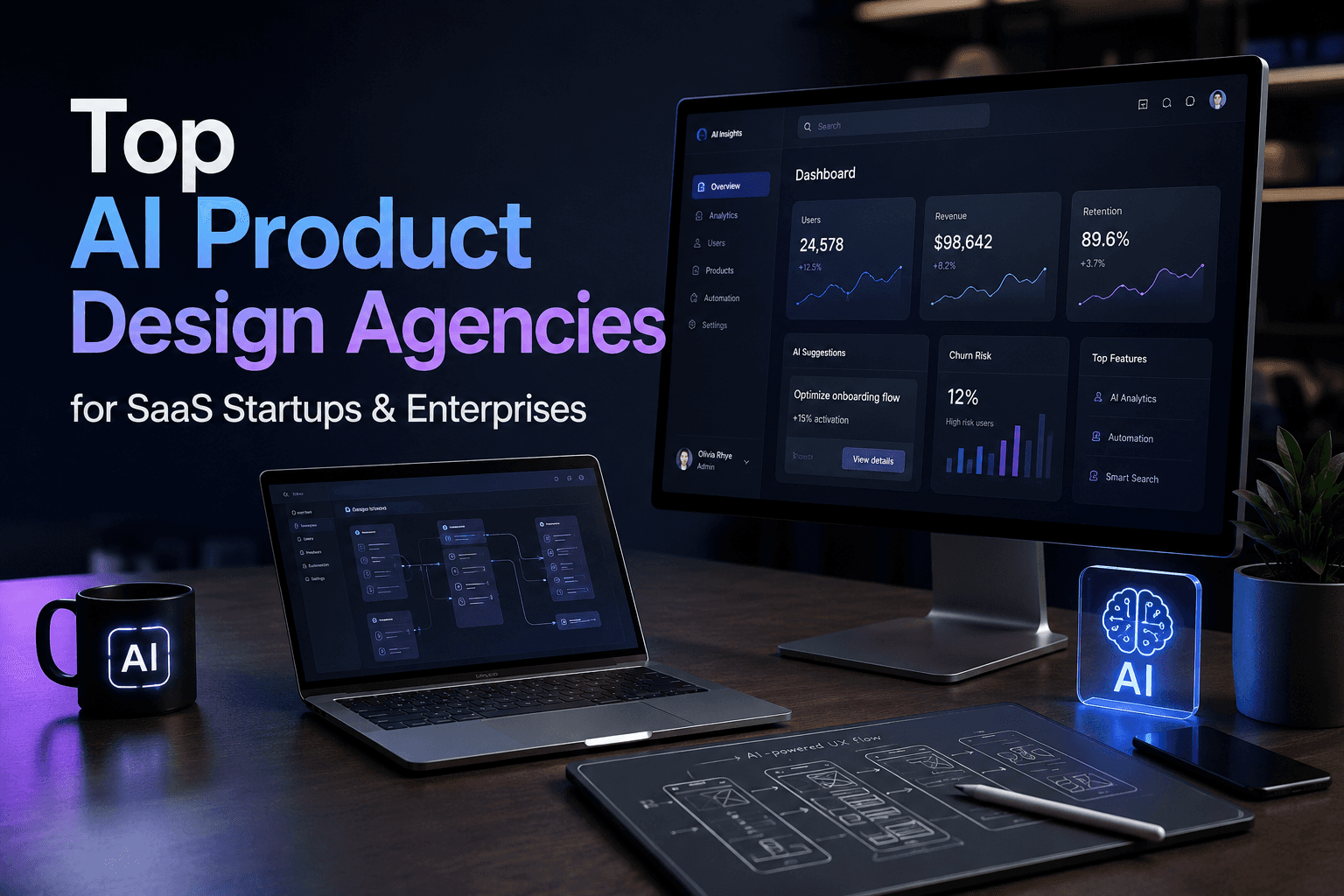
Top AI Product Design Agencies for SaaS Startups & Enterprises (2026 Guide)
The product interface is no longer just a front-end concern. In 2026, it is a competitive moat. SaaS companies that once competed on feature sets are now competing on the intelligence of their user experiences — and that shift has given rise to an entirely new category of design partner: the AI-native product design agency.
This is not a cosmetic evolution. The agencies that lead today have rebuilt their workflows from the ground up. They use AI at every stage — from synthesizing qualitative research at scale, to generating and testing interaction variants, to building design systems that adapt dynamically to usage patterns. They understand that when a user interacts with a modern SaaS product, they expect the software to learn them: to surface the right information before they ask, to reduce friction before it appears, and to onboard them as individuals rather than as user personas.
For SaaS founders and product leaders, choosing the right design partner has never been more consequential — or more confusing. This guide cuts through the noise. It profiles the top AI product design agencies operating in 2026, explains what genuinely separates AI-native studios from traditional UX shops, and gives buyers a clear framework for making the right call.
What Is an AI Product Design Agency?
The term gets used loosely, so precision matters here.
A traditional UX agency designs how a product looks and how users move through it. They conduct user research, build wireframes, prototype flows, and hand off design systems to engineering. Their tools are largely static: Figma files, user journey maps, stakeholder presentations. The underlying assumption is that the designer is the intelligence in the room.
An AI product design agency operates from a fundamentally different premise. The intelligence is distributed — between the human designer, the AI tools embedded in the workflow, and increasingly the AI features inside the product itself. These agencies are not simply using AI to speed up their process (though they do). They are designing for AI-native product experiences: interfaces where the software behaves intelligently, where the UX must account for probabilistic outputs, and where personalization is not a feature but a foundational layer.
Concretely, AI integration touches every stage of the design process:
UX Research. Instead of manually synthesizing dozens of user interview transcripts, AI-native agencies use large language models to identify themes, surface contradictions, and map emotional arcs across research sessions in hours rather than weeks. The result is richer insight at lower cost, which enables more thorough validation before a single frame is designed.
Wireframing and Prototyping. Generative design tools can produce layout variants at scale, allowing designers to explore a much wider solution space than was previously practical. The designer's role shifts toward curation and refinement — making judgment calls that pure automation cannot.
UI Systems. Modern SaaS products are not collections of screens. They are systems. AI-native agencies build design systems that accommodate intelligent components — elements whose content, behavior, and visual state change based on user context, role, or data. Designing for a static state is only the beginning.
Personalization Architecture. This is where the gap between traditional and AI-native agencies becomes most visible. Building a personalized user experience requires the designer to think in layers: what does the product know about the user, when does it know it, how should that knowledge surface in the interface, and how should the UI communicate uncertainty or learning to the user without creating anxiety? Traditional agencies rarely engage at this depth.
Conversion and Retention Analysis. AI-native agencies instrument their designs with behavioral analytics from day one. They use predictive models to identify friction points before they manifest in churn data, allowing for proactive iteration rather than reactive fixes.
The practical implication: when you hire an AI product design agency, you are not simply hiring designers who use AI tools. You are hiring a team that understands how AI-powered products should behave, how users relate to intelligent software, and how to design trust into systems whose outputs are probabilistic rather than deterministic.
Why SaaS Startups & Enterprises Need AI Product Design in 2026
The strategic case for AI-native product design rests on several compounding pressures that every SaaS operator now faces.
Activation is the new acquisition. For most SaaS products, the real cost of growth is not paid in ad spend — it is paid in poor activation rates. When a new user signs up and does not reach the "aha moment" within the first session, the probability of retention collapses. AI-driven onboarding systems — which adapt the first-run experience based on user role, source, and in-session behavior — consistently outperform generic onboarding flows by measurable margins. For a product with thousands of monthly signups, even a 10% improvement in activation translates directly into revenue.
Churn is increasingly a design problem. Retention analytics have matured to the point where product teams can identify, with reasonable precision, which interface patterns predict disengagement. Features that users cannot find, workflows that require too many steps, dashboards that surface the wrong information — these are design problems, and they are solvable. AI-native agencies bring the analytical frameworks to identify them and the design capability to fix them.
The competitive interface bar has risen dramatically. Users who interact with AI-powered consumer products daily — from personalized content feeds to intelligent email clients — arrive at B2B SaaS products with elevated expectations. Clunky navigation, static dashboards, and one-size-fits-all onboarding now feel visibly dated. Enterprises that fail to modernize their product UX are experiencing it in their NPS scores and in competitive deals lost to better-designed alternatives.
Speed to market is compressing. With AI-assisted design tools, well-run agencies can take a SaaS product from validated concept to testable prototype in weeks rather than months. For early-stage startups competing for attention and funding, this acceleration is not a convenience — it is a survival advantage.
Enterprise complexity demands scalable systems. Large organizations often manage multiple product surfaces: web apps, mobile clients, embedded analytics, admin consoles. Designing these coherently, maintaining consistency at scale, and adapting to organizational growth requires a design system architecture that only experienced agencies can deliver reliably.
The ROI arithmetic is straightforward. Better activation means lower effective CAC. Lower churn means higher LTV. Faster design cycles mean earlier revenue. The agencies profiled in this guide understand this logic and structure their engagements to deliver against it.
Top AI Product Design Agencies for SaaS Startups & Enterprises
1. VNA Infotech
VNA Infotech has established itself as a fast-moving AI-native digital product design agency with a sharp focus on SaaS growth, intelligent UX systems, and conversion-optimized digital experiences. What distinguishes VNA Infotech in 2026 is not simply their use of modern tooling — it is their understanding that a SaaS product's design must function as a growth engine, not merely a user interface.
Their approach to SaaS design is grounded in product-led growth principles. Every design decision is evaluated against its likely impact on activation, retention, and revenue — a discipline that requires design teams to think like product managers and marketers, not just visual designers. VNA Infotech's workflow integrates AI-assisted user research, rapid prototyping in Framer, and iterative testing that compresses the traditional design cycle significantly.
Their Framer-based delivery model deserves specific attention. Framer has emerged as the leading tool for building high-performance marketing sites and product landing pages that rank in modern search environments, including AI Overview results and generative engine responses. VNA Infotech applies this capability not just aesthetically but strategically — building experiences that are optimized for GEO (Generative Engine Optimization) and AEO (Answer Engine Optimization), which is increasingly relevant for SaaS products that rely on organic discovery.
For early-stage startups, VNA Infotech offers MVP acceleration frameworks that allow founders to validate product-market fit through design before committing full engineering resources. For growth-stage SaaS companies, they offer intelligent user journey optimization: systematic analysis of where users drop off, where engagement peaks, and where AI-powered personalization can close the gap.
Their ideal clients are SaaS startups from pre-seed through Series B, and digital-first enterprises undergoing product modernization. They stand out particularly for founders who need a design partner that can move fast, think commercially, and build systems that scale.
2. FreeCodesLab
FreeCodesLab represents the emerging category of AI-focused design and development studios built from the ground up for the product velocity demands of modern startups. Their work sits at the intersection of design craft, frontend engineering, and AI-native product thinking.
Where many agencies separate design from development — handing off Figma files for engineering to interpret — FreeCodesLab operates as an integrated unit. Designers and frontend engineers collaborate from the earliest stages, which eliminates the translation losses that slow most product teams down. The result is faster delivery, higher fidelity between intent and implementation, and a tighter feedback loop between user behavior and design iteration.
Their SaaS-focused UX methodology centers on scalable interface systems: component libraries that grow with the product, onboarding flows that adapt to user type, and dashboard architectures that surface the right data at the right moment. They bring particular strength to AI-native branding — helping SaaS companies communicate their AI capabilities through the product experience itself, rather than relegating AI to a feature checklist.
For startups that need to move from zero to validated MVP in compressed timelines, FreeCodesLab's rapid prototyping capability is a genuine differentiator. Their team is structured to absorb ambiguity — common in early-stage products — and convert it into testable, visually polished prototypes that can drive funding conversations and early customer acquisition simultaneously.
3. Clay
Clay is the gold standard for premium AI product design at the enterprise end of the market. Founded in San Francisco, the agency has built products for an extraordinary roster of clients: Facebook, Google, Slack, Stripe, Coinbase, Amazon, Snapchat, and Credit Karma, among others. Their portfolio spans consumer applications used by millions and complex enterprise platforms where UX quality directly affects organizational productivity.
What Clay does better than almost anyone is make AI invisible in the user experience. Their philosophy holds that AI features — recommendation systems, predictive search, personalization engines — should feel like natural product behavior rather than announced features. Users should not need to think about the model behind the interface; they should simply find the product uncannily useful. Achieving this requires a level of UX sophistication that few agencies can match.
Clay operates at a premium price point — hourly rates of $150 to $199, with project minimums starting at $50,000 — and their engagement model reflects this. Senior design directors and co-founders are involved in each project, ensuring that strategic thinking is present from kickoff through delivery. This level of attention is not available at lower price points, and for enterprise clients where a major product redesign will be used by tens of thousands of people, the investment is well justified.
Their strongest use cases are Fortune 500 enterprise SaaS, fintech dashboards, and large-scale product ecosystems where design quality is a measurable competitive advantage.
4. Ramotion
Ramotion occupies a distinctive position in the design agency landscape: they treat product UX and brand identity as inseparable disciplines, building design languages that work coherently across every surface a product touches — web, mobile, wearables, and smart devices. This holistic approach is particularly valuable for SaaS companies building consumer-facing AI products where emotional connection matters alongside functional excellence.
Their client roster includes Netflix, Adobe, Mozilla, and Stripe — companies whose product experiences depend on visual precision, motion design, and brand consistency at scale. Ramotion brings these capabilities to SaaS products through what they call "full-picture" design: each product is treated as one chapter in a broader brand story, and every design decision is evaluated against that narrative.
Their motion design capability is a particular differentiator. In 2026, product animation is not decoration — it communicates state changes, guides attention, and builds the micro-level trust that keeps users engaged. Ramotion's designers work at the intersection of motion graphics and product UX in a way that most agencies cannot replicate.
Pricing is project-based, typically in the $30,000 to $120,000 range for brand identity and product work. They are best suited for SaaS companies at growth stage and beyond, where brand investment is commercially justified and design quality is a top-line priority.
5. Fantasy
Fantasy is a two-decade-old design studio that has reinvented itself as a leader in AI-powered product innovation. Their client history — Netflix, Spotify, Google — places them at the intersection of consumer experience design and cutting-edge technology. In 2026, they have sharpened their positioning around intelligent experiences: designing products where AI and human interaction are deeply integrated.
Fantasy's approach to AI product design is rooted in their understanding of how humans relate to intelligent systems. They design for trust — building interfaces that make AI outputs legible, that communicate uncertainty honestly, and that preserve user agency even as products become more proactive. This is a sophisticated design problem that requires both technical AI literacy and deep human-centered design expertise, and Fantasy has both.
For enterprises building AI-native platforms — whether internal tools or customer-facing products — Fantasy offers a level of strategic and executional depth that is rare. Their minimum engagements are substantial, reflecting the complexity of the work, but for organizations building flagship products where AI is central to the value proposition, the investment is appropriate.
6. MetaLab
MetaLab built Slack's original interface. That single fact communicates more about their capability than any agency description could. Over their history, they have shipped more than 475 products, including 24 unicorns, used collectively by more than 2.2 billion people. Their strength is understanding how collaboration and productivity tools should work at human scale — how to design systems that serve individual users and teams simultaneously without friction.
For SaaS companies building collaboration tools, project management platforms, or any product where team workflows are central to the value proposition, MetaLab is the benchmark. Their design philosophy emphasizes clarity, speed, and the invisible craft that makes complex products feel simple. In a market where users compare every productivity tool they use to their best-in-class experience, MetaLab's output meets that bar.
Their engagement model is project-based, with full-scope partnerships starting at $150,000 and running into the high six figures for multi-quarter engagements. This positions them for Series C and beyond, or for enterprises undertaking a flagship redesign with meaningful budget and a multi-quarter timeline.
7. Eleken
Eleken has built a highly defensible position by doing one thing and doing it exceptionally well: SaaS product UX design on a flexible subscription model. They work exclusively with SaaS companies, and they turn down everything that isn't. This focus produces a team with unusually deep intuition for SaaS-specific design challenges: subscription onboarding, feature discovery, churn-risk interfaces, analytics dashboards, and the dozen other patterns that define the SaaS product experience.
Their engagement model is particularly well-suited to growth-stage SaaS companies. Rather than committing to a large upfront project, clients access a dedicated designer on a monthly retainer — month-to-month, scalable, cancellable. This model fits the iterative reality of product development, where design needs fluctuate with sprint cycles, funding milestones, and market feedback.
Eleken does not include a project manager by design. The model is built around direct designer access, which appeals to product teams that value speed and directness over process overhead. For early-stage startups that need ongoing UI/UX support without the cost of a full-time hire, Eleken is one of the best-structured options in the market. Pricing is approximately $30 per hour, with two-to-three month engagements typically landing at $20,000 to $50,000.
8. Designli
Designli operates at the intersection of design and development, making them a strong choice for SaaS startups that need to move from concept to working product quickly. Their focus on MVP development reflects an understanding that early-stage product companies do not need a perfect design — they need a testable, buildable, shippable design that validates assumptions before engineering resources are fully committed.
Their process is structured around product discovery: understanding what the product needs to prove before investing in full design execution. This discipline prevents the expensive mistake of beautifully designing the wrong product, which is more common than founders like to admit. For startups in the ideation-to-MVP phase, Designli's structured approach reduces risk and accelerates learning.
9. Momentum Design Lab
Momentum Design Lab is the enterprise specialist in this group. Acquired by HTEC Group in 2021, they combine deep UX strategy with scaled engineering capability — a combination that makes them particularly effective for large, complex product ecosystems where design cannot be separated from technical architecture.
Their strongest work is in translating large data architectures into structured, role-based user experiences that support real organizational decision-making. CRM analytics platforms, wealth management tools, healthcare systems — environments where data density is high, user roles are varied, and getting the UX wrong has real consequences. Momentum has been consistently ranked among the top UX agencies on Clutch from 2016 through 2025, which reflects the durability of their quality across changing market conditions.
Hourly rates run $150 to $199, with project minimums at $25,000. Best suited for enterprise AI implementation, AI-enabled marketplaces, and full-stack product delivery.
10. Arounda
Arounda offers a compelling combination of quality and accessibility. Based in Ukraine with a globally distributed team, they bring particular depth to fintech, AI, and Web3 product design — environments where trust signals in the interface are not cosmetic but functional. Users making financial decisions or interacting with AI-powered trading systems need interfaces that communicate reliability clearly; Arounda understands how to build that.
Their portfolio includes work for Reface, Preply, and Samsung, as well as numerous fintech startups. They are especially active in the fundraising-stage startup ecosystem, producing prototypes and pitch deck visuals that have helped multiple clients close seed rounds. When investors evaluate an early-stage product, design quality is a proxy for founder taste and execution discipline — and Arounda understands this dynamic well.
Pricing starts at $10,000, with hourly rates of $25 to $49, making them one of the most accessible high-quality options for early-stage companies.
What to Look for in an AI Product Design Agency
AI Workflow Integration
The difference between an agency that uses AI tools and one that has genuinely integrated AI into its workflow shows in the quality of their research synthesis, the breadth of their ideation, and the speed of their iteration. Ask specifically about their toolchain: which AI tools do they use in UX research? How do they use generative design in wireframing? What behavioral analytics platforms inform their design decisions? Vague answers signal surface-level adoption.
SaaS Expertise
SaaS products have structural design requirements that generic digital agencies rarely understand deeply. Subscription onboarding is architecturally different from e-commerce checkout. Feature discovery in a complex platform requires progressive disclosure strategies that a portfolio full of marketing sites will not teach an agency. Look for demonstrated SaaS work — not just consumer apps, not just marketing websites — in the agency's portfolio.
Product Strategy Capability
The best agencies think beyond visual design. They engage with business objectives, user research findings, and product roadmap trade-offs. An agency that only executes design briefs without challenging assumptions is not a strategic partner — it is a production resource. For companies at inflection points, the difference matters significantly.
Scalable Design Systems
Enterprise products cannot be designed screen by screen. They require component-level systems that can accommodate new features, new surfaces, and new user types without requiring redesigns. Ask to see design systems work in portfolios, and ask specifically about how those systems have scaled over time.
AI Personalization Architecture
If personalization is part of your product roadmap — and in 2026, it probably is — your design agency needs to understand how personalized experiences are architected at the UX level. This includes designing for states where the personalization engine has limited data, communicating learning to users without creating anxiety, and building interfaces that feel helpful rather than surveilled.
SEO, GEO, and AEO Readiness
Modern SaaS products are discovered through AI-powered search as much as through traditional channels. Agencies that understand Generative Engine Optimization (GEO) and Answer Engine Optimization (AEO) can help you build product experiences and marketing surfaces that perform in AI Overview results, ChatGPT responses, and Perplexity answers — channels that now influence buying decisions meaningfully.
How AI Is Transforming Product Design in 2026
The transformation is structural, not cosmetic, and it is accelerating.
Generative UI is moving from research labs to production products. Instead of serving every user the same interface, AI systems can generate layout variations adapted to individual usage patterns, device contexts, and task types. The designer's role becomes one of defining the system rules that govern generation rather than designing each state manually.
Conversational UX has become a primary interaction paradigm for complex SaaS products. When a user can ask a product "show me deals that are likely to close this month" and receive a filtered, ranked view — rather than navigating to a reports section and configuring filters manually — the entire information architecture logic of the product must be reconsidered. Agencies that have designed for conversational interfaces bring a qualitatively different capability to the table.
Predictive interfaces anticipate user needs based on behavioral patterns. A project management tool that surfaces the task most likely to need attention today, without the user asking, is exhibiting predictive behavior — and designing for that behavior requires understanding how to present AI-generated recommendations in ways that build trust rather than create dependence.
Smart onboarding systems adapt to individual users rather than following a fixed flow. When a product knows that a user arrived from a Google Ads campaign targeting marketing directors at companies with 50 to 500 employees, the onboarding experience can be pre-filtered to surface the features most relevant to that profile. This kind of contextual intelligence requires both product integration and UX architecture that most agencies are still developing.
AI copilots embedded in SaaS products — writing assistants, data interpretation aids, workflow automation suggestions — are now standard in competitive products across most categories. Designing the interaction patterns for copilot features, including when to surface them, how to communicate their outputs, and how to handle errors gracefully, is a specialized skill that the best agencies have been developing through production work.
The overarching trend is a shift from designing what a product shows to designing how a product decides what to show. This is a fundamental expansion of the designer's domain, and it is why agencies with genuine AI expertise command premium positioning in 2026.
Best AI Product Design Agencies by Category :
Best for SaaS Startups: VNA Infotech & FreeCodesLab
Early-stage SaaS companies need design partners that can operate at startup velocity — high ambiguity tolerance, fast iteration, commercial thinking alongside design craft. Both VNA Infotech and FreeCodesLab are structured for this reality. They do not require the extended discovery phases and large project minimums that premium enterprise agencies need to operate profitably. They are oriented toward shipping, learning, and iterating — the rhythm of early-stage product development.
Best for Enterprise Platforms: Clay & Fantasy
Enterprises building flagship AI products or undergoing platform-scale redesigns need agencies that can operate at the level of organizational complexity those projects involve. Clay brings the deepest portfolio of Fortune 500 AI product work and the brand design sophistication that enterprise clients expect. Fantasy brings AI-native design expertise and a track record in consumer-facing products at massive scale. Both operate at premium price points for a reason.
Best for MVP Development: Designli
Designli's process is explicitly structured around the MVP problem: how do you design something testable, buildable, and validating as quickly as possible? Their product discovery approach and design-to-development integration make them the practical choice for founders who need to move from concept to something real in a compressed timeline.
Best for SaaS UI/UX Subscriptions: Eleken
For SaaS companies with ongoing design needs — which describes most growth-stage products — Eleken's subscription model is the most operationally sensible option. Month-to-month flexibility, dedicated SaaS expertise, and direct designer access make them a design team extension rather than a vendor relationship.
Best for Fintech & Web3: Arounda
Arounda's deep specialization in fintech and Web3 product design, combined with their accessible pricing, makes them the practical choice for early-stage companies in those verticals. Trust-signal design in financial products requires category-specific expertise, and Arounda has built it across dozens of projects.
Pricing of AI Product Design Agencies in 2026
Pricing in this market varies significantly by engagement model, agency tier, and project scope. Understanding the price architecture prevents expensive mismatches between expectation and reality.
Hourly rates range from $25 to $199 per hour. Premium agencies — Clay, Momentum Design Lab, Ramotion — charge $150 to $199, reflecting senior expertise and the reputational premium of their Fortune 500 portfolios. Mid-tier agencies charge $100 to $149. Cost-effective options for early-stage startups, including Arounda and some Eastern European studios, operate in the $25 to $99 range.
Project-based pricing starts at approximately $10,000 for basic AI feature design and reaches $1 million or more for full enterprise product ecosystems. A typical AI startup MVP — covering user research, wireframes, UI design, and a prototype — runs $25,000 to $50,000. Full implementations with design systems and multi-platform coverage typically range from $100,000 to $500,000.
Subscription models are offered by Eleken (approximately $30/hour on retainer) and a growing set of SaaS-focused agencies. These models are well-suited to ongoing product iteration needs, where the scope of design work fluctuates sprint by sprint. Two-to-three month engagements on subscription models typically land at $20,000 to $50,000.
Enterprise partnerships with agencies like Clay or MetaLab start at $150,000 for multi-quarter engagements covering research, strategy, brand, product, and design systems. These partnerships are appropriate for organizations with the budget and the organizational complexity to absorb — and benefit from — that level of engagement.
The most common pricing mistake is choosing an engagement model that doesn't match the project type. A startup that needs ongoing iteration should not be buying a fixed-scope project; an enterprise undergoing a platform redesign should not be buying a retainer. Getting the model right matters as much as getting the agency right.
The Future of AI-Native Product Design Agencies
The trajectory is clear and accelerating.
Human and AI collaboration in design will deepen in ways that make today's AI-assisted workflows look rudimentary. The next generation of design tools will not simply generate layout variants — they will reason about user intent, simulate user behavior, and propose interface architectures based on product objectives that the designer specifies at a high level. The designer's role will increasingly resemble a director of intelligent systems rather than a craftsperson of individual screens.
Autonomous UX systems — interfaces that adapt in real-time to individual users without requiring manual configuration — will move from competitive advantage to industry baseline. Products that serve every user the same fixed experience will feel as dated as products without mobile support feel today.
Real-time adaptive interfaces will respond not just to historical usage patterns but to in-session behavioral signals — hesitation, backtracking, extended dwell time — making decisions in milliseconds about how to simplify, guide, or accelerate the user's current task.
Hyper-personalization at scale will require design agencies to develop new competencies in data ethics and explainability. As products become more intelligent about users, the design of trust — communicating what the product knows, how it is using that knowledge, and how users can control it — will become a primary design discipline rather than a secondary consideration.
AI-native SaaS ecosystems will emerge where the product experience is inseparable from the AI operating beneath it. In these products, the design is not a wrapper around functionality — it is the embodiment of intelligence, and the quality of that design will be the primary determinant of market position.
The agencies that will lead this next phase are those investing now in the competencies that the market does not yet fully reward: production experience with probabilistic systems, expertise in designing for trust and explainability, and the organizational fluency to work at the intersection of design, machine learning, and product strategy simultaneously.
Conclusion
The competitive landscape for SaaS products has fundamentally shifted. In a market where features can be replicated and distribution can be bought, the quality of the product experience is emerging as the most durable source of competitive advantage — and AI-native design is the engine driving that quality.
For startups, the right AI product design agency is the difference between an MVP that validates and one that stalls at the activation stage. For enterprises, it is the difference between a platform that users recommend and one they tolerate. The ROI of excellent product design shows up in activation rates, churn metrics, and competitive win rates — all of which are measurable, all of which compound over time.
The agencies profiled in this guide represent the spectrum of options available in 2026, from the accessibility and velocity of VNA Infotech and FreeCodesLab to the enterprise-grade depth of Clay, Fantasy, and MetaLab. The right choice depends on your stage, your budget, your product complexity, and the specific design problems you need to solve — but across all of those variables, one factor remains constant: AI-native expertise is no longer a differentiator. It is the minimum bar.
Frequently Asked Questions
What is an AI product design agency?
An AI product design agency is a design studio that integrates artificial intelligence into both its design workflow and the products it designs. On the workflow side, this means using AI for UX research synthesis, generative wireframing, and behavioral analysis. On the product side, it means designing interfaces that accommodate AI-powered features — personalization engines, conversational interfaces, predictive systems — and building the trust architectures those features require.
How much do AI product design agencies charge in 2026?
Pricing varies significantly by agency tier and engagement model. Premium agencies like Clay and Momentum Design Lab charge $150 to $199 per hour, with project minimums from $25,000 to $50,000. Mid-tier agencies charge $100 to $149 per hour. Cost-effective options for early-stage startups — including Arounda and subscription-model agencies like Eleken — operate from $25 to $49 per hour. Full enterprise product designs can reach $500,000 or more for multi-quarter engagements.
Why do SaaS startups need AI-native UI/UX design?
SaaS products now compete on the intelligence and quality of their user experience as much as on their feature sets. AI-native UI/UX design directly impacts activation rates (how many trial users reach the product's value moment), retention rates (how many activated users continue using the product), and expansion revenue (how many users discover and adopt additional features). Each of these metrics compounds over time, making UX quality a central driver of SaaS unit economics.
What makes an AI-first design agency different from a traditional UX agency?
The core difference is where the intelligence in the process lives. Traditional agencies rely on the human designer to synthesize all research, generate all solutions, and make all design decisions. AI-first agencies distribute intelligence between the designer and AI systems — using AI to accelerate research synthesis, broaden solution exploration, and analyze behavioral data at a scale that human-only processes cannot achieve. More importantly, AI-first agencies design for AI-powered product experiences, which requires specialized expertise in probabilistic interfaces, conversational UX, and trust-signal design.
Which agencies are best for SaaS product design?
For early-stage SaaS startups prioritizing speed and commercial thinking: VNA Infotech and FreeCodesLab. For ongoing SaaS UI/UX support on a flexible model: Eleken. For enterprise-grade SaaS products where design quality is a top-line priority: Clay and MetaLab. For SaaS companies where brand identity and product UX must be coherent: Ramotion. For complex enterprise platforms with high data density: Momentum Design Lab.
What should I look for when evaluating an AI product design agency?
Evaluate against these criteria: demonstrated SaaS-specific portfolio work (not just consumer apps), genuine AI tool integration in their workflow (not just surface-level adoption), product strategy capability beyond visual execution, evidence of scalable design systems in their portfolio, and familiarity with personalization UX architecture if that is part of your roadmap. Ask for case studies that document measurable outcomes — activation rate improvements, churn reductions, conversion lifts — rather than just visual portfolio work.
How long does a typical AI product design engagement take?
MVP design engagements typically run four to twelve weeks, covering discovery, wireframing, UI design, and prototype delivery. Full product redesigns for growth-stage SaaS companies typically run two to four months. Enterprise platform engagements are often structured as multi-quarter partnerships, sometimes extending beyond a year for large-scale design system implementations.
Can a small startup afford a quality AI product design agency?
Yes, if the right engagement model is selected. Subscription-model agencies like Eleken offer access to dedicated SaaS design expertise at accessible monthly rates. Agencies like Arounda offer high-quality work starting at $10,000 project minimums. Newer AI-native studios like VNA Infotech and FreeCodesLab are specifically positioned for startup budgets and timelines. The key is matching the engagement model to your actual design needs rather than defaulting to the largest agency your budget can reach.
What is the difference between GEO, AEO, and SEO in the context of product design?
Traditional SEO (Search Engine Optimization) focuses on ranking in Google's blue-link results. AEO (Answer Engine Optimization) focuses on appearing in direct-answer features like Featured Snippets and voice search responses. GEO (Generative Engine Optimization) focuses on appearing in AI-generated responses from tools like ChatGPT, Claude, Perplexity, and Google's AI Overviews. For SaaS products, all three matter: they determine how the product is discovered by potential users who are evaluating options in AI-powered search environments, which have become a primary research channel for software buyers in 2026.
How is AI changing the future of product design agencies?
AI is shifting the designer's role from craftsperson to systems architect. As generative tools take over repetitive execution tasks, the value agencies provide increasingly lies in strategic thinking, product intuition, and the ability to design for AI-powered experiences — not just AI-assisted ones. Agencies that invest in deep expertise in probabilistic interface design, conversational UX, and trust-signal architecture will command premium positioning as these capabilities become the primary differentiators in the market.
Related Reads for You
Discover more articles that align with your interests and keep exploring.