Why Ethical SEO Is No Longer Optional in 2026
Imagine spending $50,000 on SEO, only to wake up one morning to discover your website has vanished from Google's first ten pages — not ten positions down, but completely de-indexed. That nightmare is the everyday reality for thousands of businesses that bet on shortcut tactics.
In 2026, Google's search ecosystem has undergone one of its most dramatic transformations in history. AI Overviews — Google's AI-generated answer panels — now appear on more than 60% of informational queries. AI Mode, launched as a full-scale search overhaul, synthesizes information from trusted sources and surfaces expert, authoritative content over link-manipulated pages. The signal is unmistakably clear: Google's AI systems reward trust, depth, and ethics. They punish everything else.
This is precisely why white hat SEO has shifted from a best practice to a business-critical imperative. Organic search still drives over 53% of all website traffic globally, and sustainable rankings built on ethical foundations outperform short-term manipulation by every measurable metric — traffic, lead quality, brand authority, and long-term ROI.
But choosing the right white hat SEO agency is harder than it looks. The market is flooded with agencies that claim to be ethical while quietly deploying manipulative tactics. This guide cuts through the noise. Whether you run a SaaS company in San Francisco, a local business in Miami, an eCommerce brand in Los Angeles, or an enterprise in New York, this resource will help you identify, evaluate, and hire an SEO partner that delivers sustainable, AI-ready organic growth.
2. What Is a White Hat SEO Agency?
A white hat SEO agency is a search engine optimization company that builds organic rankings exclusively through techniques that comply with Google's Webmaster Guidelines, Bing's Quality Guidelines, and the broader principles of the helpful content ecosystem. These agencies prioritize the user's experience above all else — because in 2026, that's exactly what AI-powered search engines evaluate.
Core Pillars of White Hat SEO
• Content quality and EEAT (Experience, Expertise, Authoritativeness, Trustworthiness)
• Technical SEO — ensuring fast, crawlable, accessible websites
• Semantic SEO and topical authority — covering subject matter in depth
• Ethical, earned link building — digital PR, thought leadership, brand mentions
• User experience optimization — Core Web Vitals, mobile-first design
• Structured data and schema markup — helping AI systems understand content
• Entity optimization — building a verifiable, authoritative digital identity
White hat SEO agencies work transparently. They provide regular reports, explain every tactic they deploy, and never make guarantees that no legitimate SEO professional can honestly give. Their goal is compound organic growth — rankings that build over time and resist algorithm updates rather than collapsing under them.
Google's own Search Essentials (formerly Webmaster Guidelines) define the parameters clearly: create content for people, not search engines. Earn links rather than buy them. Make your site technically sound, fast, and easy to navigate. White hat SEO agencies treat these guidelines not as restrictions, but as the blueprint for sustainable digital growth.
💡 Expert Tip: Ask any prospective SEO agency to walk you through a sample monthly report. Legitimate white hat agencies can explain every metric, every tactic, and every result in plain English.
3. White Hat SEO vs. Black Hat SEO vs. Gray Hat SEO
Understanding the spectrum of SEO tactics is critical when evaluating agencies. The differences aren't just philosophical — they have real, quantifiable consequences for your business's visibility, brand reputation, and bottom line.
Technique | White Hat | Gray Hat | Black Hat |
Core approach | User-first, guideline-compliant | Bends rules, moderate risk | Manipulative, guideline-violating |
Link building | Digital PR, earned media | Paid placements (selective) | PBNs, link farms, spammy outreach |
Content strategy | Expert, EEAT-optimized content | Thin content with some value | Spun, AI-spam, keyword-stuffed |
Ranking stability | High — compound growth | Moderate — volatile | Low — penalty-prone |
Google penalty risk | Minimal | Medium | Very high |
AI search visibility | Excellent — cited as authority | Poor | None / filtered |
Long-term ROI | Highest | Mixed | Negative after penalties |
Trust signals | Strong — builds brand equity | Weak | Damaging |
Black hat SEO may produce short-term ranking spikes, but Google's SpamBrain AI now detects manipulative link patterns, AI-generated spam content, cloaking, and PBN footprints with extraordinary accuracy. Gray hat tactics that worked three years ago are increasingly crossing into penalty territory as Google's systems grow more sophisticated. Only white hat SEO builds rankings that are genuinely defensible.
4. Why White Hat SEO Matters More Than Ever in 2026
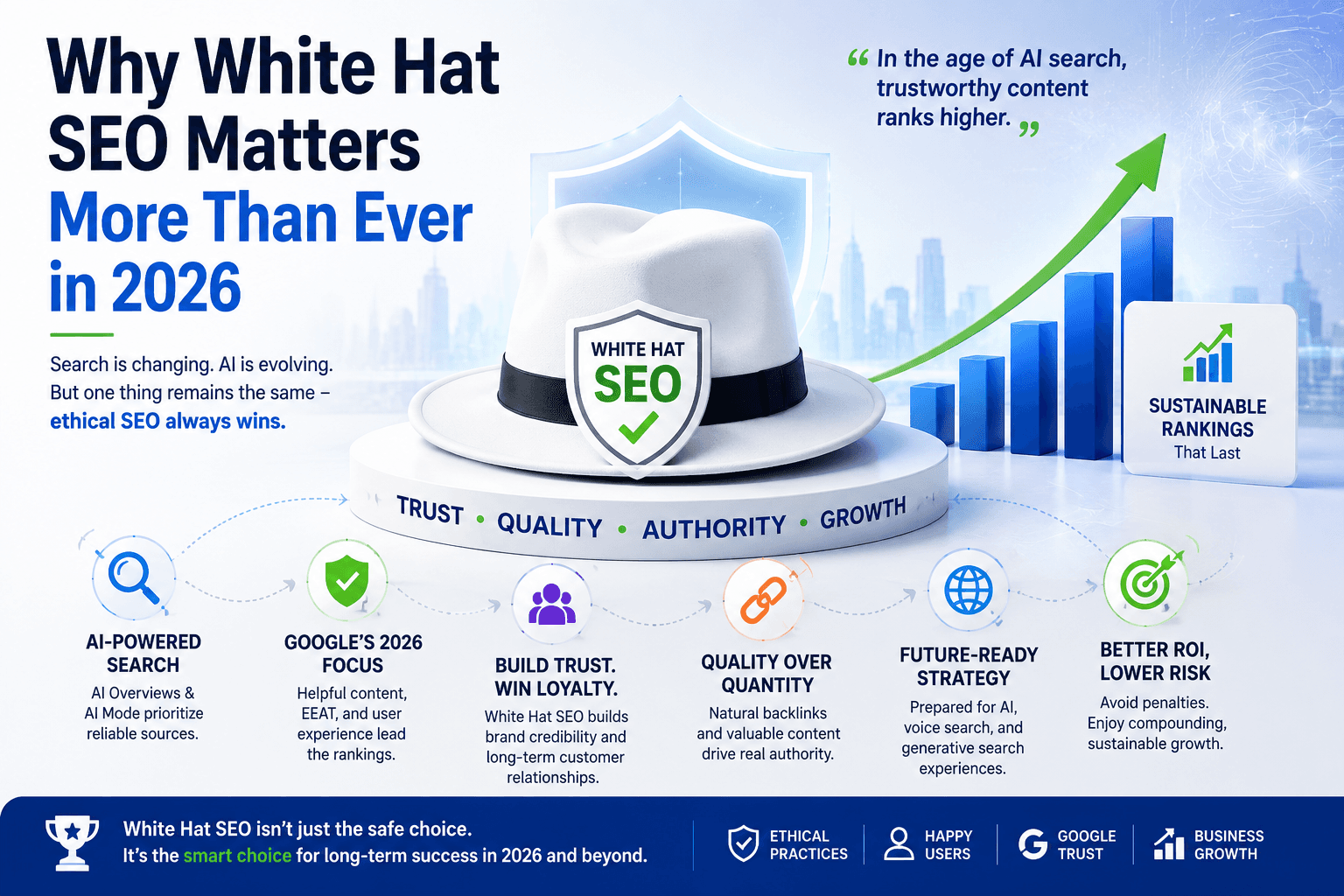
The AI Search Revolution
Google's AI Overviews, AI Mode, and the broader SGE (Search Generative Experience) evolution have fundamentally changed what it means to rank in search. Instead of simply crawling and indexing pages, Google's AI systems now synthesize content, evaluate source authority, and generate direct answers — citing only sources they trust.
This means your content doesn't just need to rank; it needs to be citation-worthy. Google's AI, along with platforms like ChatGPT Search, Gemini, Perplexity AI, and Claude AI, all prioritize content from authoritative, trustworthy entities. Websites built on white hat SEO foundations — with strong EEAT signals, clean technical profiles, and genuine topical authority — are the ones being surfaced in AI-generated answers.
The Helpful Content System
Google's Helpful Content System, now deeply embedded in the core ranking algorithm, evaluates content at the site level, not just the page level. If a significant portion of your website is thin, unhelpful, or AI-spammed, your entire domain suffers. White hat SEO agencies understand this dynamic and build content strategies designed to signal genuine helpfulness at scale.
EEAT Is Now a Core Ranking Factor
Experience, Expertise, Authoritativeness, and Trustworthiness (EEAT) are no longer supplemental guidelines — they are woven into Google's ranking systems. A white hat SEO agency will help you build demonstrable EEAT: author bylines with verifiable credentials, expert-reviewed content, external citations, brand mentions across reputable publications, and a trustworthy technical infrastructure (HTTPS, clear contact information, privacy policies, and accurate NAP for local businesses).
Semantic Indexing and Entity Recognition
Modern Google doesn't just match keywords — it understands entities (people, places, organizations, concepts) and their relationships. White hat SEO agencies that specialize in semantic SEO and entity optimization ensure your brand is recognized as a trusted entity in your niche, increasing your visibility in both traditional and AI-generated search results.
The Cost of Black Hat: Real Consequences
Companies in Texas, Florida, and across the USA have lost millions in revenue due to manual penalties and algorithmic demotion following black hat SEO campaigns. Recovery from a Google penalty takes an average of six to twelve months and requires significant investment in a link disavow campaign, content audit, and brand rehabilitation. White hat SEO isn't just the ethical choice — it's the economically rational one.
5. Signs of a Genuine White Hat SEO Agency
With hundreds of agencies claiming ethical practices, knowing what to look for is critical. Here is a comprehensive checklist of signals that distinguish genuinely trustworthy SEO partners.
Green Flags to Look For
• Transparent reporting with access to live dashboards and full data ownership
• Verifiable case studies with real client names, specific results, and time frames
• Clear explanation of link building methodology — focused on digital PR and earned media
• Dedicated technical SEO capability — schema markup, Core Web Vitals, site architecture
• Content strategy built on topical authority and semantic SEO frameworks
• AI SEO readiness — experience optimizing for AI Overviews, conversational queries, and generative search
• EEAT implementation strategies — author pages, expert contributors, editorial standards
• Honest timelines — typically three to six months for measurable movement on competitive terms
• Use of Google Search Console, Ahrefs, Semrush, or equivalent tools with data shared openly
• No reliance on proprietary "black box" ranking systems that cannot be explained
💡 Expert Tip: The best SEO agencies will proactively share what's working AND what isn't. Transparency about challenges is a hallmark of a trustworthy partner.
6. Red Flags to Avoid When Hiring an SEO Agency
The SEO industry has more than its share of bad actors. Here are the warning signs that should immediately disqualify an agency from consideration.
Immediate Disqualifiers
• Guaranteed #1 rankings — no legitimate SEO professional can guarantee specific positions
• Packages built around bulk backlink acquisition or "1,000 links per month" promises
• Private Blog Network (PBN) links — link schemes that Google's SpamBrain detects and penalizes
• AI-generated content spam — thousands of thin pages produced by automation with no editorial oversight
• Keyword stuffing — unnaturally high keyword density that degrades user experience
• Hidden redirects, cloaking, or doorway pages — all manual-action-level violations
• Fake traffic guarantees or inflated vanity metrics
• No clear content strategy or editorial standards
• Refusing to show the backlink profile or linking to low-quality foreign directory sites
• Disappearing after payment — no regular communication or progress updates
A Google Manual Action for unnatural links can result in your site being removed from search results entirely. Recovery is painful, expensive, and slow. Vetting your SEO agency rigorously before signing a contract is the single most important investment you can make in your organic search program.
7. How to Choose the Right White Hat SEO Agency: A Step-by-Step Framework
Choosing an SEO agency is a significant business decision. Use this structured framework to evaluate candidates systematically.
1. Define your business goals clearly — are you focused on lead generation, eCommerce revenue, brand awareness, local visibility, or enterprise SaaS growth?
2. Assess your current SEO baseline — request a preliminary audit or review your Google Search Console data to understand your starting point
3. Research agency specializations — SaaS SEO, local SEO, enterprise SEO, and eCommerce SEO each require different expertise
4. Evaluate their own website's SEO — an agency that doesn't rank well for relevant keywords is a concerning signal
5. Request a technical SEO audit of your site before committing — strong agencies will identify real issues, not manufactured ones
6. Scrutinize case studies — ask specifically about results for companies in your industry and at your stage of growth
7. Interview them on AI SEO strategy — do they understand AI Overviews optimization, GEO (Generative Engine Optimization), and entity-based SEO?
8. Review contract terms — avoid long-term lock-ins without performance benchmarks, and ensure you retain ownership of all content and data
9. Establish communication expectations — monthly calls, weekly updates, and clear escalation paths for algorithm changes
10. Check references — speak directly to two or three past clients, ideally in your industry
Key Questions to Ask Before Signing
• How do you approach link building, and can you show your most recent link acquisition examples?
• How do you build topical authority for a new domain?
• What is your process for optimizing content for AI Overviews and generative search?
• How do you measure SEO success beyond keyword rankings?
• What happens to content and links if we discontinue the engagement?
• How do you stay current with Google algorithm updates?
8. Essential White Hat SEO Services in 2026
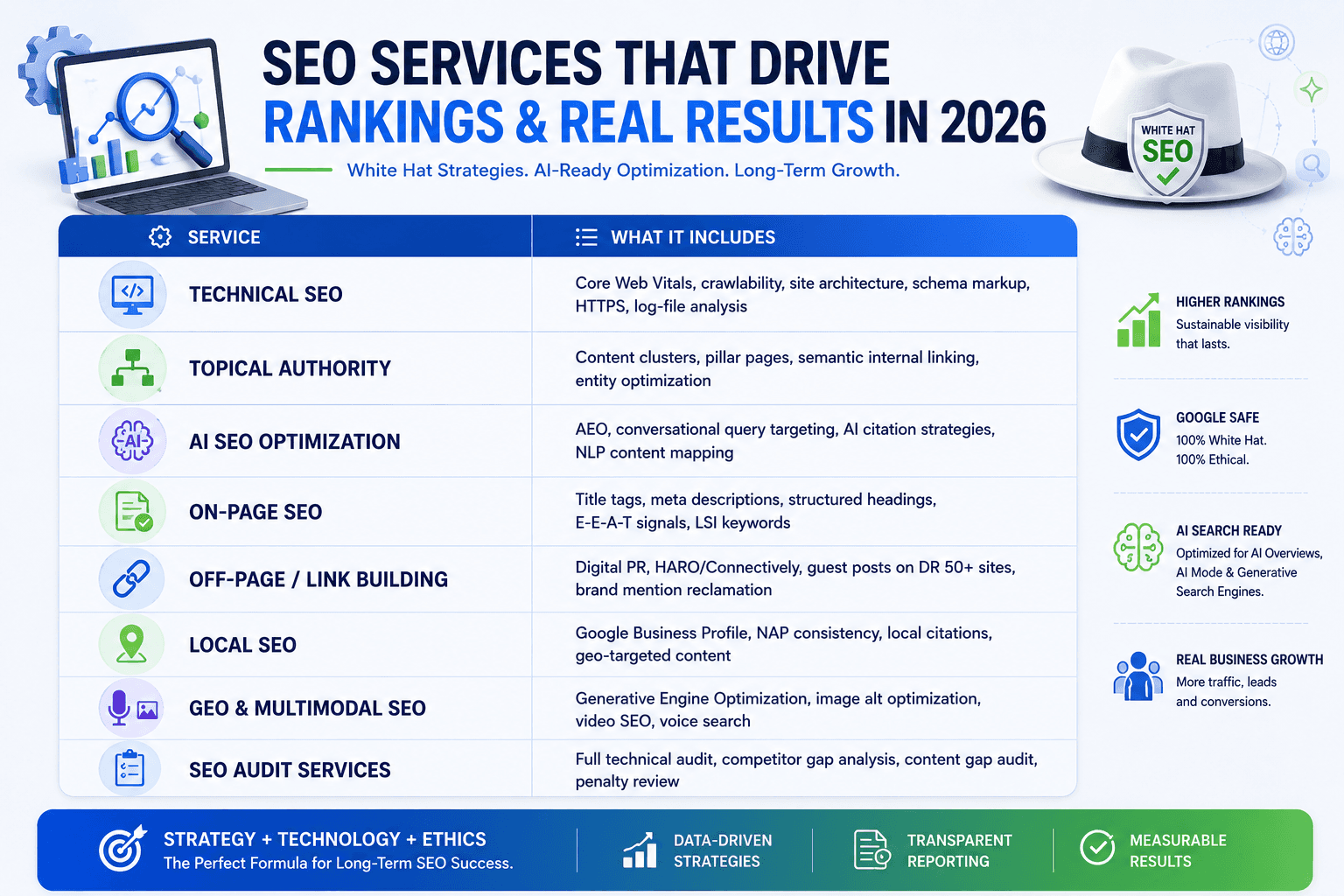
A full-service white hat SEO agency should offer an integrated suite of services that address every layer of modern search optimization. Here is what the complete picture looks like:
Service | What It Includes |
Technical SEO | Core Web Vitals, crawlability, site architecture, schema markup, HTTPS, log-file analysis |
Topical Authority | Content clusters, pillar pages, semantic internal linking, entity optimization |
AI SEO Optimization | AEO, conversational query targeting, AI citation strategies, NLP content mapping |
On-Page SEO | Title tags, meta descriptions, structured headings, E-E-A-T signals, LSI keywords |
Off-Page / Link Building | Digital PR, HARO/Connectively, guest posts on DR 50+ sites, brand mention reclamation |
Local SEO | Google Business Profile, NAP consistency, local citations, geo-targeted content |
GEO & Multimodal SEO | Generative Engine Optimization, image alt optimization, video SEO, voice search |
SEO Audit Services | Full technical audit, competitor gap analysis, content gap audit, penalty review |
The most capable agencies don't treat these services in isolation — they integrate them into a unified strategy, where technical improvements support content performance, and content quality amplifies link acquisition efforts. This interconnected approach is what separates genuine SEO partners from vendors selling disconnected tactics.
9. The Role of Artificial Intelligence in Modern SEO Agencies
AI has transformed how leading SEO agencies operate — not by replacing human expertise, but by amplifying it. Understanding how responsible agencies deploy AI tools separates modern practitioners from outdated ones.
How White Hat SEO Agencies Use AI Responsibly
• AI-assisted keyword research — identifying semantic clusters and conversational query patterns at scale
• Content gap analysis — using AI to map competitor topical coverage and identify authority-building opportunities
• Technical SEO automation — programmatic detection of crawl errors, duplicate content, and structured data issues
• Search intent modeling — AI-powered analysis of what users actually want from a given query
• Predictive SEO — forecasting ranking opportunities based on trend data and competitor velocity
• AI Overviews monitoring — tracking which content gets cited in Google's AI-generated answers
The critical distinction is that responsible agencies use AI as a research and efficiency tool, not as a content factory. Every piece of content published on a client's website should be reviewed, enhanced, and fact-checked by subject matter experts. AI-generated content that bypasses editorial oversight is precisely what Google's Helpful Content System is designed to demote.
💡 Expert Tip: Ask your prospective SEO agency: 'What is your content quality assurance process?' A clear editorial workflow with human review is non-negotiable.
10. How White Hat Agencies Optimize for AI Overviews and Generative Search
Appearing in Google's AI Overviews and being cited by platforms like ChatGPT Search, Gemini, and Perplexity AI requires a fundamentally different optimization approach than traditional ten-blue-links SEO. This is one of the most rapidly evolving areas of search strategy in 2026.
Answer Engine Optimization (AEO)
AEO focuses on structuring content to directly answer specific questions in a format that AI systems can parse, extract, and cite. This means leading paragraphs that deliver the direct answer, followed by supporting detail — the inverted pyramid of content architecture.
Key Tactics for AI Search Visibility
• FAQ schema implementation — structured Q&A blocks that AI systems can extract and surface directly
• Clear entity definition — explicitly stating what your organization is, what it does, and what it's an authority on
• Conversational query targeting — optimizing for natural language questions, not just head keywords
• Authoritative outbound citations — linking to primary research and reputable sources signals trustworthiness to AI systems
• Breadcrumb and structured data markup — helping AI understand site hierarchy and content relationships
• Content freshness — regular updates signal to AI systems that content is current and reliable
• Brand mention acquisition — being cited on authoritative third-party sites increases the probability of AI systems recognizing your brand as a trusted entity
GEO (Generative Engine Optimization) is the emerging discipline that specifically targets visibility in AI-generated search experiences. The most forward-thinking white hat SEO agencies have already integrated GEO principles into their standard client workflows.
11. Case Study Examples: White Hat SEO in Practice
Real-world results are the clearest evidence of an agency's capabilities. Here are representative examples of how ethical SEO agencies deliver measurable outcomes across different business types.
SaaS Company — San Francisco, CA
A B2B SaaS company offering project management software came to an ethical SEO agency with strong product-market fit but minimal organic search presence. Within twelve months, a topical authority strategy covering over 200 semantic content pieces — supported by structured FAQ schema, entity optimization, and targeted digital PR — resulted in a 340% increase in organic trial signups. The company's content began appearing in Google AI Overviews for high-intent queries like "best project management software for remote teams."
Local Business — Miami, FL
A multi-location dental practice in Miami needed to dominate local pack results across five neighborhoods. Through a combination of Google Business Profile optimization, locally-targeted content clusters, NAP citation cleanup, and structured data implementation, the practice achieved top-three local pack rankings for 47 primary service keywords within eight months. Patient inquiry volume from organic search increased by 180%.
eCommerce Brand — Los Angeles, CA
A direct-to-consumer skincare brand sought to reduce paid advertising dependency. White hat SEO services including technical SEO restructuring (crawl efficiency improvements, canonical tag correction, product schema implementation) combined with a content cluster strategy around skin health topics built genuine topical authority. Organic revenue increased by 220% year-over-year, reducing paid media dependency by 35%.
Startup — New York, NY
A fintech startup launching in a competitive regulatory space needed both visibility and trust. Agencies with strong EEAT frameworks — similar to the approach taken by companies like VNA Infotech and FreeCodesLab, which prioritize ethical SEO foundations, technical excellence, and AI-ready content strategies — helped the startup secure featured snippet positions for key financial planning queries within six months. The content strategy incorporated expert author credentials, external publication appearances, and a structured knowledge graph for the brand entity.
💡 Expert Tip: Agencies like FreeCodesLab and VNA Infotech represent the type of SEO partner that approaches campaigns with a systematic ethical framework: transparent tactics, AI-optimized content infrastructure, and long-term topical authority development. When evaluating agencies, look for this mindset regardless of size.
12. 20 Questions to Ask Before Hiring an SEO Agency
Strategy and Philosophy
• How do you define and measure SEO success for a business at our stage?
• Can you describe your topical authority framework and how you build it for new clients?
• How do you approach the intersection of SEO and conversion rate optimization?
• What is your philosophy on AI-generated content, and what editorial safeguards do you apply?
Technical Capabilities
• Walk me through how you approach a technical SEO audit — what tools and frameworks do you use?
• How do you optimize for Core Web Vitals, and what's your process when a site fails performance thresholds?
• What is your schema markup strategy, and how do you apply structured data for AI search visibility?
Link Building and Off-Page SEO
• Show me examples of links you've earned for clients in the last 90 days
• Do you use any PBN links, paid link insertions, or reciprocal link schemes?
• How do you approach digital PR, and what publications can you typically secure placements in?
AI and Future SEO
• How are you optimizing client content for Google AI Overviews and AI Mode?
• What is your approach to GEO (Generative Engine Optimization)?
• How do you track whether a client's content is being cited in AI-generated search answers?
Reporting and Communication
• What does your monthly reporting look like, and which KPIs do you prioritize?
• How do you communicate the business impact of SEO — not just rankings, but revenue attribution?
• How do you respond to major Google algorithm updates, and can you show a recent example?
Practical and Commercial
• What is your client retention rate, and what is the average length of client engagements?
• Who specifically will work on my account, and what is their experience level?
• How do you ensure knowledge transfer if our engagement ends?
• What does success look like at three, six, and twelve months for a company like ours?
13. The Future of White Hat SEO: What's Coming Next
The SEO landscape in 2026 is the most complex it has ever been — and the rate of change shows no sign of slowing. Understanding where search is heading is essential for choosing an agency built for the future, not just the present.
Multimodal Search
Google Lens, visual search, and AI-powered image recognition are driving a significant portion of search queries, particularly in retail, real estate, and food verticals. White hat SEO agencies are increasingly incorporating image SEO, video schema, and visual content optimization into comprehensive strategies.
Voice Search and Conversational AI
Smart home devices, AI assistants, and in-car search have made voice queries a substantial traffic source. Voice queries are conversational, question-based, and local in intent. Agencies that optimize for featured snippets, FAQ schema, and conversational content naturally capture this growing traffic segment.
Entity-Based Ranking
Google's Knowledge Graph continues to evolve toward entity-based ranking, where brands, people, and organizations are evaluated as verifiable, trustworthy entities — not just collections of keywords. Building a strong, consistent entity presence across the web — through Wikipedia presence where applicable, authoritative external citations, and structured data — is becoming as important as traditional on-page optimization.
Personalization and Zero-Click Optimization
Search results are increasingly personalized based on location, search history, and device type. Zero-click searches — where the answer is provided directly in the SERP — represent a growing share of queries. White hat SEO agencies that optimize for featured snippets, AI Overviews visibility, and branded direct traffic create sustainable advantages even as click-through rates on organic links evolve.
AI Agents and Predictive Search
AI agents capable of autonomous web browsing and multi-step research tasks are beginning to access and synthesize web content. Being a trusted, structured, easily parseable source of authoritative information will become increasingly important as AI agents become primary content consumers alongside human searchers.
Conclusion: Invest in Ethics, Invest in Growth
White hat SEO is not the slow path — it is the smart path. In a search environment dominated by AI systems that evaluate trust, authority, and genuine helpfulness, the agencies that follow ethical guidelines and build real expertise are the ones delivering exceptional, durable results.
The companies winning the most competitive organic search verticals in New York, Chicago, Los Angeles, San Francisco, and across the United States in 2026 share a common thread: they partnered with SEO agencies that understood the long game. They invested in topical authority, technical excellence, earned links, and AI-ready content strategies. They chose partners over vendors.
Whether you're a startup seeking your first 10,000 organic visitors, an enterprise brand defending hard-won rankings, a SaaS company building a content-led growth engine, or a local business trying to dominate your city's search results, the principles are the same: choose an ethical SEO company, demand transparency, insist on AI search optimization expertise, and think in years, not months.
The right white hat SEO agency will become one of your most valuable long-term business partners. The wrong one could cost you your entire organic search presence.
Ready to invest in sustainable organic growth? Start with a comprehensive SEO audit. Evaluate prospective agencies against the framework in this guide. Ask the hard questions. And choose a partner — an ethical, AI-ready, technically excellent white hat SEO agency — that is as committed to your long-term success as you are.
Frequently Asked Questions (FAQ)
What is a white hat SEO agency?
A white hat SEO agency is a search optimization company that builds organic rankings exclusively through techniques compliant with Google's guidelines and search engine best practices. This includes producing high-quality expert content, earning links through digital PR and thought leadership, optimizing technical site performance, and building genuine topical authority. White hat agencies prioritize long-term sustainable rankings over short-term manipulative gains.
Is white hat SEO worth it in 2026?
Absolutely. In 2026, Google's AI-powered search systems — including AI Overviews and AI Mode — are designed to reward trustworthy, authoritative, genuinely helpful content. Businesses that have invested in white hat SEO consistently outperform those that relied on manipulative tactics, particularly after major algorithm updates. The ROI from ethical SEO compounds over time rather than collapsing under penalties.
How do SEO agencies optimize for AI search?
AI search optimization (also called Answer Engine Optimization or AEO) involves structuring content to directly answer conversational queries, implementing FAQ schema and structured data, building verifiable EEAT signals, creating comprehensive topical authority through content clusters, and establishing your brand as a trusted entity that AI systems like Google's AI Overviews, ChatGPT Search, Gemini, and Perplexity are likely to cite.
What are Google-approved SEO techniques?
Google's Search Essentials outline approved techniques: creating helpful, reliable, people-first content; using descriptive, keyword-relevant title tags and meta descriptions; building a technically sound website with fast load times and mobile optimization; earning backlinks from relevant, authoritative sources; implementing appropriate structured data; and ensuring clear site architecture with logical internal linking.
How long does white hat SEO take to show results?
Most businesses see measurable ranking improvements within three to six months for moderate-competition keywords, with significant organic traffic growth typically occurring in the six to twelve month range. Highly competitive industries in major US markets (fintech in New York, tech in San Francisco, legal in Los Angeles) may require twelve to twenty-four months for top-ten positioning on primary commercial terms. These timelines depend heavily on domain authority, existing content, and the quality of the SEO strategy.
What is AI Overview optimization?
AI Overview optimization refers to the practice of structuring content so that Google's AI Overview system selects it as a cited source in AI-generated answer panels. It involves writing with clear, direct answers in leading paragraphs, implementing structured data, building EEAT signals, acquiring authoritative backlinks, and optimizing for conversational queries. Sites cited in AI Overviews gain significant brand visibility even when users don't click through.
How do ethical SEO companies build backlinks?
Ethical agencies build links through digital PR (securing coverage and links from journalists and publications), thought leadership content (original research, data studies, and comprehensive guides that naturally attract citations), expert contributions to industry publications, brand mention reclamation (converting unlinked brand mentions to followed links), and strategic partnerships with complementary businesses. They avoid paid link schemes, PBNs, and any tactic that violates Google's link spam policies.
What is the difference between white hat and black hat SEO?
White hat SEO follows search engine guidelines and focuses on creating genuine value for users through quality content, earned links, and technical excellence. Black hat SEO uses manipulative tactics — such as buying links, keyword stuffing, cloaking, and PBN networks — to game rankings in violation of Google's guidelines. Black hat tactics may produce short-term gains but routinely result in manual penalties, algorithmic demotions, and long-term damage to brand visibility and authority.
What is topical authority SEO, and why does it matter?
Topical authority is the practice of comprehensively covering a subject area so that search engines recognize your website as the most authoritative resource on that topic. Rather than targeting individual keywords, topical authority SEO builds interconnected content clusters — pillar pages and supporting articles — that signal deep expertise across an entire subject domain. Google's systems increasingly favor topically authoritative sites in both traditional and AI-generated search results.
How do I evaluate whether an SEO agency's case studies are legitimate?
Request verifiable case studies with specific client names (or verifiable anonymized case studies with industry and market clearly identified), documented time frames, before-and-after Google Search Console data, and direct references you can contact. Ask for the specific tactics deployed, the competitive context, and whether results were maintained following major algorithm updates. Agencies that rely on vague percentage claims without specific data should be scrutinized carefully.
What is GEO (Generative Engine Optimization)?
GEO, or Generative Engine Optimization, is the emerging practice of optimizing digital content to appear as cited sources within AI-generated search responses produced by systems like Google AI Overviews, Perplexity AI, ChatGPT Search, and Gemini. GEO strategies emphasize entity clarity, structured data, conversational content formats, EEAT authority signals, and comprehensive topical coverage — all of which increase the probability of AI systems selecting your content as a trusted citation.
How much does white hat SEO cost for a business in the USA?
White hat SEO pricing varies significantly based on scope, competition, and the agency's expertise. Local SEO campaigns in mid-sized US markets typically range from $1,500 to $5,000 per month. Regional and national SEO programs for SMBs and startups often range from $3,000 to $10,000 per month. Enterprise SEO programs for large SaaS companies, eCommerce brands, and national businesses can range from $15,000 to $50,000+ per month. Unusually low pricing — below $1,000 per month for comprehensive SEO — is a strong indicator of low-quality or manipulative tactics.
Related Reads for You
Discover more articles that align with your interests and keep exploring.